






 By Pooja Sharma
 Introduction
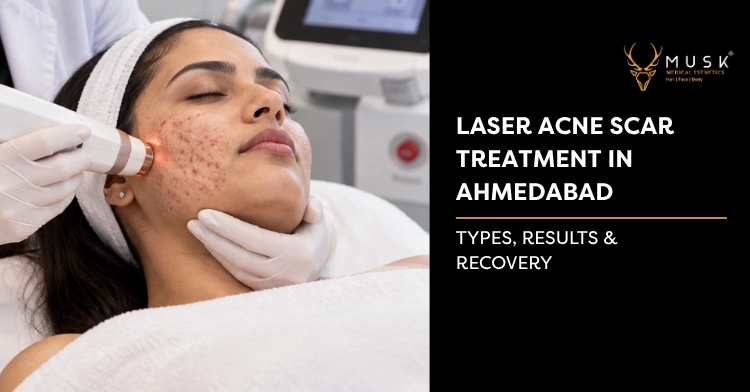
Laser acne scar treatment in Ahmedabad can improve depressed acne scars by resurfacing damaged skin and stimulating collagen remodelling, but the right laser depends on scar type, depth, skin tone and pigmentation risk. Not every acne scar responds equally to laser treatment, and some scars need combination treatment rather than laser alone.
For Indian skin, treatment selection matters particularly because deeper skin tones can be more prone to post-inflammatory hyperpigmentation after aggressive resurfacing.
Acne may settle in weeks or months, but the scars it leaves behind can remain for years.
The challenge is that “acne scars” are not one condition. A narrow ice-pick scar, a sharply edged boxcar scar and a tethered rolling scar have different structures beneath the skin. Using the same laser protocol for all three can therefore lead to disappointing results.
Laser resurfacing can be highly useful for selected atrophic acne scars, but the best treatment plan considers scar type, scar depth, skin tone, pigmentation, active acne and recovery tolerance before choosing the device or treatment intensity.
This is especially important for patients in Ahmedabad and other Indian cities, where Fitzpatrick skin types III–V are common and post-treatment pigmentation needs careful consideration. Research in darker skin supports individualised settings rather than a one-size-fits-all laser approach.
Key Takeaways
- Acne scar type matters: Ice-pick, boxcar and rolling scars do not respond equally to laser treatment.
- Fractional lasers are commonly used: CO2, Er\:YAG and non-ablative fractional lasers work through different resurfacing depths.
- Laser cannot erase scars completely: The realistic goal is smoother texture and reduced scar visibility.
- Indian skin requires careful settings: More aggressive treatment can increase post-inflammatory hyperpigmentation risk.
- Several sessions may be needed: Results usually build gradually as collagen remodels.
- Recovery depends on laser depth: Mild fractional treatments heal faster than deeper ablative resurfacing.
- Combination treatment is often useful: Deep or tethered scars may need subcision, microneedling, peels or other approaches alongside laser.
- Active acne should be controlled first: Treating ongoing breakouts helps reduce the risk of forming additional scars.
What Types of Acne Scars Can Laser Treatment Improve?
Laser treatment works best when the treatment is matched to the structure of the scar. Atrophic acne scars are commonly divided into ice-pick, boxcar and rolling scars, and each may require a different approach.
The three main depressed scar types are:
Acne Scar Type | Typical Appearance | How Laser Fits |
Ice-Pick | Narrow, deep pits extending into the skin | Often less responsive to resurfacing alone |
Boxcar | Round or oval depressions with defined edges | Shallow boxcar scars often respond well |
Rolling | Broad depressions with a wave-like appearance | Laser may help texture, but tethering may also need treatment |
Research evaluating fractional laser treatment found better responses in boxcar scars than in rolling and ice-pick scars. Deep ice-pick scars can be particularly resistant to conventional resurfacing because the defect extends more deeply into the skin.
This is why the first step should be identifying what type of scar is actually present rather than choosing a laser based only on an advertisement.
How Does Laser Treatment Improve Acne Scars?
Laser resurfacing creates controlled microscopic injury within scarred skin, triggering wound healing and collagen remodelling that can make depressed scars look shallower and the skin surface more even.
Depending on the device, the laser may either remove microscopic portions of the skin or heat tissue beneath the surface without fully removing the epidermis.
The healing response can lead to:
- New collagen formation
- Collagen reorganisation
- Improved scar edges
- Smoother skin texture
- Reduced depth of selected atrophic scars
- Better blending between scarred and surrounding skin
The changes are gradual.
Even after surface redness and peeling have settled, collagen remodelling can continue for several months.
Patients who want a broader explanation of the resurfacing process can also review Musk Clinic's laser skin resurfacing treatment information.
Which Lasers Are Used for Acne Scar Treatment?
There is no single “best acne scar laser.” Ablative fractional, non-ablative fractional and different laser wavelengths offer different balances between resurfacing strength, recovery and pigmentation risk.
Fractional CO2 Laser
Fractional carbon dioxide laser is an ablative resurfacing treatment that creates microscopic columns of thermal injury in the skin.
It may be considered for more established atrophic acne scars because it produces substantial collagen remodelling.
The trade-off is that stronger treatment can mean:
- More redness
- More swelling
- Peeling or crusting
- Longer visible downtime
- Greater pigmentation risk in darker skin
A recent meta-analysis found fractional CO2 laser effective for acne scars but also reported a higher risk of post-inflammatory hyperpigmentation compared with needling-based treatments.
Fractional Er\:YAG Laser
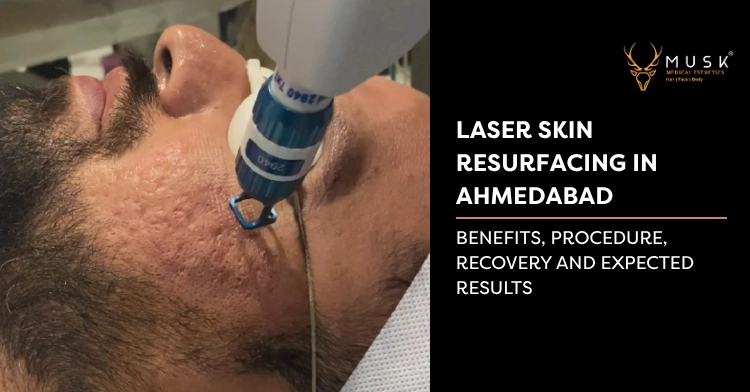
Er\:YAG lasers typically use a 2,940 nm wavelength and are another ablative resurfacing option.
Because Er\:YAG energy is strongly absorbed by water, it can remove tissue with relatively limited surrounding thermal injury compared with some deeper thermal resurfacing approaches.
A small study in Fitzpatrick III–IV skin reported improvement after fractional Er\:YAG treatment with a downtime of approximately two to three days, although results and recovery depend heavily on the device and settings used.
Musk Clinic’s existing acne-scar content also identifies Er\:YAG among its resurfacing approaches.
Non-Ablative Fractional Laser
Non-ablative fractional lasers heat deeper skin while leaving more of the surface intact.
Their advantages may include:
- Shorter recovery
- Less surface peeling
- Lower pigmentation risk in some darker skin types
- Gradual collagen remodelling
The trade-off is that several treatments may be required and improvement may be more gradual.
Evidence reviews support non-ablative fractional laser as an option for atrophic scars in darker phototypes.
Which Laser Is Better for Indian Skin?
For Indian skin, the safest choice is not automatically the strongest laser. Treatment needs to balance scar improvement against the risk of post-inflammatory hyperpigmentation.
Fitzpatrick skin types III–V have more active melanocytes than lighter phototypes and may develop pigmentation after inflammation or excessive thermal injury.
This makes several factors important:
- Laser wavelength
- Energy level
- Treatment density
- Number of passes
- Existing tanning
- Pigmentation within the scars
- Recent sun exposure
- Previous PIH
- Scar depth
- Pre-treatment skincare
Published research specifically notes that darker skin can require more conservative laser parameters because aggressive treatment increases pigmentation risk.
A 2026 meta-analysis also found a significantly higher PIH risk with fractional CO2 laser than needling-based treatments, reinforcing why scar type and skin type should both influence treatment selection.
For patients in Ahmedabad, sun exposure after treatment is another practical consideration. Treatment timing and strict post-procedure photoprotection matter, particularly after ablative resurfacing.
Can Laser Treat Ice-Pick, Boxcar and Rolling Scars Equally?
No. Different acne scar structures respond differently to resurfacing, and some require another procedure before laser treatment can work effectively.
Ice-Pick Scars
Ice-pick scars are narrow but extend deeply into the skin.
Because of this depth, surface resurfacing alone may produce limited improvement.
Some cases may need focal techniques or combination therapy rather than increasingly aggressive laser treatment.
Boxcar Scars
Shallow boxcar scars are among the more laser-responsive scar patterns.
Their defined edges and more superficial depth make resurfacing useful for softening the transition between the scar and surrounding skin.
Deep boxcar scars can be more resistant.
Rolling Scars
Rolling scars are often caused partly by fibrous bands tethering the skin downward.
Laser can improve the surface and stimulate collagen, but it cannot always release deep tethering.
Some patients therefore need subcision or another technique before or alongside resurfacing.
The key lesson is simple:
Matching treatment to scar anatomy matters more than choosing the strongest available laser.
When Is Combination Treatment Better Than Laser Alone?
Combination treatment is often more appropriate when a patient has several acne scar types at the same time, which is common in clinical practice.
One person may have:
- Ice-pick scars on the cheeks
- Rolling scars near the jaw
- Shallow boxcar scars on the temples
- Pigmentation between scars
- Active acne
- Enlarged pores
Trying to solve all of those concerns with one laser setting may be unrealistic.
Depending on assessment, a treatment plan may combine laser resurfacing with:
- Subcision
- Microneedling
- RF microneedling
- Chemical peels
- Focal scar techniques
- Selected fillers
- Other scar-revision procedures
Evidence reviews of acne scar treatment support a multimodal approach because scar types have different structural causes.
Musk Clinic also discusses combination treatments for acne scars for patients whose scar pattern may not respond optimally to a single modality.
How Many Laser Sessions Are Needed for Acne Scars?
Most patients should expect a treatment course rather than assuming one laser session will remove acne scars completely.
The number of sessions depends on:
- Scar type
- Scar depth
- Laser technology
- Treatment intensity
- Skin tone
- Pigmentation tendency
- Amount of improvement expected
- Whether other treatments are combined
Published studies vary widely in their protocols.
For example, fractional Er\:YAG studies have used several sessions spaced weeks apart, while some ablative protocols use fewer but stronger treatments.
The right endpoint is also not “scar removal.”
A realistic goal is progressive improvement in:
- Scar depth
- Texture
- Shadowing
- Skin smoothness
- Overall scar visibility
Some scars may remain visible even after a successful treatment course.
What Results Can You Expect From Laser Acne Scar Treatment?
Laser treatment can make selected acne scars shallower and less noticeable, but complete scar removal should not be promised.
Results depend heavily on the starting scar pattern.
Research comparing fractional Er\:YAG and CO2 lasers in darker-skinned patients found improvement with both technologies, with changes continuing over several months after treatment.
Another study of non-ablative fractional laser found that boxcar scars responded better than rolling scars and considerably better than ice-pick scars.
This means that before-and-after expectations should consider:
- Which scars are being measured
- How deep they were initially
- Number of sessions
- Skin type
- Combination procedures
- Photography conditions
- Time since the final session
When Do Results Become Visible?
Some surface improvement may appear after healing, but deeper remodelling takes longer.
Changes can continue for several months as collagen reorganises.
For that reason, judging the final result only a few weeks after treatment can underestimate the eventual improvement.
What Is Recovery Like After Laser Acne Scar Treatment?
Recovery can range from a few days to more than a week depending on whether the laser is non-ablative, fractional ablative or more aggressive resurfacing.
A general recovery pattern may include:
Stage | What You May Notice |
First 24–48 Hours | Redness, warmth, swelling or sensitivity |
Days 2–5 | Dryness, darkening, micro-crusting or peeling with some treatments |
Days 5–10 | Surface healing progresses after fractional ablative resurfacing |
Following Weeks | Redness gradually fades |
Following Months | Collagen remodelling and scar improvement continue |
These are general stages rather than a guaranteed schedule.
Musk Clinic's laser skin resurfacing guide notes that recovery varies significantly by treatment depth, with non-ablative procedures requiring much less downtime than deeper resurfacing.
Published Asian-skin studies also show substantial variability. Some Er\:YAG protocols produced short visible downtime, whereas CO2 treatment can involve longer erythema or pigmentation in susceptible patients.
What Is Post-Inflammatory Hyperpigmentation After Laser?
Post-inflammatory hyperpigmentation, or PIH, is temporary darkening that can develop after skin inflammation, and it is one of the most important laser considerations for Indian and other darker skin tones.
PIH may appear as:
- Brown patches
- Darkened treatment areas
- Uneven pigmentation
- Darker scar margins
It does not necessarily mean the skin has been permanently damaged, but it can last weeks or months depending on severity.
Research in Asian patients receiving fractional CO2 treatment has reported significant variation in PIH rates, which reinforces the need for cautious patient selection and settings rather than assuming one standard protocol is appropriate.
Factors that may increase risk include:
- Darker phototype
- Recent tanning
- Aggressive treatment settings
- Pre-existing pigmentation
- Poor sun protection
- Picking or scratching healing skin
- Excessive inflammation
A history of pigmentation after acne or previous procedures should be discussed before treatment.
How Should You Care for Your Skin After Laser Acne Scar Treatment?
Good aftercare aims to support healing while reducing irritation, infection and pigmentation risk.
Typical instructions may include:
-
Use The Recommended Cleanser
Avoid harsh scrubs and exfoliation while the skin is healing.
-
Keep The Skin Moisturised
Use only products recommended for the immediate recovery stage.
-
Use Strict Sun Protection
UV exposure can worsen post-treatment pigmentation.
-
Do Not Pick Peeling Skin
Allow crusting or flaking to separate naturally.
-
Pause Irritating Active Ingredients
Retinoids, strong acids or exfoliating products may need to be temporarily stopped.
-
Avoid Unplanned Salon Procedures
Waxing, peels, facials or scrubs can irritate healing skin.
-
Follow The Prescribed Recovery Plan
Different laser depths require different aftercare.
Your treating clinician should provide instructions based on the laser used rather than relying on a generic skincare routine.
How Much Does Laser Acne Scar Treatment Cost in Ahmedabad?
The cost of laser acne scar treatment in Ahmedabad depends on the laser type, treatment area, scar severity, number of sessions and whether combination procedures are required.
There is no useful single price that applies to every acne-scar patient.
Important cost factors include:
- Full-face vs localised treatment
- Ablative vs non-ablative treatment
- Number of sessions
- Scar depth
- Type and number of scars
- Combination with subcision or microneedling
- Pre-treatment skin preparation
- Post-treatment care
- Follow-up requirements
Musk Clinic’s current laser resurfacing guidance does not publish one universal treatment price because the treatment type and course are selected after assessment.
For that reason, pricing should be confirmed after evaluating the scars rather than choosing treatment solely from a per-session advertisement.
Who Is a Good Candidate for Laser Acne Scar Treatment?
Laser treatment may be considered when acne scars are established and the patient’s skin is suitable for resurfacing.
Potential candidates may have:
- Atrophic acne scars
- Shallow boxcar scars
- Selected rolling scars
- Uneven post-acne texture
- Stable acne
- Realistic expectations
- Willingness to follow sun-protection and aftercare instructions
Suitability becomes more complex when there is:
- Active inflammatory acne
- Active skin infection
- Recent significant tanning
- Strong tendency toward PIH
- History of keloid or hypertrophic scarring
- Certain medical conditions affecting healing
- Unrealistic expectations of completely scar-free skin
Individual assessment matters more than the name of the laser.
When Is Laser Not the Best Acne Scar Treatment?
Laser may not be the first treatment when the main problem is deep ice-pick scarring, strongly tethered rolling scars, raised scars or active acne.
This is an important limitation.
A person can spend money on several laser sessions and still be disappointed if the structural cause of the scar was never addressed.
For example:
- Deep ice-pick scars may require focal treatment.
- Tethered rolling scars may require subcision.
- Raised scars need a different scar-management approach.
- Active acne should usually be controlled to reduce new scar formation.
Musk Clinic's scar revision treatment page outlines how laser is one of several possible approaches depending on scar characteristics.
How Does Musk Clinic Approach Laser Acne Scar Treatment in Ahmedabad?
Musk Clinic approaches acne-scar treatment by first identifying the concern that actually needs correction rather than treating every scar with the same resurfacing protocol.
Assessment may consider:
- Scar type
- Scar depth
- Skin texture
- Pigmentation
- Skin tone
- Active acne
- Previous procedures
- Recovery tolerance
A VISIA Face Scan can also provide additional information about visible spots, texture, pores, pigmentation and other skin characteristics that may be useful during treatment planning.
Where laser resurfacing is appropriate, the intensity and treatment course should be matched to the patient’s skin. When scars have multiple structural causes, a combination approach may be considered rather than repeatedly increasing laser intensity.
For Indian skin in particular, the aim should be to improve texture without creating avoidable pigmentation problems in the process.
The Bottom Line
Laser acne scar treatment in Ahmedabad can meaningfully improve selected atrophic acne scars, but the result depends on matching the treatment to both the scar and the skin.
Shallow boxcar scars generally respond more predictably to resurfacing than deep ice-pick scars, while rolling scars may need treatment for underlying tethering as well as surface texture.
Fractional CO2, Er\:YAG and non-ablative fractional technologies each offer different balances between treatment intensity, recovery and pigmentation risk. For Indian skin, careful settings, sun protection and PIH prevention are particularly important.
The best treatment is therefore not automatically the strongest laser.
It is the treatment plan that addresses your specific scar pattern while keeping recovery and pigmentation risk within an acceptable range.
If you are unsure which acne scars can realistically be improved with laser, an in-person skin and scar assessment is the most useful starting point.
Frequently Asked Questions (FAQs)

Dr Pooja Sharma
- 5 Years of Experience