






 By Pooja Sharma
 It shows up in a photo first. Someone shares a picture from a family event, and you pause on your own face longer than usual. You do not look sick. You do not look dramatically different. You just look - tired. A little heavier around the jaw. Less defined than you remember. And the strange part is you feel completely fine. It is the face that has not kept up.
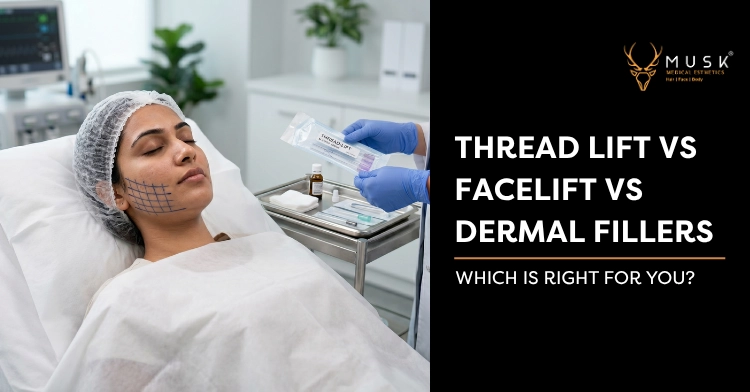
For a lot of people, that moment is when the research starts. Thread lift. Facelift. Dermal fillers. Three treatments that appear in every article about facial aging, often side by side, rarely explained in a way that tells you which one applies to you. Each has different results, different downtime, a different mechanism inside the skin - and very different consequences if you choose the wrong one for the wrong concern.
That confusion is worth addressing directly. Facial aging is not one problem. It is three happening at the same time: tissue descends with gravity, volume depletes from the cheeks and temples, and the skin surface loses its elasticity and quality. A 2025 review published in Cosmetics (MDPI) confirms that modern facial rejuvenation has shifted from single-modality correction to three-dimensional strategies - because no single treatment addresses all three aging components equally well.
Thread lifts, facelifts, and fillers each work on a different one of these layers. A thread lift repositions tissue that has descended. A facelift surgically corrects what has descended too far for repositioning alone. Fillers restore the volume that has disappeared. Choosing between them is not about which is newer or more popular. It is about matching the treatment to what your face is actually doing.
This guide lays out the clinical comparison honestly - what each treatment does, who it suits, where it falls short, and when combining two or more of them gives the most complete result. At Musk Clinic in Ahmedabad, Dr. Anand Shah and our specialist team always start with an assessment of the face before recommending any procedure. The right treatment is the one that fits your anatomy - not the one trending on social media.
Key Takeaways
- Three different mechanisms: Thread lifts reposition descended tissue. Facelifts surgically restructure the face. Dermal fillers restore lost volume. Each targets a different layer of facial aging.
- Thread lifts suit mild-to-moderate sagging: Best for patients in their mid-thirties to early fifties with early jowling, descended cheeks, or brow heaviness who want visible lifting without surgery.
- Facelifts deliver the most significant and lasting correction: Surgery addresses advanced skin laxity, deep jowling, and neck sagging. Results typically last 7 to 10 years. No non-surgical procedure replicates this.
- Dermal fillers restore volume - not structure: Fillers work on hollowing, shadow, and line depth. They do not lift descended tissue. Using fillers to compensate for sagging often makes the face look heavier, not younger.
- Thread lift results last 12 to 18 months: A large-scale analysis of over 111,000 thread lift procedures confirms growing adoption, with the majority of patients combining threads with fillers or toxins for a more comprehensive result.
- Combination approaches are now standard practice: Most specialist clinics now combine treatments - thread plus filler, or facelift plus filler - because aging is multidimensional and single-treatment results have clear limits.
- The right choice depends on your anatomy: Patient journey stage is Consideration. This blog helps you narrow down your options before a consultation - not replace one.
- Surgeon expertise matters more than treatment type: The best result from any of these three treatments depends on the specialist's anatomical understanding, injection or surgical precision, and realistic patient assessment.
Thread Lift vs Facelift vs Dermal Fillers: The Core Comparison
Before getting into the detail of each treatment, this table gives you the complete picture side by side. Use it to identify which column matches your concerns most closely.
| Factor | Thread Lift | Surgical Facelift | Dermal Fillers |
|---|---|---|---|
| What it addresses | Mild-moderate tissue descent and sagging | Advanced sagging, deep jowling, neck laxity | Volume loss, hollowing, fine lines, shadows |
| Procedure type | Minimally invasive - needles and absorbable threads | Surgical - incisions, SMAS repositioning, sutures | Non-invasive - injectable gel placed under the skin |
| Anesthesia | Local anesthesia | General or IV sedation | None or topical numbing cream |
| Downtime | 3 to 7 days | 10 to 21 days | 1 to 3 days (bruising only) |
| Results duration | 12 to 18 months | 7 to 10 years | 6 to 18 months (type dependent) |
| Ideal age range | Mid-30s to early 50s | Late 40s to 70s | Late 20s to 60s (volume-specific) |
| Can combine with others? | Yes - pairs well with fillers and Botox | Yes - fillers for volume, laser for skin surface | Yes - complements both thread lift and facelift |
| Key limitation | Cannot correct significant excess skin | Longer recovery; surgical risks | Does not lift descended tissue |
Note: Results and timelines vary by individual anatomy, skin quality, and treatment volume. This table reflects general clinical ranges. Always seek a specialist assessment before choosing.
Thread Lift: What It Does and Who It Suits
A thread lift inserts fine, dissolvable sutures - typically made from polydioxanone (PDO) or polycaprolactone (PCL) - beneath the skin through small entry points made with a needle. Once placed, these threads are gently tensioned to physically reposition descended tissue. The threads themselves dissolve over time, but as they do, they stimulate new collagen production. This dual action - immediate mechanical lift plus a longer-term skin-regenerating effect - is what makes thread lifting genuinely useful for the right candidate.
A 2025 systematic review published in Life (MDPI) analyzing thread lifting outcomes found that thread lifting effectively addresses eyebrow ptosis, nasolabial folds, marionette lines, and jawline definition - areas that are difficult to treat with fillers or Botox alone. The review also noted that improvements in thread quality are progressively narrowing the gap between thread lifting and surgical results for carefully selected patients.
Who Is the Right Candidate?
- Adults in their mid-thirties to early fifties with mild-to-moderate facial sagging
- Patients who want visible lifting without surgery, general anesthesia, or extended downtime
- Those with good underlying skin quality - thread lifting works with existing tissue, not against it
- Patients who have previously had a facelift and are experiencing gradual recurrence of laxity
Where Thread Lifts Fall Short
Thread lifts cannot correct significant excess skin. If the amount of sagging skin is beyond what repositioning can address, threads create distortion rather than improvement. They are also not a permanent solution - results last 12 to 18 months on average, after which the threads have fully dissolved and repeat treatment is needed. Setting realistic expectations upfront is essential.
Surgical Facelift: What It Does and Who It Suits
A facelift - technically a rhytidectomy - is the most structurally comprehensive facial rejuvenation procedure available. It goes beyond the surface. In a standard SMAS facelift, the surgeon lifts and repositions the deeper musculoaponeurotic layer of the face - not just the skin - which is where gravitational descent actually originates. Skin is then re-draped cleanly over the repositioned structure. Excess skin is removed. Incisions are hidden along the hairline and in the natural contours around the ear.
A facelift addresses what no injectable procedure can: genuine excess skin, deep jowling that has crossed beyond the jaw margin, and significant neck laxity. The results are also the most durable of all three options - typically 7 to 10 years - because surgery physically repositions the underlying anatomy rather than simply adding to or temporarily supporting it.
Who Is the Right Candidate?
- Adults in their late forties and beyond with significant skin laxity, jowling, or neck sagging
- Patients whose concern has progressed beyond what minimally invasive options can adequately address
- Those in good overall health with realistic expectations and sufficient downtime available
- Individuals who have previously used thread lifts or fillers and now need a more lasting structural correction
Where Facelifts Fall Short
Surgery carries inherent recovery demands - typically 10 to 21 days of visible bruising and swelling - and the standard risks of any surgical procedure, including anesthesia response, infection, and scarring. It also does not correct volume loss or surface skin quality. Most patients who undergo a facelift combine it with fillers and sometimes laser resurfacing for a fully comprehensive result.
Dermal Fillers: What They Do and Who They Suit
Dermal fillers are gel-based injectables - most commonly made from hyaluronic acid (HA), a substance naturally found in the skin - that are placed beneath the surface to restore volume, smooth lines, and reshape facial contours. They do not lift descended tissue. They fill space that has been lost or hollow areas that are casting shadows. That distinction is important.
Fillers are highly effective for the right problem. A 2025 review in Cosmetics (MDPI) on HA-based dermal fillers found that cross-linked hyaluronic acid fillers significantly improve hydration, firmness, texture, radiance, and elasticity - with strong safety outcomes and high patient satisfaction rates. The challenge arises when fillers are used to compensate for sagging
rather than hollowing. Placing filler in a face with significant tissue descent tends to add bulk in the wrong places, making the face look heavier rather than younger.
At Musk Clinic, our suite of injectable facial treatments - including Botox, dermal fillers, and the Skinvive Hydration Treatment - are used selectively based on what each patient's face actually needs, not as a one-size approach.
Who Are the Right Candidates?
- Adults experiencing hollowing in the cheeks, temples, under-eye area, or around the mouth
- Patients with nasolabial folds, marionette lines, or lip thinning driven by volume loss - not sagging
- Those with good skin elasticity who want a non-surgical improvement with minimal downtime
- Patients using fillers as part of a combination plan alongside thread lifts or post-facelift maintenance
Where Fillers Fall Short
Fillers cannot lift. They cannot remove excess skin. And they dissolve - most HA fillers last 6 to 18 months depending on the product and placement area. Overuse of fillers - particularly in patients who actually need structural lifting - is one of the most common mistakes in facial aesthetics and can result in an unnatural, overfilled appearance that is difficult to reverse.
How to Choose: Matching the Treatment to Your Specific Concern
The most useful question is not 'which treatment is best?' but 'which treatment best matches what my face is actually doing?' The table below gives you a direct match between common aging concerns and the most appropriate treatment - or combination.
| Your Primary Concern | Best Match | Why |
|---|---|---|
| Mild jowling, descended cheeks, early sagging | Thread lift - possibly with Botox | Tissue descent is mild enough for mechanical repositioning without surgery |
| Hollow cheeks, under-eye shadows, thin lips | Dermal fillers | Volume loss - not sagging - is the primary driver. Fillers restore exactly what is missing. |
| Significant skin laxity, deep jowling, neck sagging | Surgical facelift | Excess skin and deep descent cannot be corrected without surgical repositioning and removal |
| Volume loss AND mild-moderate sagging together | Thread lift + dermal fillers | The thread addresses descent; the filler restores missing volume - these do not overlap |
| Post-facelift maintenance (2 to 5 years after surgery) | Thread lift or fillers | Preserves surgical results and extends overall longevity without a second surgery |
| Structural sagging + volume loss (comprehensive rejuvenation) | Facelift + fillers + surface treatment | Surgery handles structure; fillers restore volume; laser or peels improve skin quality |
Note: This guide is a starting point. The right treatment plan is always determined by a clinical assessment - anatomy, skin quality, and patient goals all influence what works best in practice.
Can You Combine Thread Lifts, a Facelift, and Fillers?
Yes - and increasingly, this is how specialists approach comprehensive facial rejuvenation. Aging is multidimensional and rarely affects only one layer of the face at a time. Combining treatments allows each one to address exactly what it is best at, without asking any single procedure to do more than it reliably can.
A 2025 study published in the Aesthetic Surgery Journal Open Forum found that combining thread lifting with additional modalities - including volume restoration and skin surface treatments - delivered significantly superior aesthetic outcomes compared to thread lifting alone. The authors concluded that these synergistic effects support an integrative treatment paradigm for facial rejuvenation.
A large-scale retrospective analysis of over 111,000 thread lift procedures performed across more than 100 clinics between 2020 and 2024 found that more than 60% of patients underwent thread lifting alongside additional treatments - most commonly hyaluronic acid fillers (31.68%) and botulinum toxin (22.47%). This confirms that combination approaches are not the exception. They are the standard in contemporary facial aesthetic practice.
One important note: if you are planning a facelift in the future, discuss this with your surgeon before undergoing extensive thread treatments. Threads do leave some residual tissue changes that can complicate the surgical dissection planes. A specialist can advise on sequencing that protects your long-term options rather than limiting them.
Why Choose Musk Clinic for Facial Rejuvenation in Ahmedabad?
The outcome of any facial treatment - thread lift, facelift, or filler - depends almost entirely on the specialist's anatomical understanding and clinical judgment. These three treatments are not interchangeable, and using the wrong one for the wrong concern does not deliver a natural result. It delivers an avoidable problem.
At Musk Clinic, Dr. Anand Shah's board-certified maxillofacial and craniofacial surgical training gives him the anatomical foundation to assess the full picture of facial aging - not just the surface. Our comprehensive cosmetic surgery and aesthetic procedures portfolio means patients can access thread lifts, surgical facelifts, dermal fillers, and complementary skin treatments under one roof, from a team that coordinates those treatments as a unified plan rather than a menu of disconnected options.
17,000+ happy patients served, 1,000+ Google Reviews, and a 4.9/5 rating on Justdial - these reflect a consistent track record of results that look natural, plans that are honest about expectations, and a patient experience built on genuine care rather than upselling.
Every facial rejuvenation consultation at Musk Clinic begins with a structural assessment of the face - not a treatment recommendation. The treatment follows from the assessment. That order matters.
Conclusion
Thread lift, facelift, and dermal fillers are not competing options. They are complementary tools - each designed for a different layer and stage of facial aging. The thread lift repositions what has descended. The facelift corrects what has descended beyond what repositioning alone can handle. The filler restores what has been lost. Choosing between them is not about which is best overall - it is about which best matches what your face is specifically doing.
The most common mistake people make is trying to solve a structural problem with a volumetric solution - or expecting a minimally invasive procedure to deliver surgical results. Understanding the distinction clearly before you commit to any treatment is the most valuable thing this guide can give you.
At Musk Clinic in Ahmedabad, Dr. Anand Shah and our specialist team approach every facial consultation with that structural lens first. We identify what is driving your concern, explain which treatment or combination addresses it most effectively, and design a plan that is honest, safe, and built around your individual anatomy - not a trend.
Frequently Asked Questions (FAQs)

Dr Pooja Sharma
- 5 Years of Experience