






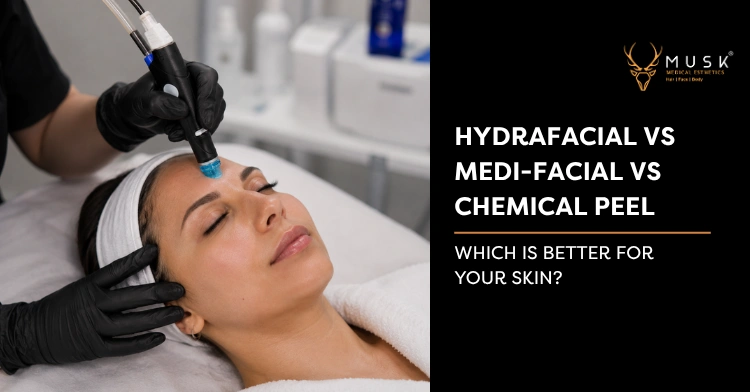
HydraFacial Vs Medi-Facial Vs Chemical Peel: Which Is Better for Your Skin?
 By Pooja Sharma
 Your skin has been feeling dull, congested, and unpredictable. A friend swears at HydraFacial.
Your dermatologist has suggested a Medi-Facial. A beauty magazine keeps recommending chemical peels. Three treatments, three price points, three sets of promises, and no clear answer on which is genuinely right for your skin.
This confusion is not accidental. All three procedures fall under the umbrella of "advanced facials," yet they work through completely different mechanisms, target different skin layers and produce very different outcomes.
Choosing the wrong one can leave you underwhelmed, or worse, cause irritation, post-inflammatory pigmentation, or breakouts.
At Musk Clinic, our dermatologists perform these three treatments daily, and the single most common question we hear is: "Doctor, which one is better?" The honest answer is that "better" depends on your skin type, your concern, your Fitzpatrick score, your lifestyle, and how much downtime you can afford. This guide will help you make that decision the way a dermatologist would.
Understanding Your Treatments
1. HydraFacial
HydraFacial is a patented, machine-based facial that uses a vortex-fusion handpiece to simultaneously cleanse, exfoliate, extract impurities and infuse the skin with serums containing hyaluronic acid, peptides and antioxidants.
It works on the superficial layers of the epidermis and is often called the "no-downtime glow facial."
2. Medical-Facial
A Medical Facial (short for medical facials) is a dermatologist-designed protocol that combines clinical-grade products, mild acids, LED therapy, mesotherapy solutions or ultrasound depending on your skin's specific needs. Unlike a standard salon facial, every step is prescribed and adjusted for your skin condition. It is not a fixed treatment; it is a category of treatments that vary from patient to patient.
3. Chemical Peel
A Chemical Peel involves applying a controlled acid solution such as glycolic acid, salicylic acid, mantellic acid, lactic acid or TCA (trichloroacetic acid) to the skin. This solution deliberately exfoliates the outer damaged layers so that fresh, evenly pigmented skin can regenerate. Peels are classified as superficial, medium, or deep depending on how far they penetrate.
HydraFacial Vs Medi-Facial Vs Chemical Peel: Side-by-Side Comparison
Parameter | HydraFacial | Medi-Facial | Chemical Peel |
Primary Purpose | Instant hydration and glow | Customized medical correction | Deep exfoliation and renewal |
Skin Layer Targeted | Epidermis (superficial) | Epidermis, adjusted by concern | Epidermis to upper dermis |
Best For | Dullness, congestion, dehydration, event-ready glow | Acne, sensitivity, mild pigmentation, personalised care | Acne scars, melasma, tan, fine lines, uneven texture |
Downtime | None | Little to none | 3 to 7 days depending on depth |
Session Duration | 30 to 45 minutes | 45 to 60 minutes | 20 to 40 minutes |
Frequency | Every 3 to 4 weeks | Every 3 to 6 weeks | Every 2 to 4 weeks (in a series) |
Visible Result | Immediate | Gradual to immediate | Progressive over sessions |
Comfort Level | Highly comfortable | Comfortable | Mild tingling, warmth or stinging |
Suitable for Sensitive Skin | Yes | Yes (formulated for you) | Only mild peels |
Cost in India (indicative) | Higher | Mid to premium | Mid |
Longevity of Result | 2 to 4 weeks | 4 to 6 weeks | Cumulative and long-term |
How Each Treatment Works Scientifically
1. HydraFacial: Vortex-Fusion Technology
HydraFacial uses a spiral-shaped tip that creates a vortex effect on the skin. In one continuous motion, it exfoliates the stratum corneum, softens debris inside pores, dislodges blackheads through gentle suction, and delivers water-based serums. Because the process is hydra-dermabrasion (wet exfoliation), it avoids the microtrauma of traditional dry microdermabrasion.
The result is skin that looks plumper and more luminous immediately, because the stratum corneum is polished and the surface is saturated with humectants.
2. Medi-Facial: Diagnosis-Led Layering
A Medi-Facial begins with a dermatologist's assessment of your Fitzpatrick skin type, sebum production, sensitivity, active acne count, pigmentation pattern and barrier health. Based on that diagnosis, the doctor layers a personalized combination:
- Gentle enzymatic or acid-based cleansing
- Mild exfoliation with mandelic, lactic or PHA
- Extraction if required
- Serum infusion via mesotherapy, ultrasound or iontophoresis
- LED light therapy (blue for acne, red for anti-aging, yellow for redness)
- Barrier-repair mask
3. Chemical Peel: Controlled Injury and Renewal
A chemical peel intentionally injures the skin in a controlled manner to trigger regeneration. The acid disrupts intercellular bonds in the epidermis so that damaged, pigmented or scarred cells shed and are replaced by newer cells with better tone and texture. Over multiple sessions, peels also stimulate collagen and reduce melanin transfer, which is why they remain in the gold-standard in-clinic treatment for melasma, post-acne marks and photoaging.
Common peels used in Indian skin:
- Glycolic acid for dullness and mild texture
- Salicylic acid for oily and acne-prone skin
- Mandelic acid for sensitive or darker skin tones
- Lactic acid for dry and dehydrated skin
- TCA for deeper concerns such as scars and stubborn pigmentation
- Kojic and phytic combinations for melasma
Peels for Indian skin (Fitzpatrick IV to V) require careful selection because higher melanin content increases the risk of post-inflammatory hyperpigmentation if the wrong depth is chosen.
Which One Should You Choose? A Decision Tree
- If your main goal is instant glowing before an event or you have healthy, dull, dehydrated skin: Choose HydraFacial.
- If you have active acne, sensitivity, mild pigmentation or unpredictable skin and want a dermatologist-designed protocol: Choose a Medi-Facial.
- If you are dealing with acne scars, melasma, sun damage, tanning, fine lines or uneven texture and are willing to invest in a series with some downtime: Choose a Chemical Peel.
- If you want the best of both worlds: Many dermatologists combine treatments. For example, a Medi-Facial with a mild peel, or a HydraFacial two weeks after a peel to boost hydration during recovery.
Benefits of Each Treatment
1. HydraFacial Benefits
- Instantly hydrated, plump, luminous skin
- Painless with zero downtime
- Safe for almost all skin types including sensitive
- Reduces the appearance of congested pores
- Great pre-event treatment
- Improves absorption of skincare afterwards
2. Medi-Facial Benefits
- Fully customized to your skin condition
- Safer for acne-prone or reactive skin than generic facials
- Combines multiple technologies in one sitting
- Prescribed and supervised by a dermatologist
- Addresses cause, not just cosmetic symptoms
- Ideal maintenance treatment between advanced procedures
3. Chemical Peel Benefits
- Corrects pigmentation, melasma and tanning
- Fades acne scars and dark spots
- Improves skin texture and fine lines
- Reduces active acne through pore decongestion
- Stimulates collagen production
- Delivers cumulative, long-lasting results
Limitations and Risks
1. HydraFacial
Results are temporary, usually lasting two to four weeks. It does not correct scars, deep pigmentation, or wrinkles. Cost is on the higher side compared to a basic facial.
2. Medi-Facial
Because the term "Medi-facial" is used loosely across salons and spas, quality varies drastically. A true Medi-Facial should only be performed under a qualified dermatologist. It also does not deliver the same depth of correction as a peel or laser.
3. Chemical Peel
Requires downtime with visible peeling, redness or dryness. Poorly performed peels can cause post-inflammatory hyperpigmentation, especially in Indian skin. Strict sun protection is mandatory during and after the treatment cycle. Not suitable during pregnancy, active herpes flares or on very sensitive, broken skin.
Who Is Suitable and Who Should Avoid
Suitable For | Should Avoid If | |
HydraFacial | Dull, dehydrated, congested skin; pre-event glow; teenagers to adults | Active severe acne, sunburn, open wounds, active rosacea flare |
Medi-Facial | Acne-prone, sensitive, mildly pigmented or reactive skin | Uncontrolled inflammatory skin disease unless prescribed |
Chemical Peel | Acne scars, melasma, tanning, fine lines, oily skin, uneven tone | Pregnancy, breastfeeding, active infection, isotretinoin uses in past 6 months, keloidal tendency |
Recovery and Timeline
HydraFacial: Walk in, walk out. Slight pinkness for an hour at most. Makeup is allowed on the same day.
Medi-Facial: Mild flushing or tingling for a few hours. Skin returns to normal within 24 hours. Full glow settles by day two.
Chemical Peel:
- Day 1: Mild redness, tightness
- Day 2 to 3: Skin darkens slightly
- Day 3 to 5: Visible peeling and flaking
- Day 6 to 7: Fresh, brighter skin emerges
- Day 8 onwards: Continue sunscreen and barrier care
Before Treatment Checklist
- Stop retinoids, AHAs and BHAs 3 to 7 days prior for peels
- Avoid waxing, threading or hair removal on the treatment area for 48 hours
- Avoid sun exposure for at least a week before a peel
- Inform your dermatologist about medications, especially isotretinoin, blood thinners or hormonal therapy
- Do not schedule a peel within two weeks of a major event
- Come with a bare face for consultation
Aftercare Checklist
- Use a gentle, non-foaming cleanser
- Apply a barrier-repair moisturizer
- Reapply broad-spectrum sunscreen SPF 50 every three hours
- Do not pick, peel or scrub the skin
- Avoid hot water, sauna, steam and intense workouts for 48 hours after a peel
Skip actives (retinol, vitamin C, AHAs) until the doctor clears you
Myths Vs Facts
Myth | Fact |
Chemical peels damage the skin. | When performed by a dermatologist at the right strength, peels are one of the safest corrective treatments in dermatology. |
HydraFacial can remove acne scars. | It cannot. It hydrates and refreshes, but scar correction needs peels, microneedling, or lasers. |
Medi-Facials and salon facials are the same. | No. Medi-Facials are prescribed and performed under medical supervision using pharmaceutical-grade products. |
One session is enough. | Most concerns need a planned series to show sustained results. |
Peels lighten the skin permanently. | Peels correct pigmentation and even out tone; they do not bleach or change your natural complexion. |
Doctor Insights from Musk Clinic
Indian skin behaves differently from lighter skin types. It has higher melanin, is more prone to post-inflammatory hyperpigmentation, and often carries a compromised barrier from harsh over-the-counter products.
Because of this, we rarely recommend the strongest peel or the trendiest facial simply because a patient asks for it. The most elegant results come from matching the treatment to the skin, not the skin to the treatment.
For a bride preparing for her wedding, we often start with a Medi-Facial series, add a mild peel mid-way and finish with a HydraFacial closer to the event.
For a working professional with acne and pigmentation, a salicylic-mandelic peel series alongside skincare correction typically outperforms any glow-facial. And for someone in their forties dealing with dullness and fine lines, a combination of hydrating and lightly resurfacing protocols works better than one aggressive session.
Realistic Expectations
HydraFacial gives you glow, not correction.
Medi-Facial gives you controlled improvement, not dramatic transformation in one sitting.
Chemical Peel gives you correction, but only if you complete the series and protect your skin from the sun religiously.
Common Mistakes Patients Make
- Choosing a treatment based on Instagram trends rather than skin diagnosis.
- Skipping sunscreen after a peel, which reverses all the progress.
- Booking a peel two days before a big event.
- Mixing at-home actives with in-clinic treatments without consulting a dermatologist.
- Assuming higher costs always means a better result.
- Doing back-to-back peels without letting the barrier recover.
When To See a Dermatologist Instead of a Facialist
If you have persistent acne, melasma, scarring, rosacea, sensitive skin, or if previous facials have caused breakouts or pigmentation, do not go to a salon. What looks like a cosmetic concern is often a treatable medical condition, and the correct diagnosis will save you years of trial and error.
Conclusion
HydraFacial, Medi-Facial and Chemical Peel are not competitors. They are three different tools in a dermatologist's toolkit, each brilliant at what it is designed to do.
HydraFacial is your instant reset.
A Medi-Facial is your personalized maintenance plan.
A Chemical Peel is your long-term correction strategy.
The smartest skincare journey is not choosing one forever; it is knowing which one your skin needs right now.
If you would like a personalized recommendation based on your skin type and concern, consult a qualified dermatologist at Musk Clinic, Ahmedabad will be happy to guide you.
Frequently Asked Questions (FAQs)

Dr Pooja Sharma
- 5 Years of Experience