






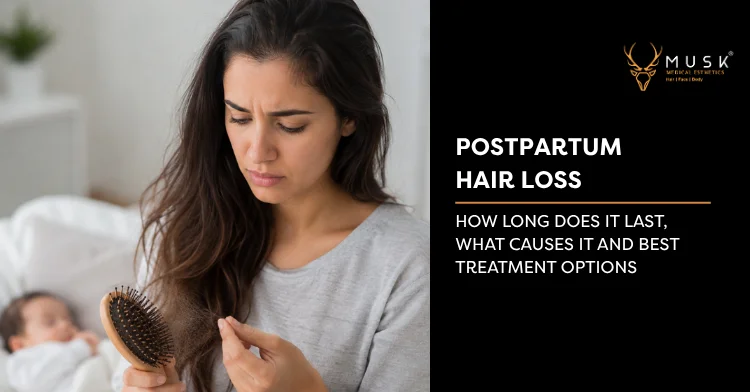
Postpartum Hair Loss: How Long Does It Last, What Causes It and Best Treatment Options
 By Dr. Anand Shah
 If you have had a baby in the past several months and are suddenly seeing far more hair in your brush, your shower drain, or your pillow than you ever did before, you are not imagining it and you are not alone. Postpartum hair loss is one of the most common experiences of new mothers, and in most cases, it is a temporary, self-limiting shift in the hair growth cycle rather than a sign that something is wrong.
It helps to have a sense of what counts as normal before worrying about what does not. Most people lose somewhere between 50 and 100 hairs a day without noticing, a baseline covered in more depth in how much hair loss is normal in the shower, and postpartum shedding simply pushes that number higher for a limited window rather than representing a new or permanent problem.
The confusion usually comes from timing. The shedding does not start right after delivery; it typically shows up two to four months later, which means many new mothers do not immediately connect the hair in their brush to the baby who is already several months old. Understanding the actual mechanism behind this makes the whole experience far less alarming.
This guide covers what causes postpartum hair loss, how long it realistically lasts, how to tell normal shedding apart from something that needs medical attention, and what genuinely helps during the process, along with when it is worth booking a proper evaluation rather than waiting it out.
Key Takeaways
- Postpartum hair loss is not true hair loss; it is telogen effluvium. Pregnancy hormones keep more hair in the growth phase, and the shift back to normal after birth causes a temporary surge of shedding rather than permanent thinning.
- Shedding usually starts around 2 to 4 months postpartum. This delay is exactly why many new mothers do not connect hair loss to childbirth right away.
- Most shedding resolves within 6 to 12 months. Hair density for most women returns close to its pre-pregnancy state by around the time their baby turns one.
- Breastfeeding can extend the timeline slightly for some women. This is a normal variation rather than a sign of a separate underlying problem.
- Diffuse, whole-scalp shedding is the expected pattern. Patchy bald spots, scalp scarring, or pain are reasons to see a doctor rather than assume it is postpartum shedding.
- Iron and thyroid levels are worth checking if shedding feels unusually heavy or prolonged. Postpartum iron deficiency and thyroid changes are common and can mimic or worsen telogen effluvium.
- Gentle hair care reduces visible breakage; it does not change the underlying timeline. Hormones drive the shedding itself, so styling adjustments support hair health without speeding up regrowth.
- Treatment beyond reassurance and nutrition is usually only needed in the past 12 to 18 months. At that point, a scalp evaluation can rule out other causes and discuss appropriate options.
What Causes Postpartum Hair Loss?
During pregnancy, elevated estrogen extends the growth (anagen) phase of the hair cycle and keeps a larger proportion of hair actively growing at once, which is why many women notice thicker, fuller hair while pregnant. After delivery, estrogen drops sharply, and a large share of those follicles shift into the resting (telogen) phase together rather than gradually, which is what produces the noticeable, synchronized shedding a few months later. This is medically referred to as postpartum telogen effluvium, a diffuse and non-scarring pattern of hair loss.
A few factors can influence how noticeable the shedding feels:
- How much hair thickness increased during pregnancy in the first place, since more anagen hair beforehand means more shedding on the way back down.
- Individual hormonal and genetic factors, which explain why the same pregnancy can affect two women quite differently.
- Breastfeeding, since ongoing hormonal changes during lactation can extend the shedding window for some women.
- General postpartum stress, sleep disruption, and nutritional demands, which can compound but do not solely cause the shedding.
How Long Does Postpartum Hair Loss Last?
Postpartum Window | What Is Typically Happening |
0 to 3 months | Minimal noticeable shedding as the body adjusts after delivery |
3 to 6 months | Peak shedding, often the most alarming stage, hair visible in the brush, drain, and pillow |
6 to 12 months | Gradual reduction in shedding as new hairs begin filling back in |
12 to 18 months | Hair usually returns close to pre-pregnancy density and pattern for most women |
How Do You Know If Postpartum Hair Loss Is Normal?
Likely Normal Postpartum Shedding | Worth a Checkup |
Even thinning across the whole scalp | One or more distinct patches of hair loss |
No scalp pain, itching, or visible scaling | Scalp pain, redness, scaling, or tenderness |
Gradually improving month over month | Shedding that plateaus or worsens past 12 to 18 months |
Started 2 to 4 months after delivery | Started well before delivery or immediately after with no clear pattern |
When Should You See a Doctor About Postpartum Hair Loss?
Most postpartum shedding does not need medical treatment, only time. That said, a few situations are worth a proper evaluation rather than waiting it out: shedding that has not started improving by 12 to 18 months, patchy rather than diffuse hair loss, or additional symptoms such as unusual fatigue, weight changes, or a change in hair texture that could point toward a postpartum thyroid change or iron deficiency, both of which are common after childbirth and can mimic or worsen telogen effluvium. It is also worth remembering that pregnancy's fuller-hair effect can temporarily mask an underlying pattern of hair thinning that becomes more visible once hormones settle, which is one of several reasons ongoing hair loss in women is worth examining properly rather than assumed away, as discussed in DHT blockers for women.
For mothers who want extra support during the shedding phase itself, some explore non-invasive options such as Low Level Laser Therapy, which is aimed at supporting circulation to follicles without any downtime, though it is not a substitute for identifying whether an underlying cause needs to be addressed first.
What Helps During Postpartum Hair Loss?
Since the shedding itself is hormonally driven, no product will stop it outright, but a few habits genuinely support healthier regrowth and reduce visible breakage while the cycle resets.
- Eating enough protein, iron, and overall calories, since postpartum nutritional demands are high and deficiencies can compound shedding.
- Being gentle with wet hair, since hair is more fragile when damp and rough detangling adds breakage on top of the natural shedding.
- Choosing looser hairstyles and soft accessories rather than tight elastics, since added tension on already-shedding hair increases visible breakage.
- Being patient with the timeline rather than trying multiple new products at once, which makes it harder to know what is helping.
If a blood test shows low iron or an underlying thyroid imbalance, treating that underlying cause matters more than any topical product, which is another reason a proper evaluation is worth it if shedding feels unusually heavy or prolonged.
Can Postpartum Hair Loss Become Permanent?
Telogen effluvium itself does not scar the follicle, so postpartum shedding on its own is not a permanent condition, and the affected follicles are expected to resume normal growth. The exception is when the shedding phase unmasks or overlaps with a separate, ongoing pattern of hair thinning that was already present but hidden by pregnancy's temporarily fuller hair. This is uncommon, but it is the main reason for thinning that has not clearly improved by 12 to 18 months deserves a proper look rather than being assumed as still-resolving postpartum shedding. For the minority of women whose shedding does not fully resolve on its own, PRP therapy is one of the in-clinic options a specialist may discuss alongside continued monitoring and any underlying nutritional or thyroid treatment.
When Postpartum Hair Loss Needs a Closer Look
For the large majority of new mothers, the right answer to postpartum hair loss is reassurance, realistic timelines, and gentle hair care rather than a clinic visit. Where Musk Clinic genuinely fits is for the smaller group, whose shedding is unusually heavy, patchy, or has not started improving on the expected timeline, where a scalp evaluation can distinguish ordinary postpartum telogen effluvium from an underlying cause worth treating directly, with options such as PRP considered only where they are actually appropriate rather than offered by default.
Conclusion
Frequently Asked Questions (FAQs)

Dr. Anand B. Shah
- 10 Years of Experience
Dr Anand B. Shah, is a board-certified Maxillofacial & Craniofacial surgeon who is highly skilled in cosmetic facial and hair restoration surgery and has exclusively practised the same, internationally and nationally.