






Minoxidil vs Finasteride vs PRP: Which Hair Loss Treatment Is Right for You in 2026?
 By Dr. Anand Shah
 Most people researching hair loss treatment do not need to be convinced that something works. Minoxidil, finasteride, and PRP all have real clinical evidence behind them. What they need is a straight answer about which one fits their specific pattern of thinning, their comfort with side effects, and their budget, because using the wrong treatment for your situation, or stopping too early, is the most common reason people feel like nothing worked.
The confusion usually comes from the fact that these three treatments are not interchangeable. Minoxidil and finasteride work through completely different mechanisms, one on blood flow to the follicle and one on the hormone that shrinks it, while PRP takes a different, procedure-based approach using a concentrate of the patient's own platelets. A scalp evaluation with a hair restoration specialist is usually where this gets sorted out properly, but understanding the differences beforehand makes that conversation far more useful.
This guide breaks down how each treatment works, who tends to respond best to it, the side effects worth knowing before starting, and what combining them looks like in practice. It also covers general cost ranges in India and the point at which medical therapy alone stops being enough and a hair transplant becomes worth discussing.
None of this replaces an in-person evaluation. Hair loss has several causes, and pattern hair loss (androgenetic alopecia) is only one of them, so the right starting point is always a proper assessment of what is happening on the scalp before choosing a treatment path.
Key Takeaways
- Minoxidil and finasteride work differently, not competitively. Minoxidil widens blood vessels to support follicle activity, while finasteride lowers DHT, the hormone that shrinks follicles in androgenetic alopecia.
- Finasteride is FDA approved for men only. It is not approved for women of reproductive potential because of pregnancy risk, though some postmenopausal women use it off label under medical supervision.
- PRP has moderate but real clinical support. Recent systematic reviews and meta-analyses show PRP can improve hair density and reduce shedding, though results vary with preparation technique and individual response.
- Combination therapy tends to outperform any single option. Minoxidil, finasteride, and PRP are frequently used together, especially for moderate loss, because they act on different parts of the hair growth cycle.
- Side effects differ significantly by treatment. Minoxidil's issues are mostly local, such as scalp irritation or initial shedding, while finasteride carries a small but real risk of sexual side effects in some men.
- Results take months, not weeks, for all three treatments. Meaningful change is usually visible between 3 and 6 months, with fuller results closer to the 12-month mark.
- PRP is priced per session in India, generally in the low thousands of rupees. Minoxidil and finasteride are lower-cost, ongoing daily treatments rather than one-time procedures.
- Medical therapy has a ceiling. Once hair loss has progressed past what minoxidil, finasteride, or PRP can meaningfully support, a transplant becomes the option that adds density rather than only slowing loss.
Why Are There So Many Hair Loss Treatment Options in 2026?
For close to three decades, only two prescription-strength treatments carried FDA approval for pattern hair loss: topical minoxidil and oral finasteride. Newer oral minoxidil formulations and other investigational drugs are now moving through clinical trials, but for most patients walking into a clinic today, minoxidil, finasteride, and PRP remain the three evidence-backed options that are readily available and well-studied. If you are still narrowing down whether your shedding fits the pattern these treatments target in the first place, this overview of common hair loss causes and prevention strategies is a useful starting point before comparing specific treatments.
How Does Minoxidil Work for Hair Loss?
Minoxidil is a topical vasodilator that widens blood vessels around hair follicles, increasing blood flow and extending the growth (anagen) phase of the hair cycle while shortening the resting (telogen) phase. It is FDA approved for both male and female pattern hair loss and is sold over the counter as a 2 percent or 5 percent solution or foam, with low-dose oral minoxidil used off-label under medical supervision in some cases.
Who Minoxidil Works Best For
- Crown and vertex thinning, where minoxidil's topical delivery tends to work well
- Women, since it is the only medication FDA approved for female pattern hair loss
- Anyone who wants to avoid a hormonal mechanism, since minoxidil does not affect DHT
- Early-stage thinning, where more follicles are still active and can respond to increased blood flow
Minoxidil Side Effects
- Scalp irritation or itching, more common with solution formulations than foam
- An initial shedding phase in the first several weeks as older hairs are pushed out to make way for new growth
- Unwanted facial hair growth if the product drips or spreads beyond the scalp
- Reversal of gains within months of stopping, since minoxidil needs to be used indefinitely to maintain results
If you are not sure whether your thinning fits the pattern that minoxidil responds to, a proper scalp evaluation is a useful first step before committing to a regimen. Musk Clinic's hair loss treatment page walks through what a consultation-based assessment looks like.
How Does Finasteride Work for Hair Loss?
Finasteride is an oral 5-alpha reductase inhibitor that blocks the conversion of testosterone into dihydrotestosterone (DHT), the hormone responsible for shrinking genetically susceptible hair follicles in male pattern baldness. Taken daily at 1 mg, it lowers serum DHT by roughly 70 percent in most men and is FDA approved for use in men aged 18 and older.
Who Finasteride Works Best For
- Men in their 20s to 40s with early to moderate androgenetic alopecia, particularly hairline and crown involvement
- Men comfortable with a daily oral medication and routine monitoring
- Men without a personal history of depression or sexual dysfunction concerns, since these are the side effects worth discussing openly with a physician first
- Not appropriate for women of reproductive potential, due to a teratogenic risk to a male fetus if used during pregnancy
Finasteride Side Effects
- A small but real risk of sexual side effects, including reduced libido or erectile difficulty, in a minority of men
- Mood changes reported by some users, though causation is harder to establish than with the sexual side effects
- Effects are generally reversible after stopping the medication, though this can take weeks to months
- Women who are or may become pregnant should not handle broken or crushed tablets, given the risk to a male fetus
For a deeper look at finasteride's safety profile specifically for patients in India, the dedicated guide on finasteride for hair loss covers dosing and monitoring in more detail.
What Is PRP Hair Treatment and How Does It Work?
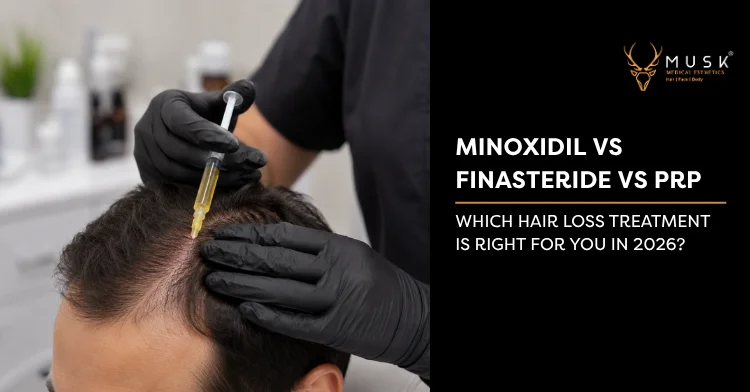
Platelet-rich plasma (PRP) therapy involves drawing a small sample of the patient's own blood, concentrating the platelets in a centrifuge, and injecting the resulting plasma into the scalp. The growth factors released by activated platelets are believed to stimulate blood vessel formation around hair follicles and extend the follicle growth phase, though the precise mechanism is still being refined through ongoing research.
Who PRP Works Best For
- Early to moderate thinning, where most studies show the clearest benefit
- Patients who want a non-drug option or an add-on to minoxidil and finasteride rather than a replacement
- Both men and women, unlike finasteride, since PRP does not carry the same hormonal restrictions
- Patients willing to commit to an initial series of sessions plus periodic maintenance treatments
PRP Side Effects and Safety
Because PRP uses the patient's own blood, it is generally well tolerated, with the most common issues being mild scalp tenderness, temporary swelling, or redness at the injection sites. It should always be performed in a sterile clinical setting by a trained professional, since preparation technique and platelet activation method meaningfully affect both safety and results. Most patients need 3 to 6 initial sessions spaced 4 to 6 weeks apart, followed by maintenance sessions roughly every 6 to 12 months.
Patients weighing PRP against topical or oral options can review how the procedure itself works on the PRP treatment page before booking a session.
Minoxidil vs Finasteride vs PRP: Side-by-Side Comparison
| Factor | Minoxidil | Finasteride | PRP |
|---|---|---|---|
| Mechanism | Widens blood vessels, extends the growth phase | Blocks DHT production | Growth factors from concentrated platelets |
| Form | Topical solution or foam | Oral tablet | In-clinic injection series |
| FDA Approval | Men and women | Men only | Regulated as a medical procedure, not a drug |
| Best Fit For | Crown and vertex thinning, women, non-hormonal preference | Hairline and crown loss in men, early to moderate AGA | Early thinning, standalone or add-on, both sexes |
| Time to See Change | 8 to 16 weeks | 3 to 6 months, up to 12 for fuller effect | 3 to 6 months after the initial session series |
| Key Side Effects | Scalp irritation, initial shedding phase | Possible sexual side effects, mood changes (uncommon) | Mild injection-site tenderness or swelling |
| Ongoing Commitment | Daily, indefinitely | Daily, indefinitely | Sessions every 4 to 6 weeks initially, then maintenance |
Which Treatment Fits Which Type of Hair Loss?
| Scenario | Best-Fit Treatment |
|---|---|
| Early thinning, wants to avoid a daily medication | PRP alone, or PRP with occasional minoxidil |
| Frontal hairline recession in a man in his 20s to 30s | Finasteride, often paired with minoxidil |
| Female pattern hair loss | Minoxidil, with PRP as an add-on (finasteride is generally not appropriate) |
| Concerned about sexual side effects | Minoxidil and PRP, skipping finasteride |
| Moderate to advanced diffuse thinning | A combination of minoxidil, finasteride, and PRP |
| Visible scalp with little to no active follicles in the area | Medical therapy alone is unlikely to restore density; a transplant is worth discussing |
Can You Combine Minoxidil, Finasteride, and PRP?
Yes, and it is common practice. Because minoxidil, finasteride, and PRP work through different mechanisms, blood flow, DHT suppression, and growth factor stimulation respectively, several studies report better outcomes when they are combined rather than used alone, particularly minoxidil paired with PRP or with finasteride.
That said, combining all three from day one is not automatically the right call for everyone. Starting multiple treatments at once makes it harder to identify what is driving results, or what is causing a side effect if one appears. Many clinicians introduce treatments in a staged way, starting with the option best suited to the pattern and stage of loss, then adding others based on response, which is one more reason a proper evaluation matters more than picking a combination off a list.
How Much Does Each Treatment Cost?
Minoxidil and finasteride are ongoing; low-cost daily treatments purchased monthly, closer in structure to a long-term prescription than a one-time procedure. PRP is priced differently, as a per-session, in-clinic procedure. Across India, PRP session pricing commonly falls in the range of roughly ₹4,000 to ₹15,000 per session, with a typical initial course of 3 to 6 sessions, though this varies by city, clinic, and the technology used for platelet preparation. Exact pricing at Musk Clinic should be confirmed during a consultation, since cost depends on the treatment plan recommended after an in-person scalp assessment.
When Should You Consider a Hair Transplant Instead?
Minoxidil, finasteride, and PRP all work by supporting follicles that are still active, extending their growth phase or slowing the process that shrinks them. None of them can restore a follicle that has stopped producing hair altogether. Once an area has progressed to visibly thin or bald scalp with little remaining follicular activity, medical therapy alone typically cannot rebuild density there, which is the point where a transplant, such as robotic ARTAS 9X FUE hair transplantation, becomes worth discussing. Many patients continue minoxidil, finasteride, or PRP after a transplant as well, since these treatments help protect the native hair surrounding the transplanted area.
Patients who have plateaued on medical therapy can review real hair transplant results to understand what robotic FUE looks like as a next step.
How Musk Clinic Approaches Hair Loss
Musk Clinic's approach to hair loss starts with a scalp evaluation rather than a default prescription, since minoxidil, finasteride, and PRP suit different patterns and stages of loss. Patients whose evaluation points toward PRP can review the procedure on the PRP treatment page, and patients whose loss has progressed beyond what medical therapy can meaningfully support are evaluated for robotic ARTAS 9X hair transplantation under Dr. Anand Shah, a board-certified maxillofacial and craniofacial surgeon with training in robotic hair restoration. The goal at every stage is matching the treatment to the pattern of loss, not defaulting to the most invasive option available.
Conclusion
There is no single best treatment among minoxidil, finasteride, and PRP. Minoxidil is the broadest fit and the only FDA-approved option for women. Finasteride addresses the hormonal driver of male pattern baldness directly but comes with a side-effect profile worth weighing carefully. PRP offers a non-hormonal, procedure-based option that works well alone or alongside the other two. The pattern and stage of your hair loss, your tolerance for side effects, and your budget all matter more than which treatment sounds most advanced.
Frequently Asked Questions (FAQs)

Dr. Anand B. Shah
- 10 Years of Experience
Dr Anand B. Shah, is a board-certified Maxillofacial & Craniofacial surgeon who is highly skilled in cosmetic facial and hair restoration surgery and has exclusively practised the same, internationally and nationally.