






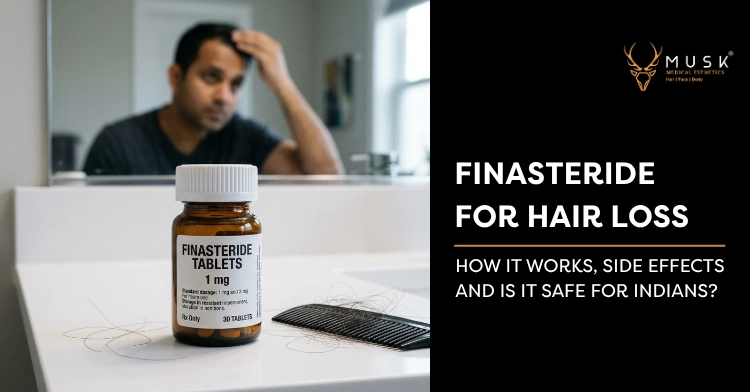
Finasteride for Hair Loss: How It Works, Side Effects and Is It Safe for Indians?
 By Dr. Anand Shah
 Picture this. You run your fingers through your hair in the morning, and a few more strands than usual come away. You check the shower drain - more hair than yesterday. You look in the mirror and notice your temples are a little further back than they were two years ago. And then someone at work casually mentions a pill called finasteride, swears by it, says it stopped his hair loss in six months.
So now you are here - searching for the truth. Does finasteride work? What are the side effects people are too afraid to say out loud? And most importantly, is it safe for Indian men specifically, given our genetics, our diet, our climate, and our hormonal patterns?
This blog answers every single one of those questions - with science, not fear-mongering. We break down exactly how finasteride works, what clinical studies show about side effects, the real results timeline for Indian patients, and when finasteride is the right choice versus when something else might serve you better.
At Musk Clinic in Ahmedabad, our specialist team evaluates every hair loss patient holistically before recommending any medicinal treatment - because the right solution depends entirely on your individual hair loss pattern, genetics, and health profile.
Key Takeaways
- What it is: Finasteride is an FDA-approved oral medication that reduces DHT - the hormone responsible for male pattern hair loss.
- How it works:It blocks the enzyme 5-alpha reductase, which converts testosterone into DHT, reducing scalp DHT by up to 60-70%.
- Effectiveness: In clinical trials, 83% of men stopped further hair loss at 2 years; 66% showed visible regrowth at 12 months.
- Side effects: Sexual dysfunction affects approximately 2-4% of users - and in most cases resolves on stopping the medication.
- Safe for Indians:Yes - finasteride works effectively for Indians, who often have early-onset androgenetic alopecia, but requires doctor supervision.
- Only works while you take it: DHT levels return to baseline within 14 days of stopping; hair loss gradually resumes.
- Not for women (generally): Contraindicated in women who are pregnant or may become pregnant. Used off-label only in specific post-menopausal cases.
- Best when combined: Finasteride works synergistically with minoxidil, PRP therapy, and hair transplants for optimal outcomes.
What Is Finasteride?
Finasteride is a prescription oral medication classified as a 5-alpha reductase (5-AR) inhibitor. It was first approved by the US FDA in 1992 for treating benign prostatic hyperplasia (an enlarged prostate) at a 5 mg dose, sold as Proscar. In 1997, a lower 1 mg dose was approved specifically for treating male pattern hair loss (androgenetic alopecia) and is sold under the brand name Propecia - with generic versions widely available today.
In India, finasteride is available as a prescription-only medication. It is regulated by the Central Drugs Standard Control Organization (CDSCO) and is one of only two medications globally recognized for treating male pattern hair loss - the other being minoxidil. This makes it one of the most scientifically validated hair loss treatments in existence, with over 25 years of clinical use and safety data.
Finasteride is taken as one 1 mg tablet daily, ideally at the same time each day. It is not a topical treatment - it works systemically by changing your body's hormonal environment at the level of the hair follicle.
The Root Cause: What Is DHT and How Does It Destroy Hair?
Before understanding finasteride, you need to understand its target: DHT (dihydrotestosterone). If you have male pattern baldness - the classic M-shaped receding hairline, thinning at the crown, or overall hair miniaturization - DHT is almost certainly the cause.
DHT is a potent androgen (male hormone) derived from testosterone through the action of the enzyme 5-alpha reductase. In people with a genetic sensitivity to DHT, the hormone binds to receptors in scalp follicles and progressively shrinks them in a process called miniaturization. Over time, the hair follicles produce thinner, shorter, and lighter strands - until eventually they stop producing visible hair altogether.
DHT does not cause hair loss everywhere on the scalp equally. It primarily targets the frontal hairline, temples, and the crown - which is why those are the first areas to thin in androgenetic alopecia. The sides and back of the scalp have follicles that are genetically resistant to DHT, which is why these donor zones are used in hair transplants.
Finasteride's entire mechanism is built around intercepting this hormonal chain before it reaches the follicle.
How Does Finasteride Work?
Finasteride is a competitive inhibitor of the type II and type III isoenzymes of 5-alpha reductase. In plain terms - it blocks the enzyme that converts testosterone into DHT.
Here is the exact process:
- Testosterone is present in the body and naturally converted to DHT by 5-alpha reductase enzymes.
- In hair follicle tissue, this DHT binds to androgen receptors and triggers miniaturization.
- Finasteride blocks 5-alpha reductase (type II) - the primary form active in hair follicles.
- With the enzyme blocked, significantly less DHT is produced. Scalp DHT levels fall by approximately 60-70%.
- With reduced DHT in the scalp environment, follicles that were miniaturizing stop shrinking. Some begin to recover and grow thicker hair again.
Importantly, finasteride does not lower testosterone levels. Many Indian men worry that blocking DHT will affect their masculinity or energy - it does not. In fact, when DHT production is reduced, circulating testosterone levels increase slightly (by about 10%), because less is being converted. Your strength, energy, and libido are primarily governed by testosterone - not DHT.
Research shows that finasteride reduces serum DHT levels by around 65-70% with a 1 mg oral daily dose, and scalp DHT levels by approximately 60-65%. That DHT reduction is sufficient in most men to halt the hair loss process and, in many cases, allow partial recovery of previously affected follicles.
Who Is the Right Candidate for Finasteride?
Finasteride works best in specific situations. Here is who typically benefits most:
- Men with androgenetic alopecia (male pattern hair loss):It is specifically approved and clinically proven for this condition. If you have a receding hairline or crown hair loss driven by genetics, finasteride addresses the root cause.
- Men in the early-to-mid stages of hair loss:Finasteride is most powerful as a preventive and stabilizing tool. It works better when follicles are still alive and producing hair - however thin - than when follicles are already completely dormant.
- Men aged 18-60: It is effective across this age range. Indian men often begin seeing signs of genetic hair loss in their mid-20s - starting finasteride early significantly improves long-term outcomes.
- Men committed to long-term use: Finasteride requires ongoing daily use to maintain its benefits. It is not a one-time cure.
Finasteride is NOT recommended as a first-line treatment for women (particularly those who are pregnant, planning pregnancy, or pre-menopausal), children, or anyone with significant liver impairment.
Finasteride Dosage: How and When to Take It
For male pattern hair loss, the standard prescribed dose is 1 mg of finasteride once daily. It can be taken with or without food - the bioavailability is approximately 65-80% and is not significantly affected by meals.
Key dosage guidance:
- Consistency is critical: Take it at the same time every day. Missing doses frequently reduces its effectiveness.
- Do not double up: If you miss a dose, skip it and continue the next day. Do not take two tablets to compensate.
- Never split or crush tablets: This is particularly important around women - finasteride can be absorbed through skin contact and poses a risk to pregnant women carrying male fetuses.
- Only take with a valid prescription: In India, finasteride is a Schedule H drug requiring a doctor's prescription. Never self-medicate.
- Regular blood work: Your doctor may periodically check PSA (prostate-specific antigen) levels, as finasteride lowers PSA - which is an important context for any prostate health monitoring.
When Will You See Results? The Finasteride Timeline
This is the number one question patients ask - and the honest answer is: be patient. Finasteride works gradually, not overnight. Here is what the science shows:
| Timeframe | What Happens | What to Expect |
|---|---|---|
| Month 1-2 | DHT levels in scalp begin dropping significantly | No visible change; possible initial shedding |
| Month 3-4 | Hair loss rate noticeably slows down | Less hair in shower drain; existing hair thickens |
| Month 6 | Hair count stabilization; early regrowth possible | Visible improvement in density in many patients |
| Month 12 | Peak hair count improvement | Up to 66% of men show measurable regrowth |
| Year 2-5+ | Maintained hair retention with continued use | 90% of men maintained or increased hair count at 5 years |
Results are based on clinical trial data and real-world outcomes. Individual responses vary. Consistent daily use is essential.
One important warning: in the first 1-3 months of starting finasteride, some men experience a temporary increase in hair shedding. This is a positive sign - it means the follicles are transitioning from a resting phase to an active growth phase. It is not a sign that the medication is failing.
The most critical milestone is 12 months. If you see no benefit whatsoever after a full year of consistent daily use, your doctor may discuss alternative or adjunct treatments.
Finasteride Side Effects: What Does Science Say?
This is where the internet gets dramatic - and people make decisions based on fear rather than fact. Let's be clear-eyed about what the data shows.
In the landmark phase III clinical trials involving 1,879 men over 2 years, the overall rate of treatment-related adverse events was 7.7% for finasteride - compared to 7.0% for placebo. The difference is smaller than most people expect.
Sexual Side Effects
The most discussed category of side effects is sexual function. Clinical trials reported the following incidence in men taking 1 mg finasteride daily:
- Decreased libido: ~1.8% of men (vs 1.3% on placebo)
- Erectile dysfunction: ~1.3% of men (vs 0.7% on placebo)
- Ejaculation disorder: ~1.2% of men (vs 0.9% on placebo)
Total combined sexual side effect incidence: approximately 3.8% with finasteride versus 2.1% with placebo. That means the actual drug-attributable sexual side effect risk is approximately 1.7% above baseline - affecting fewer than 2 in 100 users above the normal background rate.
Critically: in clinical trials, all sexual adverse effects were reversed in men who discontinued finasteride. Many also resolved spontaneously in men who continued taking the drug - suggesting the body adapts over time.
Post-Finasteride Syndrome (PFS)
A small number of men report persistent sexual or neurological symptoms even after stopping finasteride - a condition sometimes called post-finasteride syndrome (PFS). This is a real and documented concern, though it is not yet fully understood scientifically. The European Medicines Agency (EMA) updated its guidance in 2025 to note that suicidal ideation has been reported in rare cases.
This does not mean most people will experience PFS. It is rare. But it underscores the importance of taking finasteride only under medical supervision, with regular check-ins, so any early warning signs are caught and managed appropriately.
Other Side Effects (Less Common)
- Breast tenderness or enlargement (gynecomastia) - rare
- Skin rash or allergic reaction - rare
- Lowered PSA levels - affects prostate cancer screening interpretation (inform your urologist)
- Reduced semen volume - documented but typically minor
 IMPORTANT: Never start or stop finasteride without a doctor's guidance. If you experience any concerning side effects, contact your doctor promptly. Do not self-medicate.
Is Finasteride Safe for Indians? What You Need to Know
Indian men are disproportionately affected by androgenetic alopecia. Studies suggest that male pattern hair loss begins earlier and progresses more aggressively in Indians compared to many Western populations - often starting in the mid-20s. This is primarily driven by genetic DHT sensitivity, which is where finasteride is specifically designed to intervene.
Here is a careful breakdown of finasteride safety considerations for Indian patients:
1. Genetic Suitability
Finasteride works by reducing DHT - a mechanism that is equally relevant regardless of ethnicity. Indian patients with androgenetic alopecia respond to finasteride the same way as patients globally. There is no evidence that Indian genetics make finasteride less effective or more dangerous.
2. Liver Metabolism Considerations
Finasteride is metabolized in the liver via the CYP3A4 enzyme pathway. Indian patients with underlying liver conditions - including non-alcoholic fatty liver disease (NAFLD), which has a rising prevalence in India - should inform their doctor before starting finasteride. A liver function test is a routine part of responsible prescribing.
3. Sexual Health Concerns in the Indian Context
Concern about sexual side effects is especially prominent among Indian patients, partly due to cultural factors around discussing sexual health openly. The honest data, as reviewed above, shows that sexual side effects affect a small minority of users and are reversible in most cases. A frank conversation with your doctor before starting - rather than fear-driven avoidance of an effective treatment - is the right approach.
4. Indian Diet and Finasteride
Finasteride absorption is not meaningfully affected by food, including typical Indian dietary patterns involving spicy foods, high-fat meals, or fasting protocols. It can be taken with meals or on an empty stomach.
5. Not for Women - Especially Given Indian Family Planning Context
Finasteride is classified as Pregnancy Category X. In the Indian context where joint families and close cohabitation are common, it is critical that female household members who are pregnant or planning pregnancy do not handle broken or crushed finasteride tablets. The intact tablet is coated and safe to handle, but the active ingredient can be absorbed through skin. This is an important safety note for Indian households. Women experiencing hair loss should explore dedicated options for female hair loss - read our guide to DHT blockers for women for alternatives.
Finasteride vs. Minoxidil: Which One Should You Choose?
The most common question is how finasteride compares to minoxidil - the other FDA-approved hair loss treatment. They work completely differently, and many patients benefit from using both together. Here is a direct comparison (also see our deep-dive: how long does minoxidil take to work):
| Feature | Finasteride (1 mg/day) | Minoxidil (Topical) |
|---|---|---|
| How It Works | Blocks DHT at the hormonal level | Improves blood flow to scalp follicles |
| Form | Oral tablet - once daily | Topical solution or foam - applied to scalp |
| FDA Approved? | Yes - for men only | Yes - for men and women |
| Works For Women? | Off label; not recommended unless post-menopausal | Yes (5% for women) |
| Time to See Results | 3-6 months to slow loss; 6-12 months for regrowth | 3-6 months for visible improvement |
| Main Side Effects | Sexual dysfunction in ~2-4% of men | Scalp irritation, unwanted facial hair (women) |
| If Stopped | DHT returns within 2 weeks; hair loss resumes | Hair loss resumes within 3-6 months |
| Best Combined With | Minoxidil, PRP, hair transplant | Finasteride, PRP, low-level laser therapy |
Both medications work on different mechanisms and can be used together under medical supervision for synergistic results.
Who Should NOT Take Finasteride?
Absolute contraindications - do not take finasteride if any of the following apply:
- Pregnant women or women who may become pregnant: Risk of birth defects in male fetuses. Pregnancy Category X.
- Pre-menopausal women (in most cases): Not FDA-approved for women with androgenetic alopecia, though used off-label in specific cases under specialist supervision.
- Children and adolescents: Safety and efficacy not established in pediatric patients.
- Men with known hypersensitivity to finasteride or dutasteride: Allergic reactions are rare but possible.
- Men with severe liver disease:Finasteride is hepatically metabolized; avoid with significant hepatic impairment.
- Men currently under investigation for prostate cancer:Finasteride lowers PSA levels, which can mask early prostate cancer indicators.
Finasteride and Hair Transplant: A Powerful Combination
One of the most strategically sound uses of finasteride is as a complement to hair transplant surgery. Here is why: a hair transplant moves DHT-resistant follicles from the back and sides of your scalp to thinning areas. However, the existing native hairs in the recipient zone remain vulnerable to DHT-driven miniaturization.
If you have a hair transplant without addressing DHT, you may see the transplanted grafts thrive while the native hairs around them continue to thin - creating an unnatural result over time. Finasteride protects those native hairs and helps maintain the overall density of your result.
At Musk Clinic, our specialist team evaluates each patient holistically to determine whether finasteride, minoxidil, PRP therapy, or a combination of treatments is the right complement to hair restoration surgery - or whether medication alone is sufficient at the current stage of hair loss.
Alternatives to Finasteride: What Else Works?
Finasteride is not the only option. Depending on your situation, these alternatives may be relevant:
- PRP Therapy (Platelet-Rich Plasma): Uses your own blood's growth factors to stimulate dormant follicles. Non-hormonal, no systemic side effects, and increasingly used in combination with finasteride for accelerated results. Read our complete PRP guide
- Exosome Therapy:One of the most advanced non-surgical options available. Exosomes deliver targeted regenerative signals directly to scalp follicles. Learn more about exosome therapy for hair
- Minoxidil:Topical treatment that improves follicle blood supply - does not address DHT but effectively complements finasteride.
- Saw Palmetto:A natural herbal DHT blocker with weaker evidence than finasteride. May be a starting option for those averse to prescription medication. See our saw palmetto guide
- Spironolactone (for women):An anti-androgen used off-label for female pattern hair loss. Read about spironolactone for hair loss
- Hair Transplant Surgery:The permanent, definitive solution for patients with established hair loss who want to restore density with their own natural hair.
Why Consult Musk Clinic Before Starting Finasteride?
Hair loss treatment is not a one-size-fits-all decision. At Musk Clinic, we begin every hair loss consultation with a thorough clinical evaluation - including scalp analysis, DHT profiling where indicated, blood work review, and a detailed assessment of your hair loss pattern and family history.
This allows our expert team to determine whether finasteride alone is the right choice, whether it should be combined with PRP treatment, minoxidil, or advanced options like Musk Exosome Therapy, or whether your specific type of genetic hair loss is better addressed with surgical restoration rather than medication.
We use only USFDA-approved medications and technologies. Our follow-up protocol ensures you are monitored regularly throughout your treatment - so results are tracked, dosages are reviewed when needed, and any side effects are caught early.
With 1,000+ Google Reviews, a 4.9/5 rating on Justdial, and 17,000+ patients treated across hair, skin, and body treatments, Musk Clinic has established itself as a benchmark for high-quality, evidence-based aesthetic care in Ahmedabad and beyond.
Conclusion
Finasteride is one of the most well-researched, clinically proven hair loss treatments available today. For Indian men experiencing androgenetic alopecia - which often begins early and progresses aggressively - it directly addresses the root hormonal cause: DHT.
The side effects are real but far less common than the internet would have you believed. For the vast majority of users, finasteride is well-tolerated, effective, and transformative when used consistently. The key is professional supervision - starting with a proper diagnosis, regular monitoring, and a personalized plan that may combine finasteride with complementary treatments.
Do not let fear of side effects you may never experience to prevent you from addressing a problem that is only going to progress without intervention. Get the facts, consult a specialist, and make informed decisions.
Frequently Asked Questions (FAQs)

Dr. Anand B. Shah
- 10 Years of Experience
Dr Anand B. Shah, is a board-certified Maxillofacial & Craniofacial surgeon who is highly skilled in cosmetic facial and hair restoration surgery and has exclusively practised the same, internationally and nationally.