




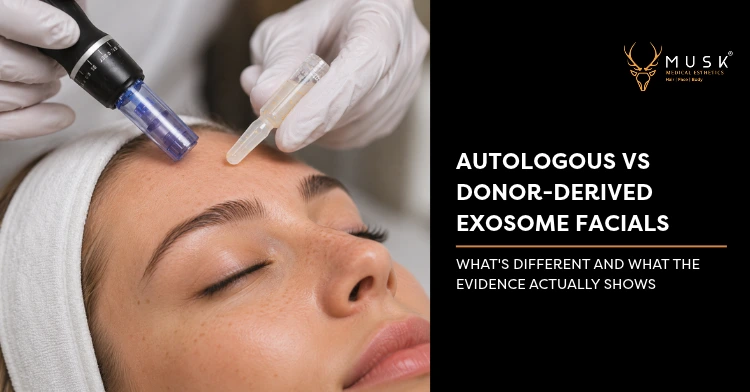
Autologous vs Donor-Derived Exosome Facials: What’s Different and What the Evidence Actually Shows
 By Pooja Sharma
Introduction
Exosome facial is now used as an umbrella term for treatments that can be biologically and legally very different. One clinic may mean a preparation made from your own platelet-rich plasma. Another may mean a manufactured product containing extracellular vesicles from cultured donor cells. Others may use plant-derived or synthetic vesicle products.
That distinction matters because source, processing, route of application, regulatory status and evidence are not interchangeable. In May 2026, India's drug regulator also clarified that injectable preparations do not fall under the definition of cosmetics, making the route of use an important question for anyone considering an exosome treatment.
Key Takeaways
- Autologous and Donor-Derived Are Not the Same: Autologous approaches start with your own blood or PRP; donor-derived products are manufactured from material produced by cultured donor cells.
- Exosomes Are Not Stem Cells: They are extracellular vesicles released by cells and carry proteins, lipids and nucleic-acid signals.
- No Exosome Product Is FDA-Approved: The FDA continues to state that there are currently no FDA-approved exosome products.
- The Best Human Evidence Is Still Small: Recent facial studies commonly involve about 10 to 30 participants, short follow-up and mixed delivery methods.
- Donor Exosomes Have Not Been Proven Better Than PRP: A 15-person split-face study found both donor exosomes and PRP improved photoaged skin without a significant difference between them.
- India's Route of Use Matters: CDSCO states that injectable preparations are not cosmetics and that cosmetics must not be used by injection in clinics.
- Ask About the Exact Product: Source, manufacturer, route, Indian regulatory status and product-specific evidence matter more than the word "exosome" on a menu.
What Is an Exosome Facial, and What Are Exosomes?
Exosomes are tiny extracellular vesicles that cells release as part of cell-to-cell communication. They can carry proteins, lipids and genetic material, which is why they are being studied in wound healing, skin ageing, pigmentation, scarring and hair research.
The term "exosome facial" is imprecise. It may mean a topical product used after microneedling or laser, a donor-cell vesicle preparation, or a PRP-based autologous approach. Some marketed products use plant-derived or engineered vesicles, so the name alone does not identify what you are receiving.
What Is an Autologous Exosome Facial?
Autologous means the starting biological material comes from you. In the MCT approach described in recent studies, blood is drawn, platelet-rich plasma is prepared and then exposed to controlled light and temperature before being used as an autologous PRP-based treatment.
A 2026 pilot enrolled 11 women, with 9 completing treatment. It reported improvement in an ultrasound skin-ageing marker and 77.8% patient-reported improvement, but the study was very small and two authors worked for the technology company.
A stronger 2026 randomised split-face study enrolled 28 adults with Fitzpatrick III to IV skin, most type IV. Photothermal-biomodulated PRP improved several wrinkle measurements more than standard PRP, while pigmentation, redness and biomechanical changes were similar. It studied processed PRP, not a bottled purified exosome product.
What Is a Donor-Derived Exosome Facial?
Donor-derived exosome products are prepared from extracellular vesicles produced by cells that are not the patient's own. In aesthetic research, a common source is cultured mesenchymal stem cells, such as adipose-derived cells.
A 2025 split-face trial in 15 people compared topical adipose stem cell-derived exosomes with PRP after radiofrequency microneedling. Both sides improved, and the study found no significant difference between treatments.
Autologous or Donor-Derived: How Do They Compare?
The two approaches differ in starting material, processing, route, evidence and regulatory questions.
| Aspect | Autologous PRP-Derived Approach | Donor-Derived Human-Cell Exosomes |
|---|---|---|
| Starting material | Your own blood or platelet-rich plasma | Extracellular vesicles produced from cultured donor cells |
| Blood draw | Yes | No |
| Preparation | Prepared for the individual patient; some systems use controlled preconditioning | Manufactured and packaged before treatment |
| What recent facial studies tested | Intradermal processed PRP in small pilot and randomised split-face studies | Mainly topical application alongside procedures such as RF microneedling |
| Evidence strength | Early; one 28-person randomised PRP comparison plus smaller pilot evidence | Early; small split-face and comparative studies |
| Consistency | Can vary with the patient and preparation process | Potentially more standardised, but depends on manufacturing quality |
| Regulatory question | Product/device classification and route need to be verified in India | Exact product, import status, classification and route need to be verified in India |
| Can one be called better? | Not from current evidence | Not from current evidence |
Bottom Line: The current literature does not justify ranking autologous or donor-derived exosome facials as universally superior. The exact product and delivery method matter more than the category name.
What Does the Evidence Actually Show?
The evidence suggests potential benefit, but certainty is much lower than many marketing claims imply.
A 2026 meta-analysis included 39 studies across skin and hair aesthetics and found an overall signal of improvement. Another review of 16 facial studies and 503 participants rated much of the evidence low or very low certainty because products, routes and study designs differed.
An Evidence Ladder for Exosome Facials
| Evidence Level | What We Have | What It Can Tell You |
|---|---|---|
| Large independent randomised trials | None identified for routine exosome facials | This is the major evidence gap |
| Systematic reviews and meta-analyses | Several 2026 reviews | Useful for the overall signal, but limited by mixed products and protocols |
| Small controlled or split-face trials | Often around 15 to 30 participants | Can compare approaches short term, but cannot settle long-term superiority |
| Single-arm pilots and case reports | Available for several products and autologous approaches | Can generate hypotheses, not prove broad effectiveness |
| Laboratory and animal studies | Extensive mechanistic research | Explains how vesicles might work, not how well a facial works in real patients |
The most honest answer to “do exosome facials work?” is therefore: some small human studies show short-term improvements, but product-specific evidence and long-term independent trials remain limited.
Are Exosome Facials Safe, and What Do Regulators Say?
Safety depends heavily on route. Topical use, procedure-assisted use and injection are not equivalent.
The U.S. FDA states that there are currently no FDA-approved exosome products. FDA has also published safety notifications after serious adverse events involving unapproved products marketed as containing exosomes.
In India, a CDSCO public notice dated 18 May 2026 states that products supplied as injectable preparations do not fall under the definition of cosmetics and that no cosmetic may be used as an injection by consumers, professionals or aesthetic clinics.
That notice should not be oversimplified into “all exosome facials are illegal.” Instead, it means a clinic in India should be able to explain what the product is classified as, whether it is being used topically or injected, and what regulatory documentation supports that route of use.
Most topical or procedure-assisted studies report mild short-term reactions, but reviews also document granulomas, tissue injury, allergic reactions and infection after some injected exosome products.
Exosome Facial, PRP or a Skin Booster: Which Fits My Skin?
PRP, exosome-based approaches and skin boosters are not interchangeable upgrades; they address different goals and have different evidence bases.
| Main Question | More Relevant Discussion | Why |
|---|---|---|
| I want an autologous option with a longer clinical history | PRP | Uses your own blood and has a broader evidence base across aesthetic and regenerative uses |
| I am specifically considering an exosome product | Product-specific exosome assessment | Source, route, manufacturer and regulatory status need to be checked |
| I mainly want hydration and smoother texture | Skin booster discussion | The problem may be skin quality rather than a regenerative-treatment question |
| I have acne scars or significant photoageing | Combination treatment planning | Microneedling, laser, PRP or other approaches may be more evidence-based depending on the scar or concern |
| I have melasma or pigmentation | Diagnosis-led pigment plan | Exosomes should not be sold as a stand-alone cure for melasma |
How Do I Check a Clinic's Exosome Claims?
Use a specific checklist before consenting to an exosome treatment.
- What is the treatment actually made from: my own blood, donor human cells, plant material or a synthetic vesicle?
- What is the exact product, brand and manufacturer, and can I see its documentation?
- How is it used: applied on intact skin, used after microneedling or laser, or injected?
- What is its regulatory status in India for this route and intended use?
- Which published human study tested this exact product or process?
- Who funded that study, how many people were included and how long were they followed?
- What result is realistic, by when, and what happens if I see no meaningful improvement?
- What are the known risks, and who will manage a reaction or complication?
Myth vs Fact: Exosome Facials
Myth: Exosomes Are Stem Cells
Fact: Exosomes are extracellular vesicles released by cells. They are not living stem cells.
Myth: Donor-Derived Exosomes Have Been Proven Better Than PRP
Fact: In the 15-person split-face trial comparing adipose stem cell-derived exosomes with PRP, both sides improved and no significant difference was found between the two treatments.
Myth: Autologous Means Proven
Fact: Using your own blood may remove some donor-source questions, but evidence for specific autologous exosome or preconditioned-PRP systems is still small and product-specific.
How Much Does an Exosome Facial Cost in Ahmedabad?
There is no reliable single Ahmedabad price without knowing the exact product, route and protocol.
A useful quotation should specify:
- Exact product or autologous preparation
- Manufacturer or processing system
- Topical, microneedling-assisted or injectable route
- Number and spacing of sessions
- Whether microneedling, laser or another procedure is included
Do not compare prices until you know whether the source, route and accompanying procedure are actually comparable. Musk Clinic can confirm personalised pricing once the exact protocol is established.
What Are the Risks and Who Should Avoid Treatment?
Risk depends on both the product and how it is delivered.
Possible concerns include temporary redness, swelling or irritation from the companion procedure, infection, allergic or inflammatory reactions, and product-specific complications. Published reviews have also reported more serious complications after some injected exosome products, including granulomas and tissue injury.
Treatment may need to be delayed with active infection or inflammatory disease, impaired healing, significant allergy history, or when pregnancy or breastfeeding safety data are inadequate. Patients with melasma or post-inflammatory hyperpigmentation should also discuss the delivery procedure separately.
What Does the Evidence Mean for Indian Skin?
There is not enough evidence to claim that either autologous or donor-derived exosome facials are proven safer or more effective specifically for Indian skin. The evidence base is still too small and product-specific.
A 2026 randomised study of photothermal-biomodulated PRP included 28 Thai participants with Fitzpatrick III to IV skin, mostly type IV. It supports further study in darker phototypes, but it cannot establish safety or effectiveness for every Indian patient or exosome product.
Donor-derived studies also include some participants up to Fitzpatrick IV, but samples remain small and evidence for Fitzpatrick V skin or active melasma is limited.
How Does Musk Clinic Approach an Exosome Consultation?
Consultation should begin with the skin concern and product documentation, not the trend label.
A VISIA Face Scan can document features such as texture, spots, pores, wrinkles and pigmentation as part of a baseline skin assessment. It does not prove that an exosome product is effective or establish its regulatory status, so those questions still need separate verification.
The Bottom Line
Autologous and donor-derived exosome facials are not interchangeable: one starts with your own PRP, while the other uses manufactured vesicles from cultured donor cells.
The evidence is promising but preliminary. Small trials show skin-quality improvements, while large independent trials and long-term product-specific safety data remain limited.
Before booking, ask what the product is made from, how it is applied, its Indian regulatory status, which human study supports it and who will manage a reaction. Those questions are more valuable than any claim that one exosome facial is “next generation.”
Frequently Asked Questions (FAQs)

Dr Pooja Sharma
- 5 Years of Experience