






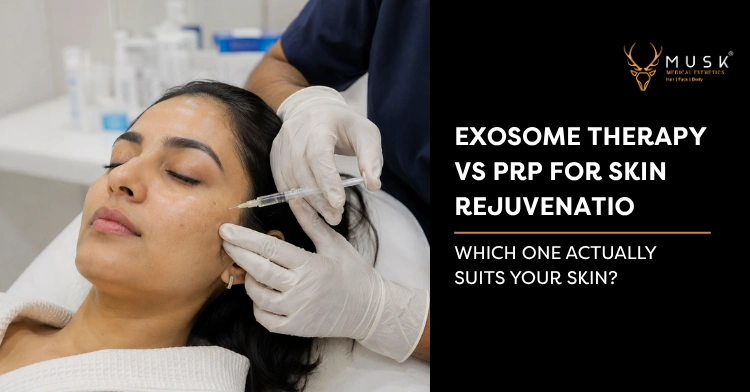
Exosome Therapy vs PRP for Skin Rejuvenation: Which One Actually Suits Your Skin?
 By Pooja Sharma
 PRP is the safer, evidence-rich first-line choice for most Indian patients seeking overall skin rejuvenation.
Exosome therapy is a stronger option when you need deeper repair - scars, significant photoaging, or accelerated healing after microneedling or lasers. For many patients, the right protocol combines both sequenced against your skin's actual biology rather than what's trending.
Every few years, regenerative treatment becomes the aesthetic industry's favourite word. Ten years ago, that word was PRP - often called the "vampire facial" after a celebrity made bloodied selfies famous. Today, the word is exosome, sold in some clinics as "the next generation of PRP," "PRP 2.0," or the treatment that will make PRP obsolete.
It's not that simple. Both therapies signal your skin to repair itself, but they do it with different biology, different evidence bases, and very different regulatory footing - especially in India, where exosome sourcing is still catching up with the marketing.
At Musk Clinic in Ahmedabad, the choice between them is treated as a clinical decision, not a menu pick - informed by VISIA-guided diagnostics and calibrated for Indian skin.
If you are between 28 and 50, dealing with early laxity, dull tone, post-acne scarring, or the tug of Ahmedabad's climate on your skin, this guide gives you the framework to choose - not the sales pitch.
Key Takeaways
- PRP uses your own blood; exosomes use nano-messengers from donor stem cells or platelets.
- PRP has 20+ years of clinical data. Exosomes are newer with limited long-term evidence.
- PRP suits mild-to-moderate ageing, dullness, and post-acne skin. Exosomes push harder on deep repair, scarring, and post-procedure recovery.
- On Indian skin (Fitzpatrick III-V), both are considered lower-pigmentation-risk than aggressive lasers.
- Exosomes are not yet FDA-approved for aesthetic use. In India, sourcing and regulation matter more than marketing claims.
- A VISIA-guided consult, not the trend cycle, should decide which one is right for you.
What is PRP therapy for skin rejuvenation?
Platelet-Rich Plasma (PRP) - sometimes called the "vampire facial" - is a treatment where a small amount of your own blood is drawn, spun in a centrifuge to concentrate on the platelets, and reintroduce into your skin via injection or microneedling.
Those concentrated platelets release growth factors - PDGF, TGF-β, VEGF, EGF - that stimulate collagen production, angiogenesis, and cellular repair.
Because PRP comes from your own body, it carries no risk of allergy or immune rejection. Dr. Anand Shah notes that in Musk Clinic consultations, this autologous nature is often the deciding factor for patients cautious about "foreign" biologics.
How PRP works on skin
Once activated in the dermis, platelets release their alpha-granules for over 5-10 days. The signaling proteins do specific jobs:
- PDGF (Platelet-Derived Growth Factor): drives fibroblast proliferation and collagen synthesis
- VEGF (Vascular Endothelial Growth Factor): encourages microcirculation, which contributes to skin radiance
- TGF-β (Transforming Growth Factor Beta): supports tissue remodeling and the skin's structural framework
- EGF (Epidermal Growth Factor): promotes epidermal turnover of dull, sun-damaged cells
What PRP typically treats
- Early fine lines, crow's feet, under-eye hollowing
- Overall dullness and uneven tone
- Post-acne texture and mild atrophic scarring
- Melasma-adjacent dullness (as an adjunct, not a standalone cure)
- Hair thinning at the scalp (a separate protocol)
What is exosome therapy for skin?
Exosome therapy uses tiny extracellular vesicles - 30 to 150 nanometers wide - that carry proteins, lipids, mRNA, and growth factors between cells. In aesthetic use, exosomes are typically derived from mesenchymal stem cells (MSCs), platelets, or plant sources, and applied topically after microneedling or fractional lasers.
Think of exosomes as the messengers that stem cells and platelets naturally use to communicate. Isolating those messengers alone - without the cells - is what makes exosome therapy attractive.
Why "cell-free" matters
This is the scientific distinction most patients don't hear clearly in a consultation. PRP delivers whole platelets that release signaling molecules over days. Exosomes are the signaling molecules themselves - pre-loaded, cell-free vesicles.
The practical implications:
Stability: exosomes are more stable than the cells that produce them
Immune profile: because there are no cells to reject, allergic response risk is theoretically lower (though not zero - sourcing still matters)
Precision payload: each vesicle carries a defined mix of mRNA, microRNA, cytokines, and proteins engineered to instruct fibroblasts, keratinocytes, and immune cells
Age-independence: unlike PRP, whose potency depends on your own cell health, an exosome formulation delivers the same instruction set regardless of how well your cells are ageing
How exosomes work on skin
Exosomes carry pre-loaded biological instructions. When they enter the skin - usually through microchannels created by microneedling - they can:
- Modulate inflammation via cytokine signaling
- Trigger fibroblast activity more directly than PRP in some in-vitro models
- Deliver mRNA and microRNA that influences collagen and elastin gene expression
- Support wound healing and post-procedure recovery
Exosomes are used for
- Moderate to advanced photoaging
- Deeper acne scarring
- Post-laser or post-microneedling recovery
- Melasma protocols (when paired with pigment-safe treatments)
- Skin priming before or after energy-based procedures
Exosome therapy vs PRP: Comparison
Factor | PRP | Exosome therapy |
Source | Your own blood (autologous) | Donor MSCs, platelets, or plant-derived (allogeneic) |
Active ingredient | Concentrated platelet growth factors | Nano-vesicles with proteins, lipids, mRNA, microRNA |
Cell content | Whole platelets | Cell-free vesicles only |
Consistency batch-to-batch | Varies with your own biology | Lab-standardised |
Evidence base | 20+ years, broad clinical use | 5-8 years in aesthetics; strong lab data, limited large trials |
Downtime | 1-3 days redness/mild swelling | 1-2 days; often less inflammation than PRP |
Sessions needed | 3-4, spaced 4-6 weeks | 2-4, spaced 3-4 weeks |
Onset of visible change | 4-8 weeks | 2-6 weeks (reported) |
Cost per session (India) | ₹5,000-₹15,000 | ₹15,000-₹40,000+ |
Blood draw | Required | Not Required |
Allergy / rejection risk | Effectively none | Low but non-zero (depends on sourcing) |
Regulatory status (India) | Established clinical use | Evolving; CDSCO oversight variable by product |
Regulatory status (US, for context) | Widely used | No FDA-approved aesthetic exosome product |
Best suited for | Overall rejuvenation, mild scarring | Deeper repair, scarring, post-procedure healing |
Why your PRP quality varies but exosomes don't
PRP is only as good as your blood on the day of treatment. Exosome formulations are laboratory-standardized, so what you receive in session one matches session five. This is a genuinely underdiscussed point in Indian clinics.
Your platelet count and growth-factor concentration are affected by:
- Age (platelet growth-factor content declines gradually after 40)
- Sleep quality in the 48 hours before the draw
- Hydration status Recent illness or systemic inflammation
- Nutritional status (iron, B12, vitamin D deficiencies are common in Indian patients)
- Anti-inflammatory medication use
- Smoking
In our Ahmedabad practice, our team occasionally sees patients whose first PRP session outperforms their second - often because life happens between sessions. Exosome formulations do not have this problem. If your clinic uses a certified product from a controlled lab, session-to-session consistency is one less variable to worry about.
The takeaway isn't "exosomes are always better." It's this: if your lifestyle is volatile, or if you are over 45 and want predictable results, that consistency factor deserves weight in your decision.
Which one is better for Indian skin (Fitzpatrick III-V)?
Which one is better for Indian skin (Fitzpatrick III-V)? For most Indian skin types, PRP remains the safer first-line regenerative treatment because it carries virtually zero risk of post-inflammatory hyperpigmentation. Exosomes are also considered pigment-safe but depend heavily on the product source and the delivery protocol.
The pigmentation question matters more here than in Western clinics. In Musk Clinic's Ahmedabad practice, Dr. Anand Shah frequently sees patients who developed PIH after aggressive laser resurfacing is done elsewhere.
Both PRP and exosomes are useful precisely because they rehabilitate skin without adding pigmentation trauma - but only when the underlying microneedling depth, needle count, and post-procedure care are calibrated for melanin-rich skin.
Indian-context factors that change the decision
- Ahmedabad climate: heat, dust, and hard water compromise the barrier - both PRP and exosomes help, but exosome anti-inflammatory signalling can be helpful in high-inflammation skin.
- Melasma prevalence: neither PRP nor exosomes treat melasma alone. They can support pigment-safe regimens but must not be positioned as a cure.
- Cost consciousness: an autologous PRP series often delivers 70-80% of the visible improvement of an exosome series at a fraction of the price for early-stage ageing.
How do PRP and exosomes work with microneedling?
Microneedling is not a competing treatment - it's the delivery system that makes both PRP and exosomes work harder. The micro-channels created by the needling device let large regenerative molecules reach the dermis, where they can influence collagen and elastin.
1. Microneedling with PRP
The pen or roller creates thousands of controlled micro-injuries in the epidermis. PRP is either applied topically before/during the needling or injected in a series of small doses across the treatment zone. The growth factors reach the papillary dermis, where fibroblasts respond by producing new collagen over the following 6-12 weeks.
This is the most popular combination in Indian clinics because it multiplies the benefit of both: microneedling alone triggers the wound-healing cascade; PRP amplifies it with your own growth factors.
2. Microneedling with exosomes
Same delivery mechanism, different payload. Because exosome vesicles are only 30-150 nanometres wide, they pass through microchannels with minimal resistance and reach deeper layers efficiently. Reported benefits when compared with microneedling + PRP:
- Less post-procedure inflammation (useful for patients with sensitive or reactive skin)
- Faster resolution of redness (often 24-48 hours vs 2-3 days for PRP)
- More consistent results in patients over 45
Which combination should you choose?
If cost matters and you're under 40 with mild-to-moderate concerns: microneedling + PRP. If you're over 45, have significant photoaging, or you've had aggressive laser recently: microneedling + exosomes.
If your goal is deep acne scar remodeling: either can work, often layered across sessions.
Post-laser and post-procedure recovery: where exosomes genuinely lead
One area where exosome therapy has a clear, evidence-supported edge over PRP is post-procedure recovery - particularly after fractional CO₂ laser, erbium resurfacing, radiofrequency microneedling, and other energy-based treatments.
These treatments deliberately damage the skin to trigger renewal. The trade-off is downtime: redness, warmth, oozing, crusting, sensitivity to light - and, in Indian skin, a real risk of post-inflammatory hyperpigmentation if inflammation isn't controlled quickly.
Exosomes' anti-inflammatory cytokines and pre-loaded mRNA instructions accelerate the healing phase in three ways:
- Faster resolution of erythema (redness)
- Improved barrier reconstitution (less trans-epidermal water loss)
- Lower risk of prolonged inflammation, which is the mechanism that triggers PIH in Fitzpatrick III-V skin
In Musk Clinic's practice, our team frequently pairs exosomes with fractional laser sessions specifically for patients who want laser-grade results but cannot afford the extended downtime - or the pigmentation risk - that comes with them.
This is not a claim that PRP can't be used as a post-laser. It can and often is. It's simply that exosomes appear to move the recovery curve faster, and in Indian skin that speed matters.
Choosing between PRP and exosome therapy
Your choice comes down to three things: how deep your skin concern is, what you can spend, and how comfortable you are with a newer treatment. Here's a simple way to think about it.
Match the treatment to your skin concern
- Mild concerns - dull skin, a few fine lines, slightly uneven texture → PRP is enough
- Moderate concerns - some acne scars, visible sun damage, early sagging → Either works. Exosomes may give faster results
- Deep concerns - pitted acne scars, heavy sun damage, older skin → Exosomes, often combined with laser
Match the treatment to your budget
- Under ₹40,000 → PRP series of 3-4 sessions
- ₹40,000 to ₹1,00,000 → Exosome sessions, or a mix of PRP and exosomes
- No fixed budget → A custom plan with lasers and regenerative therapy together
Match the treatment to your comfort level
- Prefer something with a long safety record → Choose PRP
- Comfortable with a newer treatment backed by strong lab research → Exosomes are a safe bet
The simple rule of thumb
- Under 40 mild concerns - start with PRP.
- Over 45 or dealing with deeper issues - consider exosomes.
- Unsure where you fit - book a VISIA scan first. The imaging tells you before the treatment is done.
The combination approach
The most sophisticated protocols don't pick one. A common Musk Clinic sequence for a patient with combined dullness and acne scarring:
- VISIA Face Scan baseline
- Two sessions of PRP with microneedling (weeks 0 and 4)
- One session of exosomes with microneedling (week 10)
- Maintenance PRP or exosomes every 6-12 months
What does exosome therapy or PRP cost in Ahmedabad?
In India, PRP for skin runs approximately ₹5,000-₹15,000 per session. Exosome therapy runs ₹15,000-₹40,000 per session, with premium sourced products going higher. Full protocols typically involve 3-4 sessions.
What drives the price
- Source of the exosome product - MSC-derived from a certified lab is priced very differently from generic imports
- Number of microchannels / needling depth - deeper protocols use more product
- Clinic overhead and expertise - a VISIA-guided, physician-supervised protocol is not the same as a beauty-clinic add-on
- Combination with other treatments - bundling with lasers, peels, or facials changes total cost
- Maintenance frequency
Why the source of your exosome product matters
Exosome therapy is only as safe and effective as the lab that made it. Unlike PRP, which is prepared from your own blood in front of you, exosome formulations are pre-manufactured - which means the entire safety and efficacy chain sits with the manufacturer, not the clinic.
Before you agree to an exosome session anywhere in India, ask your clinic these five questions:
What is the exact product name and manufacturer? A vague "we use imported exosomes" is not an answer.
What is the biological source? MSC-derived (umbilical, adipose, bone marrow), platelet-derived, or plant-based - each has different profiles.
Is there a certificate of analysis? Reputable manufacturers provide batch-specific documentation showing sterility, endotoxin levels, and vesicle concentration.
Has the product been screened for viruses and contaminants? This is standard for donor-derived biologics.
What is the storage protocol? Exosomes are sensitive to temperature; improper cold-chain handling degrades potency and can introduce contamination.
A clinic that can answer all five clearly is a clinic that has done its diligence. A clinic that deflects is a clinic to walk out of. This matters especially in India, where exosome regulation is still evolving and product sourcing varies dramatically between suppliers.
Are there risks or side effects with PRP and exosome therapy?
Both are considered at low risk when performed correctly. Both can cause temporary redness, swelling, mild bruising, and pinpoint bleeding. Exosome therapy carries an additional layer of sourcing-related risk that patients need to understand.
PRP risks
- Injection-site bruising and swelling (usually 1-3 days)
- Rare risk of infection at injection sites
- Temporary tenderness
- Very rare vascular occlusion if injected incorrectly around eyes or forehead
Exosome-specific risks
- Product sourcing variability - quality control differs between suppliers
- Delayed hypersensitivity reactions (rare but reported)
- Unknown long-term effects due to shorter clinical track record
- Potential contamination if the manufacturing chain is not certified
Who should avoid these treatments
- Active skin infection or open acne cysts in the treatment area
- Bleeding disorders or active anticoagulant use (relative contraindication for PRP)
- Pregnancy and breastfeeding
- History of keloid scarring (proceed with caution)
- Active autoimmune flare
- Recent isotretinoin use (typically wait 6 months)
When should you see a specialist instead of booking a treatment?
Book a diagnostic consultation, not a treatment, if you have persistent melasma, recurring cystic acne, unexplained diffuse skin dullness, or a history of poor healing. These often need medical management before - or instead of - regenerative aesthetics.
Both PRP and exosome therapy are rejuvenation treatments. They are not substitutes for treating underlying dermatological conditions. A patient whose real problem is untreated melasma or hormonal acne will be disappointed by either.
How Musk Clinic approaches exosome therapy and PRP
At Musk Clinic, regenerative aesthetics start with diagnosis, not with a menu. Every patient considering PRP or exosome therapy begins with a VISIA Face Scan - a multi-spectral imaging tool that quantifies wrinkles, pores, spots, UV damage, redness, and porphyrin activity.
That baseline lets Dr. Anand Shah's and his team decide whether your skin needs surface work (peels, medical facials), regenerative work (PRP, exosomes), or a combination.
For patients who choose PRP, the clinic offers it as a standalone microneedling protocol or bundled into the Twilight Facelift (Face PRP).
For patients whose skin needs the deeper signaling of exosomes, sourcing is non-negotiable - the clinic uses only products with verifiable manufacturing standards, batch-specific certificates of analysis, and controlled cold-chain handling. And for combination protocols, the sequencing is planned across the full year, not a single session.
Conclusion
Exosome therapy is not "better" than PRP, and PRP is not "outdated." They are different tools with different biology, different price points, and different levels of clinical maturity.
PRP is the smart, evidence-rich starting point for most Indian patients seeking overall skin rejuvenation. Exosomes make sense when the problem is deeper, when you're recovering skin from a more aggressive procedure, or when session-to-session consistency matters more than autologous purity.
The right choice comes from a proper diagnostic consult, not from what a treatment sounds like in a WhatsApp forward.
Frequently Asked Questions (FAQs)

Dr Pooja Sharma
- 5 Years of Experience