






 By Pooja Sharma
 You just had rhinoplasty - or you are about to. And right now, you probably have one big question on your mind: what is going to happen to my face for the next few weeks?
That uneasy feeling before recovery begins is completely normal. But here is the truth: most rhinoplasty patients describe the recovery as far easier than they imagined - once they knew what to expect. Anxiety almost always comes from not knowing. You fear the worst because you can't picture each stage.
This blog fixes that. We are going to walk you through rhinoplasty recovery week by week - from the moment you wake up after surgery to the day your nose fully settles into its final shape at the one -year mark. Every stage, every milestone, every "is this normal?" moment is covered right here.
By the end of this guide, you will feel prepared, informed, and calm about every phase of your healing journey. And if you are considering rhinoplasty at Musk Clinic in Ahmedabad, our specialist surgical team will walk through this entire timeline with you - personally - before you book a single thing.
Key Takeaways
- Total recovery time: 9 -12 months for the final, fully settled result.
- Presentable in public: Most patients feel confident going out by the end of Week 2.
- Back to Work:Desk jobs - within 7 -10 days. Physical jobs - 3 - 4 weeks.
- Exercise: Light walking from Week 1; gym from Week 6 only after clearance.
- The nasal tip is last: The tip takes the longest to refine - often up to 12 months.
- Splint removal: Day 7 - your first exciting glimpse of the new shape.
- Swelling is not linear: It fluctuates daily - good days and puffy days are both normal.
- Follow -up matters:Never skip post-op appointments - they protect your results.
Before the Clock Starts: How to Prepare for Recovery
A smooth recovery begins before you even get to the operating table. Here is how to set yourself up for success in the days leading up to surgery:
- Stop smoking:At least 2-4 weeks before surgery. Nicotine restricts blood flow and directly slows healing.
- Avoid blood thinners:Stop aspirin, ibuprofen, and certain supplements like fish oil and vitamin E as directed by your surgeon.
- Stock up at home:Saline nasal spray, cold packs, extra pillows, button-up shirts (no pullovers), easy -to -eat soft foods, and prescribed medications.
- Arrange help: You will need someone to drive you home and assist you for at least the first 24 -48 hours.
- Create your resting zone:Set up a comfortable, elevated sleeping position. A wedge pillow or a recliner works brilliantly.
Think of this prep phase as building the foundation of your recovery. The more organized you are before surgery, the calmer and smoother the first week will be.
Week 1: The Hardest Week - and Why It's Fine
Let's be honest - Week 1 is the most intense stage of rhinoplasty recovery. But intense does not mean unbearable. It means your body is working hard, and that is exactly what it should be doing.
Days 1 -3: Rest Is Your Only Job
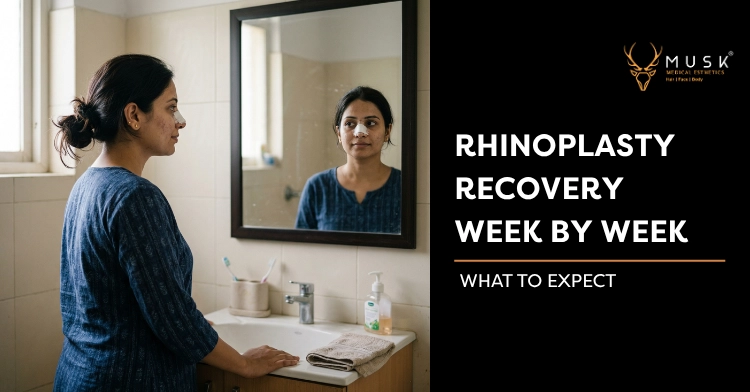
You will wake up from surgery with a nasal splint, some packing inside the nostrils, and a face that looks more swollen than you expected. Your eyes may look bruised. Your nose will feel blocked. This is completely normal.
- Swelling and bruising peak within the first 72 hours - that is your body's natural inflammatory response.
- Keep your head elevated at all times, even while sleeping. Use 2 -3 pillows or a wedge.
- Apply cold compresses to your cheeks - not directly on the nose - for the first 1 - 2 days
- Rest. No phone scrolling for hours, no errands, no bending or lifting.
- Take prescribed medications exactly as instructed.
Most patients find the discomfort manageable with medication - actual pain is less common than people expect. Congestion feels strange, but it is temporary.
Days 4 - 7: Starting to Turn a Corner
By Day 4, the worst of the swelling is usually plateaus. You may start to feel more alert and restless - which is a good sign but try not to overdo it. Short, gentle walks around the house are fine and help with circulation.
Day 7 brings one of the most exciting moments of recovery: your surgeon removes the splint. This is the first real look at your reshaped nose. Keep expectations grounded - the nose is still swollen, and the final result is months away - but for most patients, this moment already feels wonderful.
Week 2: The Turning Point
Week 2 is where recovery transforms from "surviving" to "progressing." The dramatic bruising around the eyes fades quickly - often from deep purple to yellow -green and then gone within a few days. The swelling softens noticeably.
- Return to desk work: If your job is not physical, most patients feel comfortable returning to work by Day 10 -12.
- Social activities:Light, low -key social events are fine. You will no longer look like you just had surgery - just slightly puffy.
- Glasses: Still avoid resting glasses or sunglasses on your nasal bridge. Switch to contacts or tape your frames to your forehead.
- Nasal rinses:Saline sprays and gentle rinses help with congestion and keep healing tissue moist.
One thing many patients notice in Week 2: the nose looks asymmetric or slightly uneven on some days. This is not a complication - it is called asymmetric healing, and it is a completely normal part of how the body recovers from surgery. It resolves on its own.
Weeks 3 -4: Confidence Returns
By the third and fourth week, you will feel like yourself again. Most of the visible bruising is gone. The nose continues to refine, especially along the bridge. The tip will still feel somewhat firm or puffy - this is completely normal and expected.
- Most patients attend social events, return to work fully, and feel comfortable in photos by Week 3.
- Low -impact exercise like brisk walking is generally fine from around Week 3.
- Avoid any activity that involves contact with your nose - no contact sports, no rough play, nothing that risks impact.
- Keep protecting the nose from sun exposure. UV rays can darken any healing skin and slow tissue recovery.
Emotionally, Weeks 3 - 4 tend to feel positive. Friends and colleagues may not even notice you have had work done - which is exactly the sign of a natural result taking shape.
Months 2 -3: The Refining Phase
This is when swelling starts to clear from the bridge of the nose, and the overall structure becomes much more defined. You can see the real shape emerging. Breathing improvements - if you had functional rhinoplasty - become fully noticeable at this stage.
The nasal tip is the last area to fully refine. It may still feel slightly firm or swollen. That is because the tip contains a high concentration of cartilage, skin, and soft tissue - all healing at their own pace. Trust the process.
- Light gym sessions: Resume low - impact exercise from around Month 2 if cleared by your surgeon.
- Glasses:You can cautiously start wearing lightweight glasses from around 6 weeks - always confirm with your surgeon first.
- Swelling fluctuations: Swelling naturally increases in warm weather, after salty meals, or after a late night. This is normal, not a setback.
Months 3 -6: Near -Final Shape
By Month 3 -6, most of the meaningful healing has happened. The bridge is sharp, the overall nose looks refined, and the majority of patients feel genuinely thrilled with their results at this stage.
Subtle swelling around the tip may persist - especially noticeable in bright lighting or photographs - but this resolves gradually. If you had septorhinoplasty for breathing correction, you will now be experiencing the full functional benefit of clearer nasal airways.
Your lifestyle should be fully back to normal. The only thing to continue avoiding is any trauma or direct impact to the nose - and good sun protection remains important for the skin.
Months 9 -12: The Final Reveal
This is the moment. The nasal tip fully settles. Scar tissue has matured and softened. Any lingering numbness or stiffness resolves. The nose is completely in harmony with your face - naturally, beautifully.
The one - year mark is when surgeons consider rhinoplasty results fully matured. The shape you see at 12 months is your final, permanent result. And for most patients, that result looks and feels completely natural - like a nose that was always meant to be there.
Rhinoplasty Recovery at a Glance
| Stage | What You'll Feel | What You Can Do | What to Avoid |
|---|---|---|---|
| Days 1–3 | Peak swelling, bruising around eyes, congestion, mild discomfort | Rest, head elevated, cold compress on cheeks | Blowing nose, bending over, any strenuous movement |
| Days 4–7 | Swelling at its highest, splint still on, breathing feels blocked | Short gentle walks indoors, light meals, stay hydrated | Touching nose, heavy lifting, sun exposure |
| Week 2 | Splint removed, bruising fades, nose shape emerges | Return to desk work, light social activities | Exercise, glasses on the bridge, dusty environments |
| Weeks 3–4 | Most bruising gone, nose more defined, tip still puffy | Resume most daily activities, | Contact sports, heavy lifting |
| Months 2–3 | Visible improvement, tip softening, breathing improving | Light gym (no contact), resume normal routines | Glasses resting on bridge, direct sunburn on nose |
| Months 3–6 | Near-final shape, bridge defined, subtle refinement ongoing | Full normal lifestyle restored | High-impact nose contact |
| Months 9–12 | Complete healing, final result visible, tip fully settled | Everything - results are fully yours now | - |
The Golden Rules of Rhinoplasty Recovery
Follow these and you give yourself the best possible chance of a smooth, complication -free result:
- Keep your head elevated for the first 3 -4 weeks - even during sleep.
- Never blow your nose for the first 3 weeks. If you need to sneeze, do it through your mouth.
- No glasses on the nasal bridge for at least 6 weeks.
- Apply SPF 30+ on your nose when going outdoors from Week 2 onwards.
- Stay well hydrated and eat anti-inflammatory foods - rich in vitamin C, zinc, and protein.
- Absolutely no smoking. It cuts oxygen supply to healing tissue and can ruin your results.
- Never miss a follow-up appointment - your surgeon needs to see your nose healing correctly.
- Be patient with swelling. Good days and puffy days will alternate - both are completely normal.
Warning Signs: When to Call Your Surgeon
Recovery is generally smooth and predictable. But contact your clinic immediately if you notice:
 Sudden, severe pain that worsens instead of improving over the first week
Heavy or uncontrolled bleeding from the nose that does not stop with gentle pressure
Signs of infection - increasing redness, heat, pus, or fever
Significant asymmetry or structural change after a bump or accidental impact
Breathing suddenly becoming much more restricted after Week 2
These situations are rare - but knowing them means you act fast if needed, and fast action protects your final result.
Why Musk Clinic Is the Right Partner for Your Recovery
At Musk Clinic, we understand that rhinoplasty recovery is not just a medical process - it is an emotional one too. That is why our specialist team does not just perform your surgery and send you home with a leaflet.
We provide a structured, personalized post -operative care protocol that covers every stage of your recovery journey - from pre -surgery preparation to your Month 12 final follow -up. Our team of specialists uses USFDA -approved technologies and follows international surgical protocols to ensure both your safety and your outcome are held to the highest standard.
With 1,000+ Google Reviews, a 4.9/5 rating on Justdial, and 17,000+ happy patients across all our aesthetic services, Musk Clinic has built a track record that speaks for itself.
Beyond rhinoplasty, our cosmetic surgery portfolio includes Blepharoplasty, Mini Facelift, Comprehensive Facelift, Ear Correction, Orthognathic Surgery, and Cleft Lip & Palate Surgery. And for patients who want to complement their surgical results with non -invasive treatments, we offer Dermal Fillers, Botox, Thread Lift, Liquid Face Lift, and a full range of expert Medical Facials - all under one roof.
Conclusion
Rhinoplasty recovery is a journey - not a single event. Yes, the first week demands patience. Yes, you will have days where the swelling frustrates you. But week by week, the changes are real, the progress is steady, and the destination is a nose that looks natural, feels right, and lasts a lifetime.
The key is simple: follow your care plan, protect the nose, attend every follow-up, and give the process the time it deserves. Your surgeon has done their part. Now recovery is the one place where your commitment directly shapes your results.
At Musk Clinic, our team of specialists guides you through every single stage - with expert care, honest communication, and a genuine commitment to your outcome.
Frequently Asked Questions (FAQs)

Dr Pooja Sharma
- 5 Years of Experience