






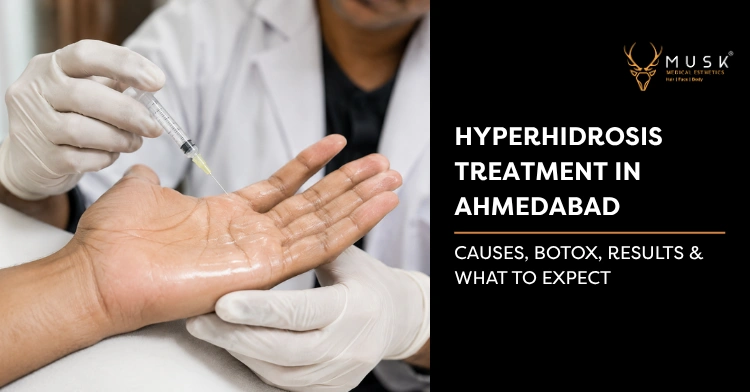
Hyperhidrosis Treatment in Ahmedabad: Causes, Botox, Results & What to Expect
 By Pooja Sharma
 Hyperhidrosis treatment in Ahmedabad most commonly use botulinum toxin (Botox) injections to temporarily block the nerve signals that trigger overactive sweat glands.
A single session takes 20-40 minutes, delivers visible dryness in about a week, and controls sweating for 4-9 months on average, with costs per treated area.
If your palms leave watermarks on paper, if your shirt shows underarm patches before a meeting even starts, or if you have quietly stopped shaking hands - you are not "just a heavy sweater." You may be living with hyperhidrosis, a diagnosable medical condition that affects one to three out of every hundred adults, and one that Ahmedabad's 42°C summers make impossible to hide.
The frustrating truth is that most people with hyperhidrosis haven't been diagnosed for a decade.
They try clinical antiperspirants, change deodorant brands, avoid silk shirts, and blame themselves. This guide breaks down what hyperhidrosis is, how Botox works to control it, what a real treatment session looks like at Musk Clinic, and how to decide if it's the right option for you.
Key Takeaways
- Hyperhidrosis is a medical condition - not just heavy sweating - that affects roughly 1-3% of adults and often begins in their teens or twenties.
- Botulinum toxin (Botox) injections are the most evidence-backed non-surgical treatment for underarm, palm, sole, and facial sweating.
- Results usually appear within 3-7 days, peak at 2 weeks, and last 4-9 months per session.
- Ahmedabad's dry heat and humid monsoons amplify the social and professional impact - but heat sensitivity alone isn't hyperhidrosis.
- Botox costs for hyperhidrosis in Ahmedabad typically range from ₹18,000 to ₹45,000 per area, driven by units used and brand of toxin.
- The treatment is safe for Indian skin (Fitzpatrick III-V) with minimal pigmentation risk, since needles are superficial.
- A specialist consultation - including a Minor's starch-iodine test to map sweat zones - is what separates guesswork from a precise, cost-efficient session.
What is Hyperhidrosis, and how is it different from normal sweating?
Hyperhidrosis is excessive sweating that goes beyond what your body needs for temperature regulation - it happens even at rest, in air-conditioning, or when you are not physically stressed. In clinical terms, it's the sweat glands and their nerve signals firing on overdrive.
Normal sweating is a controlled response to heat, exercise, or emotional stress. Hyperhidrosis is often disproportionate: soaked underarms in a cool room, dripping palms during a normal conversation, or beads of sweat on the forehead during a job interview that feels like they might never stop.
At Musk Clinic, Dr. Anand Shah's team commonly sees patients who have spent years assuming their sweating is a personality flaw or a hygiene problem. It is neither. It is a physiological pattern of the autonomic nervous system - and it responds well to treatment.
What causes excessive sweat? Primary vs secondary hyperhidrosis
There are two clinical categories and knowing which one you have determined whether Botox is appropriate.
- Primary focal hyperhidrosis affects specific areas - most often underarms, palms, soles, or face - and typically starts in childhood or adolescence. It has no underlying medical causes. It's thought to involve an inherited overactivity of the sympathetic nerves that control sweat glands. Roughly two-thirds of patients have a family member with the same pattern.
- Secondary generalized hyperhidrosis is triggered by another condition. Common culprits include thyroid disorders (particularly hyperthyroidism), diabetes, menopause, certain medications (SSRIs, some blood pressure drugs), infections, and - rarely - lymphoma or other systemic diseases. It usually affects the whole body, often includes night sweats, and typically begins in adulthood.
- Botox is the go-to treatment for primary focal hyperhidrosis. For secondary hyperhidrosis, the underlying cause must be identified and treated first - which is why a proper diagnostic consultation matters more than a quick injection appointment.
Feature | Primary Focal | Secondary Generalized |
Age of onset | Teens / 20s | Any age, often adulthood |
Areas affected | Localized (armpits, palms, soles, face) | Whole body |
Night sweats | Rare | Common |
Family history | Often yes | Often no |
Underlying cause | None identified | Thyroid, diabetes, meds, infection |
Best treated with | Botox, topicals, iontophoresis | Treating the root cause |
How do you know if you have hyperhidrosis? A self-assessment
If you check three or more of the following, a specialist consultation is worth the time:
- Your sweating is visible through clothing on most days, even in cool environments.
- It started before the age of 25.
- It happens on both sides of your body equally (both palms, both underarms).
- It stops when you are asleep.
- It's interfering at least once with work, relationships, or activities you used to enjoy.
- You've tried two or more clinical-strength antiperspirants without meaningful relief.
- At least one close relative has the same issue.
This is a screening framework, not a diagnosis. But if your answer is yes to three or more, the pattern is consistent with primary focal hyperhidrosis - and treatment options open considerably.
How does Botox treat hyperhidrosis?
Botox works by temporarily blocking acetylcholine, the neurotransmitter that tells sweat glands to activate. When the signal is blocked, the gland is present but idle - you produce dramatically less sweat in the treated area for the duration of the drug's effect.
The mechanism is the same one used in aesthetic Botox for wrinkles, but the target is different. Instead of muscles, the toxin is injected just under the skin to reach the small nerve endings that innervate eccrine sweat glands.
Botox for hyperhidrosis is delivered in dozens of tiny, superficial injections spaced roughly 1-2 cm apart across the treated area.
Botox for underarm sweating has been approved by the US FDA since 2004. For palms, soles, and face, it is used off label but is supported by well-established clinical evidence and international dermatology guidelines.
Which body areas can Botox treat for sweating?
The four most treated areas are underarms (axillae), palms, soles, and face/scalp - each with slightly different technique and dosing.
- Underarms. The most common request, typically 50 units of Botox per side (100 units total). Highest response rate, longest results, near painless with a fine needle.
- Palms (palmar hyperhidrosis). Uses higher doses (around 100 units per palm). Injections can be uncomfortable, so we typically pair the session with a topical an aesthetic cream, ice, or a nerve block for sensitive patients. Occasional transient weakness in fine hand movements is possible but uncommon.
- Soles (plantar hyperhidrosis). Similar dosing to palms. Injections are more painful because of thick, keratinized skin - a nerve block is often used. Results tend to last a little less than underarm treatment because deeper glands are harder to reach.
- Face and scalp (craniofacial hyperhidrosis). Lower doses used, with careful placement to avoid affecting the expression of muscles. Particularly useful for people whose foreheads drip through makeup, kajal, or during weddings and formal events. Groin folds and under-breast folds can also be treated in select cases where topical management has failed and where lifestyle impact is significant.
What happens during a Botox hyperhidrosis session at a clinic in Ahmedabad?
A well-run session takes 20-40 minutes for underarms and 40-60 minutes for palms or soles. Nothing about it should feel rushed - precise mapping is what separates a good result from a mediocre one.
Here is what to expect, step by step:
- Consultation and diagnosis (Day 0). The doctor reviews your medical history, medications, family history, and pattern of sweating. Thyroid function may be checked if secondary hyperhidrosis is suspected. Photographs are taken for baseline reference.
- Minor's starch-iodine test. An iodine solution is painted on the treatment area and dusted with starch. Where sweat is active, the starch turns dark purple - creating a precise sweat map. This step is skipped by clinics that rush treatments; at Musk Clinic, our team considers it essential for accurate dosing.
- Topical numbing. Lidocaine cream is applied for 20-30 minutes. For palms and soles, ice packs or a nerve block may be used.
- Injections. Using a very fine 30G or 32G needle, tiny volumes of diluted Botox are injected at 1-2 cm intervals across the mapped area. Each injection is superficial - into the layer just below the skin - so the sensation is more like a pinprick than a deep injection.
- Post-session care. No dressing is needed. You can drive home, return to work, and shower normally. Avoid intense heat, saunas, and heavy exercise for 24 hours. Avoid rubbing or massaging the treated area for 4 hours to keep the toxin localized.
What results and recovery should you expect?
You will usually notice reduced sweating within 3-7 days, with peak effect at 2 weeks. Results then remain stable for 4-9 months, depending on your metabol
ism, the area treated, and the dose delivered. Here's a realistic timeline:
Timepoint | What you'll notice |
Day 1-2 | Minor redness, occasional bruising, sweating unchanged |
Day 3-7 | Noticeable reduction begins |
Week 2 | Peak dryness - best time to judge results |
Month 4-6 | Slow, gradual return of sweating |
Month 6-9 | Time to consider re-treatment |
Most patients report an 80-90% reduction in sweating in the treated area. Complete absence of sweat is not the goal - some baseline moisture is normal and desirable for skin health.
Repeat sessions maintain the effect. Some people find that after several rounds of treatment; they can space sessions further apart.
How much does hyperhidrosis Botox cost in Ahmedabad?
In Ahmedabad, Botox for hyperhidrosis typically ranges from ₹18,000 to ₹45,000 per area treated, with underarms at the lower end and both palms or both soles at the higher end.
Cost is driven by five factors:
- Brand of botulinum toxin used. Botox (Allergan), Dysport (Ipsen), and Xeomin (Merz) all work - pricing varies. Genuine, cold-chain-maintained products from a reputable clinic will always cost more than counterfeit or diluted alternatives circulating in unregulated setups.
- Units are required. Underarms need 100 units' total. Both palms need ~200 units. Both soles need ~200 units. Larger patients and heavier sweaters may need slightly more.
- Clinic expertise and setup. A clinic with a full diagnostic workup, sterile injection area, and experienced injectors will price higher than a walk-in beauty salon offering "Botox packages" - and the difference in safety and outcome justifies it.
- Add-ons. Minor starch-iodine mapping, nerve blocks for palms/soles, and follow-up review appointments may be bundled or itemized.
- Number of areas. Combined underarm + palm sessions often come with a small, bundled discount.
At Musk Clinic, we quote transparently after the consultation because a fair price depends on the exact units your body needs - not a headline number designed to get you through the door.
What are the risks and side effects?
Botox for hyperhidrosis has a well-established safety record, but every medical intervention carries a risk profile. Being honest about them is what allows an informed decision.
Common and short-lived:
- Minor bruising at injection sites (resolves in 3-5 days)
- Mild soreness or tenderness for a day
- Small red bumps at the needle points, gone within hours
- Occasional headache after facial or scalp treatment
Less common:
- Transient, mild weakness in grip strength after palm injections (usually 1-3 weeks). This matters for musicians, surgeons, and people whose work depends on fine hand control - worth discussing at consultation.
- Compensatory sweating: rare with Botox, unlike surgical sympathectomy. When it occurs, it's mild and localized.
- Flu-like symptoms for 24 hours in a small subset of patients.
Rare:
- Allergic reaction to the toxin or albumin carrier
- Muscle weakness beyond the treatment area (very rare with correct dosing)
Not applicable in properly done treatment:
Skin pigmentation issues. Because the needle is superficial and doesn't cause the kind of thermal or inflammatory damage that triggers post-inflammatory hyperpigmentation (PIH), Botox for hyperhidrosis is a safe choice for Fitzpatrick III-V Indian skin - a genuine advantage over some laser-based sweat treatments that carry higher pigmentation risk.
Who should not have Botox for hyperhidrosis?
Botox is not appropriate for everyone. It should be avoided or postponed if you:
- Are pregnant or breastfeeding
- Have a neuromuscular disorder such as myasthenia gravis, Lambert-Eaton syndrome, or ALS
- Have an active skin infection or open lesion at the injection site
- Are on aminoglycoside antibiotics (they can amplify Botox effect)
- Have a known allergy to botulinum toxin or its excipients
- Have generalized sweating suggesting an underlying medical cause that hasn't been worked up
If your sweating started suddenly in adulthood, only affects one side of the body, or is accompanied by weight loss, night sweats, or fever, do not start with a cosmetic clinic. Start with a physician who can rule out thyroid disease, infection, or other systemic conditions first.
When should you see a specialist for excessive sweating?
Consider a specialist consultation if any of the following apply:
- Sweating interferes with your work, clothing choices, or social confidence
- Clinical-strength antiperspirants (aluminum chloride 15-20%) haven't helped after 4-6 weeks
- You are avoiding activities you used to enjoy
- You are spending significant money on replacement clothing, dry-cleaning, or grip aids
- The sweating started or changed recently, particularly in adulthood
The consultation cost is small compared to years of quietly managing a treatable condition. And even if Botox turns out not to be right for you, the assessment often reveals a simpler solution - an underlying deficiency, a medication side effect, or a topical protocol that hasn't been tried properly.
Musk Clinic approach to hyperhidrosis
At Musk Clinic, Ahmedabad, hyperhidrosis is treated as a medical condition first and an aesthetic concern second.
Every consultation begins with a proper history and, where indicated, targeted blood work to rule out secondary causes. The Minor's starch-iodine mapping is standard - not an optional extra - because it turns treatment from an estimation into a precise, unit-efficient plan.
Dr. Anand B. Shah and the clinical team use USFDA-approved botulinum toxin brands, delivered in a sterile environment with the same protocols followed at international dermatology centers.
For patients whose sweating is limited to specific triggers (weddings, exams, performances), we also discuss shorter-term alternatives and combination strategies. The goal is honest, individualized advice - not upselling a longer treatment plan than your body needs.
Conclusion
Hyperhidrosis is not a personality trait, a hygiene issue, or something you must accept.
It's a medical condition with a well-understood treatment pathway, and Botox is currently the most reliable non-surgical option for the focal patterns that affect most patients.
If sweating has been shaping your daily choices - what you wear, whom you shake hands with, which meetings you dread - a properly conducted consultation is the single most useful hour you can spend on it.
Frequently Asked Questions (FAQs)

Dr Pooja Sharma
- 5 Years of Experience