






 By Dr. Anand Shah
 Introduction
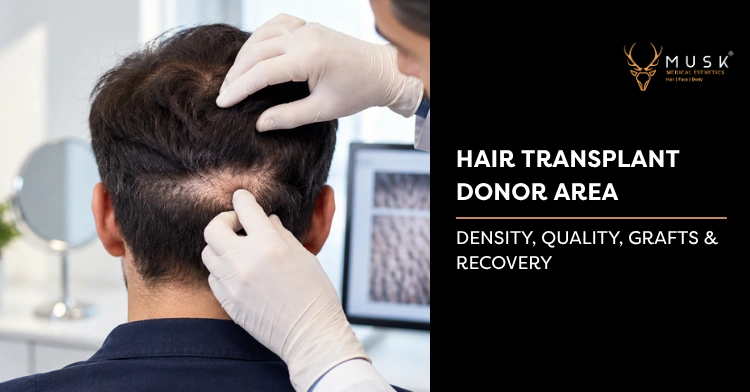
Your hair transplant donor area is the limited supply of follicles available for transplantation, usually from the back and sides of the scalp. Its density, hair thickness, follicular-unit quality, stability and safe harvesting capacity help determine how many grafts can be transplanted without unnecessarily thinning the donor region.
A good hair transplant plan therefore does not begin by asking, “How many grafts can we implant?” It begins by asking, “How many grafts can the donor area safely provide now while preserving enough hair for the future?”
Patients often focus on the bald or thinning area they want to restore. Surgeons have to look just as carefully at the hair that will be left behind.
Unlike an unlimited resource, donor follicles cannot simply be replaced after they are harvested. Standard hair transplantation moves follicular units from one area to another, which means long-term planning matters as much as the number of grafts used in the first procedure. Research on hair transplantation consistently identifies donor density, hair characteristics and donor availability as important parts of candidate assessment and surgical planning.
Understanding your donor area helps answer four important questions: Do you have enough hair for transplantation? How much can be safely harvested? How much visual coverage can those grafts create? And what should the donor area look like during recovery?
Key Takeaways
- Donor hair is finite: Extracted follicular units do not normally regenerate in the original extraction site.
- Density is only one factor: Hair calibre, hairs per follicular unit and future hair loss also influence transplant potential.
- More grafts are not always better: Safe donor preservation is more important than reaching an arbitrary graft number.
- Indian donor characteristics vary: An Indian study reported an average scalp density of 78.2 follicular units/cm², but individual variation was substantial.
- Overharvesting can create visible thinning: Poor extraction planning may leave a patchy or depleted donor area.
- FUE recovery is usually relatively quick: Small extraction sites commonly heal over the early postoperative period, although redness and sensitivity can persist longer.
- Future planning matters: Donor reserves should account for possible progression of androgenetic alopecia and future procedures.
What is the Donor Area in a Hair Transplant?
The donor area is the region from which healthy follicular units are harvested and transferred to thinning or bald areas. For most scalp hair transplants, this means selected parts of the back and sides of the scalp.
These regions are often preferred because follicles within an appropriately selected donor zone tend to retain more of their original characteristics after transplantation. This principle, commonly called donor dominance, underpins modern hair restoration surgery.
However, the entire back and sides of the head should not automatically be considered permanent donor hair.
Research in Indian men has shown considerable variation in the dimensions and stability of the safe donor area. A study involving 681 Indian men concluded that there is no single clearly defined donor zone that fits every patient and recommended conservative donor selection.
That is why donor mapping should consider both where follicles are taken from and how much hair is removed from each region.
How Do Doctors Check Hair Transplant Donor Area Density?
Donor density is commonly assessed by measuring the number of follicular units and hairs within a defined area of scalp, usually expressed per square centimetre.
A follicular unit is a naturally occurring group that may contain one, two, three or sometimes more hairs. This distinction matters because 2,000 follicular units do not necessarily equal 2,000 individual hairs.
Published clinical references describe mid-occipital donor densities around 65 to 85 follicular units per cm² in many patients, although individual values can fall above or below this range.
Importantly, Indian-specific research found a mean scalp density of approximately 78.2 follicular units/cm² among 580 male patients studied for safe donor-zone assessment.
These figures are useful population references, but they should not be treated as a universal pass-or-fail number.
What Does a Donor Density Measurement Actually Tell You?
A surgeon is generally trying to understand:
- How many follicular units exist in each donor zone
- How evenly density is distributed
- Whether there is miniaturisation within the proposed donor region
- How much density can remain after harvesting
- Whether previous transplants have already reduced the reserve
- Whether future hair loss could expose areas currently assumed to be stable
A high starting density can provide more flexibility, but safe extraction planning is still required even in a dense donor area.
Does Hair Quality Matter as Much as Donor Density?
Yes. Two patients with similar follicular-unit counts can achieve different visual coverage because the quality and characteristics of their donor hair are different.
Hair calibre is particularly important.
Thicker hair shafts occupy more visual space than finer hairs. Published hair-transplant literature notes that greater shaft diameter can provide more surface coverage, which means fewer thick hairs may sometimes create better visual density than the same number of very fine hairs.
Doctors may therefore assess:
Donor Characteristic | Why It Matters |
Follicular-unit density | Helps estimate the available donor reserve |
Hair shaft thickness | Thicker hair can create greater visual coverage |
Hairs per follicular unit | Multi-hair grafts can contribute more volume |
Hair curl or wave | Can influence the appearance of coverage |
Hair-to-scalp contrast | Lower contrast may make thinning less noticeable |
Miniaturisation | May indicate that some donor hair is not as stable as expected |
Donor distribution | Determines whether harvesting can be spread safely |
Bottom Line: A donor area should not be judged simply by how thick it looks in the mirror. Proper assessment considers both the number and the characteristics of the follicles available.
How Many Grafts Can a Donor Area Provide?
There is no universal number of grafts that every donor area can safely provide.
The available lifetime supply depends on starting density, donor-zone size, hair calibre, follicular-unit composition, previous harvesting and the expected progression of hair loss.
One survey of experienced hair transplant surgeons estimated approximately 4,200 to 7,900 potentially harvestable follicular units across different hypothetical patients, depending on donor density and the expected severity of future male pattern baldness. The authors emphasised that donor follicles are finite and that overly aggressive hairline or density goals can create long-term limitations.
Those figures are useful for understanding the concept of donor limitation. They are not a personalised graft estimate.
For an individual patient, graft planning should answer three questions:
- How many grafts are required now?
- How many can be harvested safely now?
- How many should remain available if hair loss progresses?
This is especially important for younger patients or anyone with extensive androgenetic alopecia.
Why is the Safe Donor Area Different for Every Patient?
The safe donor area is the region surgeons expect to remain relatively stable despite the progression of pattern hair loss. Its boundaries are not identical in every person.
This is particularly relevant in Indian patients.
A study of 681 Indian men aged 50 to 55 with androgenetic alopecia found meaningful variation in occipital donor patterns. More than one-fifth of the participants did not fit neatly within commonly used standard safe-donor-area criteria. The authors recommended conservative selection and avoidance of overharvesting.
Factors that may influence donor-zone planning include:
- Current Norwood pattern
- Family history
- Age
- Diffuse thinning
- Retrograde alopecia
- Miniaturisation at donor margins
- Previous hair transplant procedures
- Scarring
- Expected future progression
This is one reason a photograph alone cannot always determine a reliable graft count.
What Is Donor Area Overharvesting?
Donor overharvesting occurs when too many follicular units are removed, or when they are removed too heavily from a limited region, leaving visible thinning, patchiness or an unnatural donor appearance.
Hair transplant complications associated with the donor region can include donor depletion, altered pigmentation, scarring, cyst formation and other healing problems. A 2026 review of FUE complications highlighted both patient-related and technical factors, including follicular-unit density and surgical technique.
The key issue is distribution.
Removing a large graft count is not automatically unsafe, and removing a smaller number is not automatically safe. What matters is:
- Starting density
- Size of the usable donor zone
- Extraction pattern
- Punch size
- Follicular spacing
- Existing miniaturisation
- Previous extraction
- Future donor requirements
Why “Maximum Grafts” Should Not Be the Main Goal
Hair transplantation should be planned around maximum long-term cosmetic value, not simply the largest graft number possible in one sitting.
A patient who uses too much donor supply for an extremely dense frontal area may have limited options later if hair loss progresses through the mid-scalp or crown.
Conservative graft allocation can therefore be more valuable than aggressive harvesting.
Do Donor Hairs Grow Back After FUE?
The follicular units successfully removed during conventional FUE are relocated rather than regenerated, so the same extracted follicles are not expected to grow again from their original donor sites.
The remaining unharvested follicles continue growing, which is why a carefully harvested donor area can still appear visually dense once the hair grows and the scalp heals.
Hair-transplant literature identifies limited donor availability and reduced donor density as fundamental limitations of conventional follicular-unit harvesting.
This distinction is important:
Donor-area recovery does not mean that every extracted follicle grows back.
It means that:
- Extraction sites heal
- Redness settles
- Remaining hairs continue growing
- Temporary postoperative shedding may recover
- Surrounding hair provides visual coverage
This is why protecting the donor reserve during the first transplant matters.
What Does Hair Transplant Donor Area Recovery Look Like?
After FUE, the donor area usually passes through an early healing period involving small extraction points, mild redness, tenderness or crusting.
Musk Clinic’s existing hair-transplant guidance notes that donor and recipient areas generally undergo their main early healing over approximately 7 to 10 days, although individual recovery can differ.
A recent systematic review of FUE donor-site healing also found that postoperative wound care remains important, with early care associated with a lower risk of issues such as folliculitis.
Typical Donor Area Recovery Timeline
Stage | What You May Notice |
First 1–3 days | Redness, tenderness and visible extraction points |
Days 4–7 | Small crusts begin settling as healing progresses |
Around 7–10 days | Many extraction sites become much less noticeable |
Following weeks | Residual redness or sensitivity gradually settles |
Longer term | Remaining donor hair grows and helps restore visual coverage |
Recovery varies according to the number of grafts harvested, technique, skin response and postoperative care.
Persistent increasing pain, discharge, marked swelling, worsening redness or other unusual symptoms should be assessed by the treating medical team rather than managed through internet advice alone.
For a broader look at the postoperative process, Musk Clinic's existing hair transplant timeline explains what patients may notice during different stages of healing and growth.
How Can You Tell If You Have a Strong Donor Area?
A strong donor area is not defined by one number. It is a combination of adequate density, stable follicles, favourable hair characteristics and sufficient long-term reserve.
Use this checklist as a discussion guide rather than a self-diagnosis tool.
Donor Area Assessment Checklist
Ask your surgeon:
- Has follicular-unit density been measured rather than visually estimated?
- Is there miniaturisation within the proposed donor zone?
- How many hairs are present in the average follicular unit?
- What is the average hair calibre?
- Which parts of the donor zone will be harvested?
- How will extraction be distributed?
- How much donor density should remain afterwards?
- Is future hair-loss progression being considered?
- How many grafts may remain available for a later procedure?
- Has previous surgery affected donor capacity?
- Are scalp-only grafts sufficient, or would expectations need adjustment?
A credible donor assessment should sometimes lead to lower graft recommendations, not automatically higher ones.
That can be a sign of appropriate long-term planning rather than a limitation in treatment.
What If Your Donor Area Is Weak or Limited?
A limited donor area does not automatically mean that no treatment is possible. It may mean that the strategy needs to become more conservative.
Possible approaches can include:
Prioritising The Hairline
For extensive hair loss, restoring the frontal region may create more visual impact than trying to cover every thinning area at low density.
Reducing The Planned Density
A smaller number of strategically distributed grafts may create a more sustainable result.
Staging Treatment
A surgeon may recommend preserving part of the donor reserve rather than attempting complete coverage in one procedure.
Preserving Existing Hair
Appropriate medical treatment may be discussed when clinically suitable to help manage continuing loss of native hair.
Considering Alternative Donor Sources
Selected patients may be assessed for beard or other body-hair grafts when scalp donor supply is inadequate. An Indian donor-area study found that beard hair can provide an additional follicular-unit source in appropriate patients, although beard and scalp hair have different characteristics.
Expectations matter. A limited donor supply cannot always recreate adolescent density across a large bald area.
How Does ARTAS 9X Relate to Donor Area Planning?
Robotic FUE can assist with follicular-unit identification and harvesting, but technology does not replace clinical judgment about how many grafts should be taken.
The ARTAS system is an image-guided, computer-assisted hair harvesting system designed to assist physicians in identifying and extracting follicular units during hair transplantation. FDA documentation describes the system as operating under physician direction using imaging, a robotic arm and computer-assisted follicular-unit selection.
Musk Clinic uses ARTAS 9X robotic FUE within its hair-restoration services. For suitable patients, the technology can form part of donor-area assessment and follicular-unit harvesting.
The important principle remains the same regardless of whether harvesting is manual or robotic:
A good transplant protects the donor area while using enough grafts to create meaningful improvement in the recipient area.
Patients considering higher-density restoration can also review Musk Clinic's high-density hair transplant guide for further context on donor reserves and coverage planning.
What Risks Should You Know About in the Donor Area?
FUE is generally considered minimally invasive, but it is still a surgical procedure and donor-area complications can occur.
Potential issues include:
- Temporary redness
- Tenderness
- Swelling
- Folliculitis
- Temporary postoperative shedding
- Small hypopigmented scars
- Uneven extraction patterns
- Visible donor thinning
- Cysts
- Infection
- Hypertrophic scarring in susceptible individuals
Recent evidence reviews emphasise that patient selection, surgical technique and postoperative care all influence complication risk.
Smoking, certain medical conditions, medications and individual healing characteristics may also affect recovery.
The goal is not to promise a scar-free donor area. FUE creates many small extraction wounds rather than the linear donor scar associated with FUT.
When Should You See a Hair Transplant Specialist?
Consider a professional donor-area assessment before deciding on a graft number, especially if:
- Your hair loss is extensive
- Your donor area already looks thin
- You have diffuse thinning at the back or sides
- You have undergone a previous transplant
- You have visible donor scars
- You are considering 3,000 or more grafts
- You have been quoted very different graft numbers by different clinics
- You may need another transplant later
- You are young and your hair loss is still progressing
- You are unsure whether scalp donor hair is sufficient
The donor area should ideally be assessed before the hairline design and graft target are finalised.
How Does Musk Clinic Assess the Donor Area?
Hair transplant planning at Musk Clinic can include assessment of the donor region alongside the pattern and extent of hair loss, recipient-area requirements and the patient’s long-term restoration goals.
Where clinically appropriate, ARTAS 9X robotic technology can assist follicular-unit identification and harvesting as part of the transplant process. However, the central question remains how to use the available donor supply conservatively rather than simply maximising the graft count.
This is especially important for patients with advanced hair loss, previous transplantation or plans for high-density restoration.
The Bottom Line
Your hair transplant donor area is one of the most important factors determining what a hair transplant can realistically achieve.
A strong donor area is not simply one with a lot of visible hair. Doctors also need to assess follicular-unit density, hair calibre, donor-zone stability, extraction distribution, future hair loss and how much reserve should remain after surgery.
Because donor follicles are finite, the best graft number is not necessarily the highest number available today. It is the number that provides useful coverage without compromising the donor area or future treatment options.
If you are considering a hair transplant, start by understanding your donor capacity before deciding how many grafts you want.
Frequently Asked Questions (FAQs)
Dr. Anand B. Shah
- 10 Years of Experience
Dr Anand B. Shah, is a board-certified Maxillofacial & Craniofacial surgeon who is highly skilled in cosmetic facial and hair restoration surgery and has exclusively practised the same, internationally and nationally.