



Facial Before a Wedding or Festival: What to Get and How Many Days Before (Dermaplaning, Laser and ZO Peel Timeline for Indian Skin)
 By Pooja Sharma
Introduction
For Indian skin, the safest pre-event rule is simple: the stronger the treatment, the earlier it should sit on the calendar. Dermaplaning can fit close to an event when your skin already tolerates it. A ZO 3-Step Peel needs a larger buffer. Laser timing depends completely on whether you mean a gentle non-ablative treatment or true resurfacing.
A wedding, engagement, Navratri night, Diwali event or family celebration is not the ideal deadline for experimenting with an unfamiliar procedure. Redness, peeling, temporary breakouts and post-inflammatory hyperpigmentation can all outlast the “downtime” listed on a treatment menu.
A better plan works backwards from the first important function, not just the main ceremony. The goal is calm, predictable skin that photographs well and accepts makeup comfortably, rather than the strongest possible treatment at the last minute.
Key Takeaways
- Dermaplaning Fits Closest to the Event: If previously tolerated, a practical window is about 3 to 7 days before the function.
- ZO 3-Step Peel Needs More Buffer: Because visible peeling can last several days, plan it weeks rather than days before a major event.
- “Laser” Is Not One Treatment: ClearLift-style non-ablative laser and ablative resurfacing have very different recovery timelines.
- Indian Skin Needs Pigment Planning: Fitzpatrick III to V skin can develop post-inflammatory hyperpigmentation after overly aggressive peels or laser treatment.
- The Final Week Is for Maintenance: Avoid unfamiliar peels, strong laser sessions and aggressive treatment stacking in the last few days.
- Start Earlier for Acne or Pigmentation: Corrective concerns usually need a series of treatments, not one pre-event facial.
- Trial Before the Big Date: If you have never had the treatment, do not make the wedding or festival your first test.
How Many Days Before a Wedding or Festival Should You Get a Facial?
There is no single “best facial day.” The timing should depend on treatment intensity, your previous response, your pigmentation risk and whether the skin must be camera-ready for more than one function.
| Treatment | Practical Pre-Event Window | Why |
|---|---|---|
| Dermaplaning | 3 to 7 days before, if previously tolerated | Minimal downtime, but a short buffer allows sensitivity or redness to settle. |
| Gentle Hydration Facial | 5 to 7 days before when familiar | Useful for hydration and makeup preparation without intentionally creating peeling. |
| ZO 3-Step Peel | Preferably 3 to 4 weeks before; keep at least a 2-week buffer | Musk Clinic describes 3 to 5 days of downtime, and medium-strength peels can cause visible peeling and pigment changes. |
| Non-Ablative Laser Such as ClearLift | At least 4 weeks before if the goal is visible improvement | Results build over time and a course may be needed; it is not a last-minute glow treatment. |
| Ablative Laser Resurfacing | Usually 6 to 12 weeks or more before an important event | Surface healing may take 10 to 15 days, while redness or pigmentation changes can last much longer. |
Bottom Line: If your event is close, move toward gentler and familiar treatments. If the goal is to correct scars, pigmentation or texture, start months rather than days ahead.
What Should You Get Based on How Much Time You Have?
Count backwards from your earliest major function. For multi-day Indian weddings, that could be the engagement, haldi, mehendi, sangeet or pre-wedding shoot rather than the wedding day itself.
| Time Remaining | Best Focus | What to Avoid |
|---|---|---|
| 12+ Weeks | Consultation, acne/pigmentation treatment, laser course, peel planning | Waiting until the final month to address long-standing concerns |
| 6 to 8 Weeks | Complete stronger corrective treatments and reassess recovery | Introducing aggressive resurfacing without a recovery buffer |
| 3 to 4 Weeks | ZO 3-Step Peel where suitable, final corrective session, barrier support | Stacking peel plus laser simply to “boost glow” |
| 7 to 10 Days | Familiar dermaplaning or gentle hydration-led facial | New strong peel, ablative laser, aggressive extraction |
| 48 to 72 Hours | Simple cleanser, moisturiser, sunscreen and familiar routine | New facial, new actives, scrubs, DIY peels or experimental products |
When Should You Get Dermaplaning Before an Event?
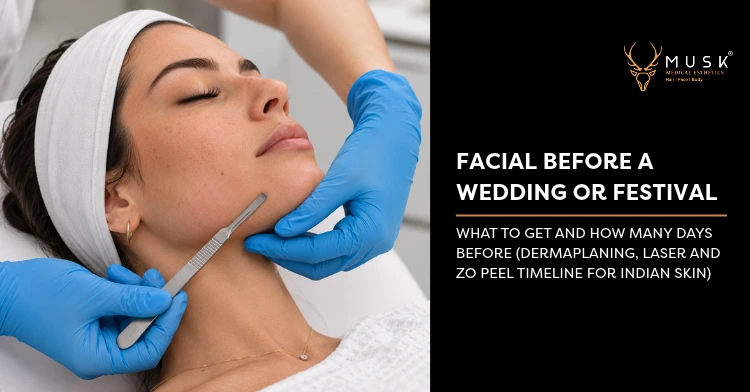
Dermaplaning is the closest of the three headline treatments to an event-friendly procedure because it removes superficial dead skin and fine facial hair without intentionally creating a deep wound. Musk Clinic includes dermaplaning as the first step of its Signature Facial and describes it as a no-downtime treatment.
For a wedding or festival, a conservative practical window is about 3 to 7 days before the first major function when you have had dermaplaning before and your skin responds well. This is an event-planning buffer, not a fixed medical rule.
Dermaplaning can be useful when the goal is a smoother surface for makeup, removal of surface flaking and a polished texture. It is less useful when the real problem is active acne, melasma, deep pigmentation or acne scarring.
At Musk Clinic, dermaplaning forms part of the Musk Signature Facial, where it is combined with other steps based on the treatment protocol.
Avoid scheduling dermaplaning over sunburned, actively inflamed or visibly irritated skin. Also tell the clinic about recent peels, retinoids, waxing, laser or other procedures so the skin is not over-exfoliated.
How Long Before the Event Should You Get a ZO 3-Step Peel?
A ZO 3-Step Peel should sit much earlier on the calendar than dermaplaning. Musk Clinic describes it as a medium-strength medical peel containing TCA, salicylic acid, lactic acid and retinol, with around 3 to 5 days of downtime.
The skin may flake or peel after treatment. Even when the visible peeling settles quickly, a major event needs extra buffer for residual dryness, redness, sensitivity or pigment change.
For an important wedding or festival, planning the peel about 3 to 4 weeks ahead is more conservative than placing it in the final week. Musk Clinic’s broader chemical-peel guidance also advises against scheduling a peel within two weeks of a major event.
Read the treatment details for the ZO 3-Step Peel before deciding whether its recovery fits your date.
Why Indian Skin Needs a Larger Safety Margin
Skin of colour has a higher tendency to develop post-inflammatory hyperpigmentation after inflammation. Reviews indexed by the U.S. National Library of Medicine note that superficial peels can be used safely in darker skin when appropriately selected, while medium-depth peels require greater caution.
For evidence on pigment risk, see this PubMed review on cosmetic procedures in darker skin.
If you already have melasma, PIH, active irritation or recent tanning, the treatment plan may need priming, a gentler peel or a different timeline.
How Long Before a Wedding Should You Get Laser Treatment?
First ask which laser. A low-downtime non-ablative treatment and ablative laser resurfacing should not share the same pre-wedding timeline.
Non-Ablative Laser: Plan Weeks, Not Days
Musk Clinic’s ClearLift page describes a course of 3 to 5 treatments, typically around four weeks apart, with visible results beginning around one month and optimal results developing over several months. That makes it a planning treatment rather than an emergency glow treatment.
If ClearLift fits your concern, review ClearLift laser skin rejuvenation early enough to complete the recommended course rather than relying on one session days before the event.
Ablative Laser Resurfacing: Give It a Much Longer Runway
Musk Clinic’s laser resurfacing guidance states that healing can take around 10 to 15 days and that redness may remain visible for considerably longer. In darker phototypes, post-inflammatory hyperpigmentation is an additional concern.
For true resurfacing, review the laser skin resurfacing procedure months rather than days before a major wedding or festival.
A practical planning window is often 6 to 12 weeks or more before a major event, depending on the device, treatment depth and your previous reaction. The treating clinician may advise a longer runway for acne scars, melasma, darker skin or aggressive resurfacing.
Why Does Indian Skin Need Different Pre-Event Planning?
inflammation. Fitzpatrick III to V skin can develop PIH after acne, peels, lasers, burns or other irritation.
A current review of post-inflammatory pigmentation notes that skin of colour has a higher risk of more pronounced dyspigmentation. Another 2026 review of laser and energy devices emphasises conservative device selection and parameter optimisation in darker phototypes.
See the PubMed review on post-inflammatory hyperpigmentation for the underlying risk in skin of colour.
That is why “no downtime” and “safe for all skin types” should never replace an individual assessment. Your tanning history, melasma, acne marks, previous PIH and current barrier condition all matter.
Which Treatment Fits Which Pre-Event Skin Concern?
Choose the treatment by the problem you want to improve. A facial for smooth makeup application is very different from a procedure intended to correct pigmentation or acne scars.
| Main Concern | Treatment Direction to Discuss | Why |
|---|---|---|
| Fine facial hair, surface roughness, flaky texture | Dermaplaning or a dermaplaning-based facial | Immediate surface smoothing with little planned downtime when suitable. |
| Dullness or dehydration close to the event | Familiar hydration-led medical facial | Keeps the final week focused on comfort and predictability. |
| Pigmentation, uneven tone or acne marks | Peel or selected laser course started early | Corrective concerns often need multiple sessions and pigment-risk planning. |
| Texture, acne scars or photoageing | Laser resurfacing planned well in advance | Creates more inflammation and needs a longer recovery window. |
| Medium-depth renewal with planned peeling | ZO 3-Step Peel | Can suit selected concerns but needs several weeks of event buffer. |
| Active acne or irritated skin | Medical assessment first | A “glow facial” does not replace treatment of active inflammation. |
Can You Combine Dermaplaning, Laser and a Peel Before the Same Event?
Sometimes procedures can be combined or staged, but stacking them simply because the event is close can increase irritation without improving the final photograph. The closer you get to the event, the more conservative the plan should become.
- Do not schedule a medium-strength peel and another aggressive resurfacing treatment back-to-back unless your clinician specifically plans the sequence.
- Do not use dermaplaning to “speed up” peeling skin after a chemical peel.
- Do not add a new retinoid, acid or scrub during post-procedure recovery unless instructed.
- Do not treat sunburned, inflamed or recently over-exfoliated skin just because the event date is fixed.
- Tell the clinic about every recent facial, peel, laser, injection, waxing or threading appointment.
What Should You Do in the Final Week Before the Wedding or Festival?
The final week should be boring in the best possible way. Your goal is a stable skin barrier, comfortable hydration and predictable makeup, not visible peeling or an experiment with a new device.
- Keep cleansing gentle.
- Use your usual moisturiser rather than introducing several new “bridal glow” products.
- Apply broad-spectrum sunscreen consistently, especially for outdoor functions and daytime travel.
- Avoid picking acne or manually peeling flaking skin.
- Avoid DIY chemical peels and high-strength acid products. The U.S. FDA warns that chemical-peel products can cause serious injury when used without appropriate professional supervision.
- If you want a final facial, choose one you have tolerated before and keep the treatment gentle.
The FDA warning on unsupervised chemical peels is especially relevant when social media encourages at-home “pre-wedding peel” experiments.
Does the Timeline Change for an Outdoor Festival?
Yes. Sun, heat, sweat, dust and repeated makeup can make post-procedure skin harder to manage. A treatment that is reasonable before an indoor event may be less convenient immediately before an outdoor festival or destination wedding.
For outdoor Garba nights, daytime weddings or destination events, build extra time for photoprotection and barrier recovery. Peeling skin and freshly resurfaced skin should not be exposed to avoidable sun and heat.
If the event is only days away and you are already tanned, sunburned or irritated, postponing the optional procedure can be more sensible than trying to force the original plan.
Seven Questions to Ask Before Booking a Pre-Event Facial
- Exactly what treatment am I having, and how strong is it?
- What visible redness, peeling or swelling should I realistically expect?
- How many days should I keep between this treatment and my first important function?
- Have I had this treatment before, and how did my skin react?
- Do I have melasma, PIH, active acne or recent tanning that changes the plan?
- Which skincare products should I stop before and restart after the treatment?
- What is the backup plan if I develop a breakout, redness or pigmentation before the event?
How Does Musk Clinic Plan Skin Treatments Before an Event?
A useful pre-event consultation starts with the date, the skin concern and the downtime you can realistically accept. The same “glow” goal can lead to very different recommendations for someone with dehydrated skin, active acne, melasma, acne scars or a history of PIH.
A VISIA Face Scan can help document features such as spots, texture, pores, UV-related changes and pigmentation before a treatment plan is built.
For Indian skin, the sensible strategy is usually to do corrective work early and make the final week progressively gentler. That protects the time you have already invested instead of risking a last-minute reaction.
The Bottom Line
The best facial before a wedding or festival is not automatically the treatment with the strongest peel, highest laser setting or most steps.
Dermaplaning can fit about 3 to 7 days before an event when it is familiar and appropriate. A ZO 3-Step Peel belongs earlier, preferably several weeks ahead. Non-ablative laser should be planned weeks to months in advance, while ablative resurfacing needs a substantially longer recovery buffer.For Indian skin, pigmentation risk makes that timing even more important.
Work backwards from the first function, test unfamiliar treatments early and keep the final days calm. If there is not enough time for a procedure to heal predictably, the safer choice is often to postpone it rather than force it into the calendar.
Frequently Asked Questions (FAQs)

Dr Pooja Sharma
- 5 Years of Experience