






 By Dr. Anand Shah
 Introduction
A crown hair transplant can require as many or more total grafts than a hairline transplant when the crown bald area is large, even though the hairline is usually transplanted at a higher density per square centimetre. The exact graft requirement depends on the size of each area, existing hair, donor supply, hair characteristics and the stage of hair loss.
The better question is therefore not simply, “Which area uses more grafts?” It is where those limited donor grafts will create the greatest long-term cosmetic benefit.
The hairline and crown behave very differently during hair transplant planning.
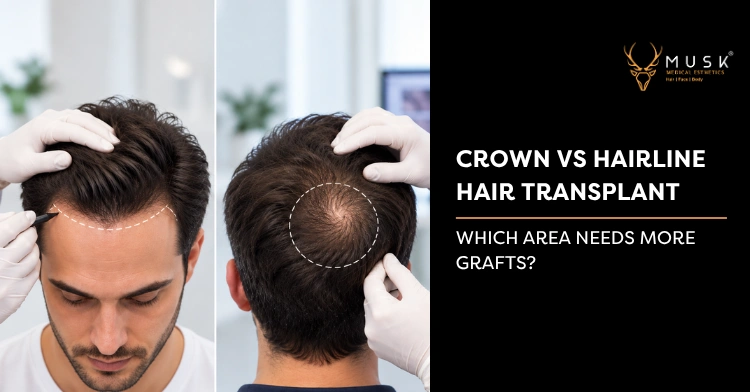
The hairline covers a relatively defined frontal zone, but it plays a major role in framing the face. The crown, also called the vertex, can cover a much larger circular area and requires grafts to follow its natural whorl pattern.
That creates an important planning trade-off. A surgeon may use a higher graft density at the front but still need a large total number of grafts for an extensive crown.
Because donor hair is limited, deciding how many grafts go to the hairline, mid-scalp and crown should be part of a long-term strategy rather than a one-session graft target. Clinical hair-transplant guidance specifically warns that the vertex can consume substantial donor resources.
Key Takeaways
- Neither area always needs more grafts: Total graft count depends mainly on the surface area being restored.
- Hairlines usually need greater density: The frontal zone requires careful density and natural single-hair placement.
- Crowns can consume large graft numbers: A wide vertex has a large circular surface that can progressively expand.
- Hairline restoration is often prioritised: The frontal frame usually creates greater visible change per graft.
- Crown design is different: Follicles must follow the natural spiral or whorl direction.
- Donor hair is finite: Using too many grafts in one area can limit future restoration options.
- Future hair loss matters: Crown transplantation requires particular caution when pattern hair loss is still progressing.
Does The Crown or Hairline Usually Need More Grafts?
The crown can require more total grafts when the bald area is large, while the hairline usually requires a higher implantation density across a smaller and more visually important area. Therefore, graft requirements cannot be compared accurately without measuring the size and condition of both regions.
One clinical review explains that the frontal region is commonly planned at a higher density, while density can taper towards the vertex. Another hair-transplant guideline notes that the vertex can consume a particularly large number of grafts.
The difference becomes easier to understand when you separate density from total graft count.
Factor | Hairline | Crown |
Typical Shape | Frontal band or triangular region | Circular or oval vertex |
Visual Priority | Very high because it frames the face | Important mainly from above and behind |
Implantation Density | Usually higher | Often lower per cm² |
Growth Direction | Forward with natural irregularity | Spiral or whorl pattern |
Total Area | Often smaller | Can become substantially larger |
Graft Demand | High density in a defined area | Can require many grafts across a broad area |
Future Loss Concern | Hairline recession can progress | Crown diameter may continue expanding |
Bottom Line: The hairline generally needs more careful dense packing, but an extensive crown may consume more grafts overall.
Why Can the Crown Use So Many Hair Transplant Grafts?
The crown can consume a large number of grafts because hair loss may involve a broad circular surface rather than a narrow frontal band. As the radius of the thinning area increases, the total area requiring coverage rises quickly.
Hair-transplant literature commonly describes the vertex as one of the more graft-demanding regions. Indian hair-transplant practice guidelines even refer to the vertex as a potential “black hole” for grafts because of the amount of donor supply it can consume.
There are three main reasons.
1. The Crown Can Cover a Large Surface Area
The crown may start as a small thinning spot but gradually expand outward with androgenetic alopecia.
A larger treatment area naturally requires more follicular units.
2. The Hair Must Follow a Whorl
Crown hairs do not simply point in one direction.
They typically rotate around one or more whorl points. Grafts must therefore be positioned according to:
- Direction
- Angle
- Natural rotation
- Existing hair
- Whorl location
Simply placing more grafts does not guarantee a natural crown.
3. Hair Loss May Continue Around the Transplant
The transplanted area may remain while untreated native hair around it continues to thin.
This can create an unnatural island or ring effect if crown surgery is performed without considering the future pattern of hair loss. Clinical guidance therefore recommends particular caution with vertex-only transplantation.
Why Is Hairline Density So Important?
The hairline usually receives greater cosmetic priority because it frames the face and is visible from almost every normal viewing angle. Small errors in density, direction or graft selection can therefore be much more noticeable at the front.
A natural hairline is not simply a dense straight row of transplanted follicles.
The transition from forehead to thicker frontal hair usually requires:
- Fine single-hair follicular units at the leading edge
- Gradual increases in density behind the first rows
- Natural micro-irregularities
- Appropriate direction and angle
- Age-appropriate placement
- Consideration of future recession
Hair-transplant literature recommends single-hair grafts in the frontal transition zone and progressively greater volume behind it.
Musk Clinic already provides dedicated information about hairline reconstruction, while the comparison in this guide helps explain how frontal restoration fits into the larger graft-allocation strategy.
How Many Grafts Does a Hairline Hair Transplant Need?
There is no universal graft number for hairline transplantation. Requirements depend on how far the hairline has receded, whether the temples and frontal tuft also need restoration, the width of the forehead and the target cosmetic density.
A small recession may require considerably fewer grafts than frontal restoration extending into the mid-scalp.
Published surgical research illustrates how widely graft numbers can vary. In one retrospective study of advanced male pattern baldness, average frontal coverage involved about 2,982 follicular units, whereas a limited frontal forelock treatment averaged about 1,240 follicular units. These are study averages, not standard treatment prescriptions.
Another observational study noted that approximately 250–300 follicular units may be used specifically to construct the immediate hairline itself, with additional grafts required behind it to restore frontal density.
The total number therefore depends on the entire area being treated, not simply the first centimetre of the hairline.
How Many Grafts Does a Crown Hair Transplant Need?
Crown graft requirements depend heavily on the diameter of the thinning area, existing native hair and the density that can realistically be achieved without exhausting the donor supply.
A small early crown may require substantially fewer grafts than an advanced vertex.
In the retrospective study of 820 advanced hair-loss cases, vertex-only transplantation averaged about 2,770 follicular units. By comparison, frontal-only coverage averaged about 2,982 units.
This highlights an important point:
Crown surgery does not automatically require more grafts in every patient.
The crown becomes highly graft-demanding when:
- The bald diameter is large
- Hair loss extends into the mid-scalp
- Existing crown hair is very miniaturised
- The patient wants high apparent density
- The whorl requires broader reconstruction
- Future crown expansion is likely
This is why online graft calculators should be treated as rough educational tools, not surgical planning systems.
Why Do Two People with the Same Bald Area Need Different Graft Counts?
Graft count is influenced by more than the number of square centimetres being treated. Hair thickness, follicular-unit composition, hair-to-scalp contrast, curl, donor density and remaining native hair all affect the amount of visual coverage each graft can create.
Important Factors That Affect Graft Requirements
Hair Shaft Thickness
Thicker hairs create more visual coverage than fine hairs.
Number Of Hairs Per Follicular Unit
A follicular unit may contain one, two, three or sometimes more hairs.
Two patients receiving the same number of grafts can therefore receive different total numbers of hairs.
Existing Native Hair
A thinning crown containing useful native follicles may require a different strategy from a completely bald crown.
Hair Texture
Wave or curl can create greater visual volume than very straight hair.
Hair-To-Scalp Contrast
Lower colour contrast between hair and scalp can make coverage appear fuller.
Donor Density
A patient with limited donor density cannot safely pursue the same graft target as someone with a stronger donor reserve.
This is why graft planning should be personalised rather than selected from a generic package.
Should The Hairline or Crown Be Transplanted First?
When donor supply is limited, the frontal hairline and frontal zone are often prioritised because they provide a greater cosmetic impact and frame the face. Crown transplantation may be staged or approached more conservatively, especially when future hair loss is uncertain.
Current clinical guidance supports conservative frontal planning and cautions against consuming excessive donor grafts in the vertex.
A surgeon may consider:
- Current Norwood stage
- Patient age
- Stability of hair loss
- Donor density
- Hairline position
- Mid-scalp thinning
- Crown diameter
- Expected future hair loss
- Lifetime donor reserve
- The patient’s main cosmetic concern
For example, trying to completely fill a large crown in a young patient while leaving an unstable frontal region untreated could create difficult long-term planning problems.
Hairline vs Crown: Where Do Grafts Create More Visual Impact?
Frontal grafts usually create greater visible change per follicular unit because the hairline frames the face, while crown grafts primarily improve coverage when the scalp is viewed from above or behind.
This does not mean the crown is unimportant.
It means grafts should be allocated according to priorities.
Hairline Grafts May Offer Greater Value When:
- Frontal recession is the main visible concern
- The hairline has lost definition
- Temple recession makes the face look older
- Donor supply is limited
- Hair loss is likely to progress
Crown Grafts May Become a Higher Priority When:
- Frontal density is already satisfactory
- Crown loss is clearly visible
- Hair loss is stable
- Donor supply is strong
- The crown bald area is unlikely to expand dramatically
- The patient’s primary concern is vertex visibility
A personalised plan may also divide grafts between the frontal zone, mid-scalp and crown rather than treating only one region.
How Does Donor Supply Affect Crown vs Hairline Planning?
Every graft allocated to the crown is a graft that cannot later be used for the hairline, mid-scalp or another procedure. Donor preservation is therefore central to deciding how aggressively either area should be restored.
Hair transplantation redistributes a finite supply of relatively stable donor follicles.
Long-term planning becomes particularly important in:
- Younger patients
- Norwood V–VII hair loss
- Diffuse thinning
- Weak donor density
- Previous transplant patients
- Progressive crown loss
- Patients requesting very low hairlines
- Patients seeking very high density
Published hair-transplant guidance stresses that achieving normal native density across advanced baldness is usually impossible with scalp donor supply alone. Instead, surgeons use strategic placement to create cosmetic coverage.
For a detailed explanation of how donor density affects treatment capacity, see Musk Clinic’s hair transplant donor area guide once published.
Can the Crown and Hairline Be Transplanted in the Same Session?
Yes, selected patients may have the frontal region, mid-scalp and crown addressed during one surgical plan, but full coverage is not appropriate or achievable for everyone.
Whether combined treatment makes sense depends on:
- Total graft requirement
- Donor density
- Safe donor availability
- Extent of baldness
- Hair calibre
- Existing native hair
- Surgical duration
- Patient health
- Long-term hair-loss pattern
Research involving advanced baldness illustrates the limitation clearly. Patients receiving full coverage required substantially more grafts than those receiving frontal or crown-only restoration, and full coverage was feasible mainly in patients with stronger donor resources.
That is why a 4,000-graft recommendation should never be judged only by the number itself.
The important question is where those grafts are going and what donor reserve will remain afterwards.
What Is a Practical Graft-Priority Framework?
Use this framework to understand the questions that should be answered before dividing grafts between the crown and hairline.
Step 1: Measure The Donor Reserve
Assess donor density, calibre, safe donor boundaries and previous harvesting.
Step 2: Map The Entire Hair-Loss Pattern
Do not assess the hairline or crown in isolation.
Step 3: Estimate Future Progression
Consider age, family history, miniaturisation and current Norwood pattern.
Step 4: Prioritise Cosmetic Impact
Determine whether frontal framing, mid-scalp coverage or crown visibility causes the greatest concern.
Step 5: Set Realistic Density Goals
Trying to reproduce teenage density across every region may use donor grafts inefficiently.
Step 6: Preserve Future Options
Leave enough donor capacity for later progression wherever possible.
What Are the Risks of Using Too Many Grafts in One Area?
Overcommitting grafts to one region can reduce future treatment options and may create an unnatural imbalance if surrounding native hair continues to disappear.
Potential planning problems include:
- Excessively depleted donor density
- A dense crown with a weak frontal region
- An unnaturally low hairline that becomes difficult to support later
- Visible gaps if progressive hair loss surrounds transplanted follicles
- Insufficient donor reserve for a second procedure
- Poor balance between hairline, mid-scalp and crown
The risk is especially important in younger patients with an evolving pattern of androgenetic alopecia. Clinical literature recommends stabilising and evaluating progressive loss before aggressive surgical planning.
When Should Crown Hair Transplantation Be Approached Conservatively?
Crown transplantation deserves extra caution when hair loss is still progressing, donor supply is limited or the frontal region has not yet been adequately planned.
A specialist assessment becomes particularly important if:
- You are relatively young
- Crown thinning is expanding
- You have diffuse thinning
- Your donor area is weak
- You also need frontal restoration
- You have already undergone a transplant
- You want very high crown density
- Different clinics have suggested very different graft numbers
The crown should be planned as part of the whole scalp, not as an isolated bald spot.
How Does Musk Clinic Plan Crown and Hairline Restoration?
Hair transplant planning at Musk Clinic considers the recipient area together with donor availability, hair-loss pattern, existing hair and the patient’s long-term goals.
The clinic has dedicated treatment pathways for both hairline reconstruction and crown hair transplant, allowing the surgeon to consider the different density, direction and design requirements of each region.
For appropriate patients, ARTAS 9X robotic FUE may also form part of the harvesting process. Technology can assist follicular-unit selection and extraction, but the key clinical decision remains how those finite grafts should be distributed across the scalp.
Patients considering treatment in Gujarat can also review Musk Clinic’s hair transplant in Ahmedabad service before arranging an individual assessment.
The Bottom Line
In a crown vs hairline hair transplant, neither area automatically needs more grafts.
The hairline usually requires greater density and precise graft selection because it frames the face. The crown often uses a lower density per square centimetre but can become the larger graft consumer because of its broad circular area, whorl pattern and potential for future expansion.
The best plan is therefore not the one with the highest graft number. It is the one that creates the greatest cosmetic improvement while protecting enough donor hair for the future.
If you are deciding whether to restore the crown, hairline or both, a full scalp and donor assessment can help determine where your available grafts will provide the most value.
Frequently Asked Questions (FAQs)

Dr. Anand B. Shah
- 10 Years of Experience
Dr Anand B. Shah, is a board-certified Maxillofacial & Craniofacial surgeon who is highly skilled in cosmetic facial and hair restoration surgery and has exclusively practised the same, internationally and nationally.