






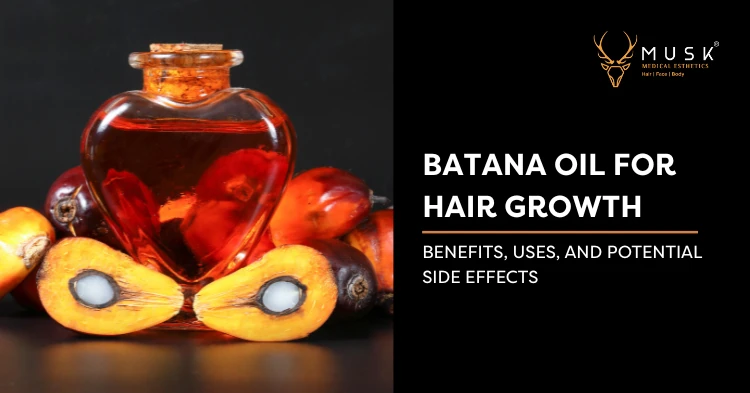
Batana Oil for Hair Growth: Benefits, Side Effects, And What Science Says
 By Dr. Anand Shah
 Batana oil is everywhere on social media, especially in hair growth videos that promise thicker, longer, shinier hair. But if your hair is thinning, your part is widening, or your hairline is changing. The real question is simple: can batana oil grow hair, or does it only make existing hair look healthier?
The honest answer is more useful than the hype. Batana oil can be a rich conditioning oil for dry, coarse, curly, or frizz-prone hair. It may help reduce breakage, improve shine, and support a more comfortable scalp. However, it should not be treated as a proven cure for genetic hair loss, bald patches, DHT-related thinning, or medical hair fall.
This guide explains what batana oil is, what it can and cannot do, how to use it safely, possible side effects, how it compares with rosemary and castor oil, and when it is better to consult Musk Clinic for evidence-based hair loss treatment.
Key Takeaways
- Batana Oil Is Mainly a Conditioner: It can moisturize dry hair, improve shine, reduce frizz, and make breakage-prone hair feel smoother.
- Hair Growth Proof Is Limited: There is no strong clinical evidence that batana oil regrows bald spots or reverses pattern hair loss by itself.
- It May Help Hair Look Fuller: By reducing dryness and breakage, batana oil may make hair look healthier even if it does not stimulate new follicles.
- Hair Type Matters: Batana oil is usually better for thick, dry, curly, coily, or damaged hair than for very fine, oily, or low-porosity hair.
- Patch Testing Is Important: People with sensitive skin, scalp acne, dandruff, seborrheic dermatitis, or nut and palm oil sensitivities should be careful.
- Use It as Support, Not Treatment: For progressive shedding, receding hairline, crown thinning, or widening part, batana oil should not replace medical evaluation.
- Better Options May Be Needed: Depending on the cause, hair loss may require minoxidil, PRP, LLLT, medicinal treatment, or hair transplant planning.
What Is Batana Oil?
Batana oil is a thick, natural oil traditionally made from the nuts of the American palm tree, also known as Elaeis oleifera. It is commonly linked with Central and South American hair care traditions and is promoted for dry hair, shine, scalp comfort, and breakage control.
It is rich in fatty acids and antioxidant compounds, which is why many people use it as a deep-conditioning oil. Its texture is usually heavier than argan oil or diluted rosemary oil, closer to a butter-like treatment that melts when warmed gently.
The important distinction is this: conditioning and hair regrowth are not the same. A hair oil can make strands feel softer and reduce snapping, but that does not mean it can restart follicles that have miniaturized or stopped producing visible hair.
Does Batana Oil Help Hair Growth?
Batana oil may help hair appear healthier by reducing dryness and breakage, but it is not a proven hair regrowth treatment. Current medical discussions note no strong clinical evidence that batana oil alone can reverse balding, regrow hair on bald spots, or stop androgenetic alopecia.
This is where many people get confused. If hair breaks less, it may look longer over time because more length is retained. If frizz reduces, hair may look denser. If the scalp feels less dry, the routine may feel like it is working. These are useful for cosmetic benefits, but they are not the same as follicle-level regrowth.
For someone with dry, damaged, or curly hair, batana oil can be a helpful part of a hair care routine. For someone with progressive thinning, a widening part, temple recession, or crown hair loss, the root cause still needs evaluation.
Bottom Line: Batana oil may support hair quality, but it should not be sold or used as a guaranteed solution for hair loss.
What Are the Real Benefits of Batana Oil for Hair?
The strongest benefits of batana oil are cosmetic and conditioning benefits. It can help dry strands feel smoother, improve manageability, and reduce breakage caused by dryness, heat styling, coloring, friction, or harsh washing routines.
1. Moisture And Softness
Batana oil can coat dry strands and help reduce moisture loss. This may be helpful for rough, brittle, curly, coily, or heat-damaged hair that feels dull or frizzy.
2. Breakage Control
When hair is dry and fragile, it can snap before reaching its full length. Batana oil may reduce friction and make the hair shaft feel smoother, which can help with length retention in some people.
3. Shine And Frizz Reduction
Because it is rich and emollient, batana oil can make the outer hair surface look smoother. This can improve shine and reduce flyaways, especially in textured or high-frizz hair.
4. Scalp Comfort
Some people find that oiling reduces scalp tightness or dryness. However, anyone with dandruff, scalp acne, seborrheic dermatitis, itching, burning, or active inflammation should use caution and seek medical guidance if symptoms persist.
Is Batana Oil Good for Every Hair Type?
No. Batana oil is not ideal for every scalp or hair type. It is usually more suitable for dry, thick, curly, coily, or damaged hair. It may feel too heavy for fine hair, oily scalps, low-porosity hair, or people who easily develop scalp buildup.
What Are the Side Effects of Batana Oil?
Batana oil is generally used as a cosmetic hair oil, but side effects are possible. The most common concerns are greasiness, scalp buildup, itching, redness, follicle congestion, acne-like bumps, dandruff flare-ups, or allergic reactions in sensitive users.
Do not assume natural means risk-free. Heavy oils can trap sweat, flakes, styling residue, and dead skin if they are not washed out properly. This can make some scalp conditions feel worse.
Who Should Be Careful with Batana Oil?
- People with very oily scalps or scalps acne.
- People with dandruff, seborrheic dermatitis, psoriasis, or eczema flare-ups.
- People with known sensitivity to palm oils, nut oils, fragrances, or unregulated hair oils.
- People using medicated scalp treatments who have not checked compatibility with their doctor.
- People with sudden hair loss, patchy bald spots, pain, scaling, redness, or pus-filled bumps.
Before applying batana oil widely, rub a small amount behind the ear or on the inner arm and wait 24 hours. If redness, itching, swelling, burning, or bumps appear, avoid using it on the scalp.
How To Use Batana Oil Safely for Hair?
The safest way to use batana oil is to start small, avoid overheating it, keep it away from irritated skin, and wash it out properly. More oil does not mean better results. In many cases, using less gives better softness without buildup.
1. Use It as a Pre-Shampoo Mask
- Warm a pea-sized to coin-sized amount between your palms until it softens.
- Apply mainly to the mid-lengths and ends if your scalp is oily or sensitive.
- Leave it on for 20 to 45 minutes at first, not overnight on the first use.
- Wash thoroughly with a gentle shampoo and check how your scalp feels the next day.
2. Use It for Scalp Massage Only If Suitable
- Part the hair in sections and apply a very small amount to the scalp.
- Massage with fingertips for 3 to 5 minutes without scratching.
- Avoid applying to open skin, acne-like bumps, scaly plaques, or painful areas.
- Rinse well and reduce frequency if the scalp feels greasy or itchy.
3. Use It on Dry Ends
- Rub a tiny amount between your fingers.
- Apply only to the driest ends, not the roots.
- Use this only when needed for frizz or dullness.
How Often Should You Use Batana Oil?
Batana Oil Vs Rosemary Oil, Castor Oil, Argan Oil, And Pumpkin Seed Oil
Batana oil is not the only oil people use for hair. The right comparison depends on your goal. If you want softness and frizz control, batana may help. If you are trying to manage hair loss, the evidence behind most oils is still limited and should not replace diagnosis.
When is Batana Oil Not Enough for Hair Loss?
Batana oil is not enough when hair loss is progressive, patterned, sudden, patchy, painful, or associated with scalp symptoms. In those cases, delaying evaluation can allow treatable causes to continue unchecked.
You should consider a hair loss consultation if you notice any of the following:
- A widening part line or reduced ponytail thickness.
- A receding hairline, temple thinning, or crown thinning.
- Hair fall that continues for more than 6 to 8 weeks.
- Patchy bald spots or sudden circular hair loss.
- Scalp itching, burning, scaling, redness, or pimples.
- Hair loss after illness, crash dieting, new medication, childbirth, or major stress.
- Family history of male or female pattern hair loss.
A proper hair loss diagnosis may include scalp examination, medical history, hair pull testing, blood tests, or other checks depending on symptoms. The goal is to identify whether the issue is DHT-related, nutritional, inflammatory, hormonal, stress-related, or a mix of causes.
What Works Better Than Batana Oil for Hair Loss?
The right treatment depends on the cause of hair loss. Some people need scalp care and nutritional correction. Some need medical treatment. Some may benefit from PRP or LLLT. Advanced pattern hair loss may need hair transplant planning after donor area assessment.
Can Batana Oil and Medical Hair Treatment Be Used Together?
Sometimes yes, but it depends on the treatment and the scalp. Heavy oils can interfere with topical medications if applied at the wrong time, and they may irritate some sensitive scalps. Always ask your doctor how to schedule oiling if you use minoxidil, medicated shampoos, scalp treatments, or post-procedure care.
In general, batana oil should be treated as a supportive grooming step, not the main treatment. A patient with DHT-related thinning may still need medical management. A patient with dandruff may first need scalp treatment. A patient with advanced baldness may need restoration planning.
Why Choose Musk Clinic for Hair Loss Guidance?
Hair loss care should begin with the cause, not with a trend. Musk Clinic helps patients understand whether the issue is dryness and breakage, pattern thinning, nutritional shedding, scalp inflammation, hormonal change, or a more advanced restoration concern.
This matters because the right solution can be very different from one patient to another. One person may only need better scalp care and gentle hair routines. Another may need medicinal support. Another may need PRP, LLLT, or hair transplant planning. The goal is to choose the treatment direction after evaluation, not after guessing.
Patients can discuss non-surgical and surgical options through Musk Clinic's hair restoration services, including PRP, LLLT, medicinal support, and hair transplant planning where appropriate.
Conclusion
Batana oil can be useful for softer, shinier, more manageable hair, especially if your hair is dry, thick, curly, coily, or damaged. It may help reduce breakage and improve the appearance of hair quality. But it is not a proven treatment for bald spots, genetic hair loss, DHT-related thinning, or sudden medical hair fall.
Use batana oil carefully, patch test first, and avoid overusing it on oily or sensitive scalps. If your concern is only dryness, it may fit your routine. If your concern is ongoing hair fall, crown thinning, a receding hairline, or a widening part, it is better to find the cause before losing time on oils alone.
Musk Clinic can help you understand whether your hair concern needs routine care, scalp treatment, medical support, PRP, LLLT, or advanced hair restoration planning.
Frequently Asked Questions

Dr. Anand B. Shah
- 10 Years of Experience
Dr Anand B. Shah, is a board-certified Maxillofacial & Craniofacial surgeon who is highly skilled in cosmetic facial and hair restoration surgery and has exclusively practised the same, internationally and nationally.