






Hair Transplant Cost in USA vs India: Treatment, Travel & Recovery Compared
 By Dr. Anand Shah
 Introduction
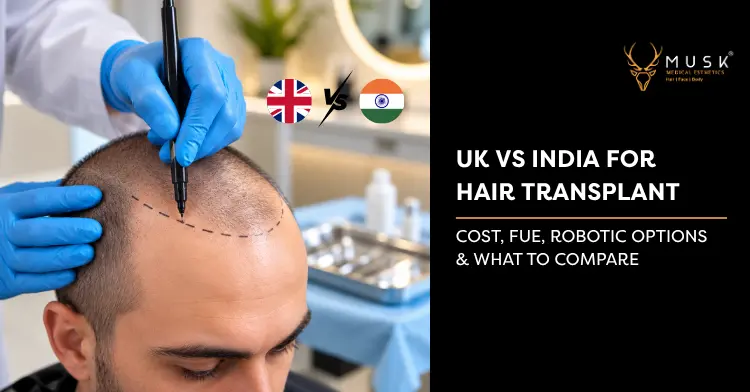
A hair transplant in India can have a lower procedure cost than treatment in the USA, but the fairest comparison includes more than the surgery quote. Flights, visa requirements, accommodation, time away from work, early recovery and follow-up after returning home all affect the real cost and convenience of treatment. Musk Clinic is located in Ahmedabad, India. It does not operate a hair transplant clinic in the United States.
Key Takeaways
- Compare the same treatment plan: Graft count and technique should be similar before comparing USA and India quotes.
- Procedure price is only one cost: International patients also need to budget for flights, accommodation, visa and local travel.
- Hair transplantation is usually self-funded: Cosmetic hair transplantation is generally treated differently from medically necessary care in the USA.
- India requires travel planning: US patients travelling specifically for treatment need to check current Indian medical-visa requirements.
- Recovery affects the itinerary: Do not book return travel based only on the shortest possible postoperative timeline.
- Follow-up matters after you fly home: Clarify how photographs, video reviews and complications will be handled from the USA.
- Lower cost should not override quality: Surgeon involvement, donor planning, safety and long-term graft strategy remain essential.
- Ahmedabad can be considered as one India treatment option: Musk Clinic provides hair restoration in Ahmedabad for domestic and international patients.
How Does Hair Transplant Cost in the USA Compare with India?
Hair transplantation generally costs more at the procedure level in the United States than in India, but there is no single national price in either country. Your actual quote depends on graft requirements, surgical technique, surgeon involvement, donor complexity and what services are included.
Musk Clinic's international-content framework deliberately avoids using a fixed India-vs-USA savings percentage because quotes are rarely truly like-for-like.
A 1,500-graft frontal procedure should not be compared with a 3,500-graft front-and-crown restoration simply because both are labelled "FUE."
A more useful comparison looks like this:
| Cost Factor | USA Treatment | India Treatment from USA |
|---|---|---|
| Hair Transplant Procedure | Usually the main expense | May have a lower procedure-level quote |
| Flights | Usually unnecessary for local treatment | International airfare required |
| Visa | Not applicable for domestic US treatment | Medical travel documentation may be required |
| Accommodation | Usually minimal if treated locally | Needed during the Ahmedabad stay |
| Local Transport | Usually routine | Airport and local transport should be budgeted |
| Time Away from Work | Depends on recovery | Includes treatment plus international travel |
| Follow-Up | Easier in person when local | Requires a structured remote-care plan |
| Unexpected Care | Local access may be simpler | US care after returning may add expense |
Bottom Line: Compare the total financial and logistical plan, not only the number shown beside the procedure.
Why Is Hair Transplant Pricing Different Between the USA and India?
Hair transplant pricing reflects local operating costs, professional fees, clinic infrastructure, staffing, technology and the number of grafts required.
Geography affects price, but geography alone does not tell you whether treatment is appropriate or well performed.
The final quote can change because of:
- Number of grafts
- Size of the recipient area
- Donor density
- Hairline design
- Crown involvement
- FUE vs FUT
- Robotic FUE where suitable
- Previous transplant repair
- Scar tissue
- Need for body or beard donor hair
- Number of sessions
- Surgeon involvement
- Facility and technology costs
This is why the most useful first step is a graft and donor assessment, not a generic country price.
Patients comparing India options can review Musk Clinic's hair transplant in India information for its treatment approach and cost factors.
Is a Hair Transplant Usually Covered by Insurance in the USA?
Hair transplantation performed primarily to improve appearance is generally treated as an elective cosmetic expense rather than routine medically necessary care in the United States.
The IRS Publication 502 specifically lists hair transplants within its cosmetic-surgery guidance and generally excludes purely cosmetic procedures from deductible medical expenses, while noting exceptions for certain reconstructive situations.
Private health-plan coverage varies, so patients should verify their own policy rather than assuming treatment or later complication care will be reimbursed.
For practical budgeting, many patients should plan for hair transplantation as a self-pay procedure.
What Should You Compare When Searching for the Best Hair Transplant in the USA?
When researching the "Best Hair Transplant in USA," compare the actual treatment plan rather than rankings, advertising claims or price alone.
Who Performs the Surgical Steps?
Understand which parts of the procedure are performed or directly supervised by the physician.
How Is the Donor Area Assessed?
A large graft quote has little value if harvesting compromises future donor reserves.
Is the Hairline Designed for Long-Term Hair Loss?
Hair transplantation moves existing follicles. It does not stop untreated native hair from continuing to thin.
Which Technique Is Being Recommended?
FUE, FUT and robotic-assisted FUE are harvesting approaches with different advantages and limitations.
Is the Graft Estimate Explained?
Ask why the proposed number is appropriate for your hairline, mid-scalp or crown.
What Happens if You Need Another Procedure?
A good first transplant should account for possible future hair loss.
What Follow-Up Is Included?
Clarify postoperative checks, emergency contact, medicines and long-term reviews.
These same questions should be applied when considering treatment in India.
Should You Compare Cost per Graft?
Cost per graft can help explain a quotation, but it should not become the only measure of value.
Two clinics may both quote 2,500 grafts but differ significantly in:
- Donor-area planning
- Follicular-unit selection
- Hairline design
- Physician involvement
- Recipient-site creation
- Graft handling
- Operating-room protocols
- Follow-up
- Revision planning
A lower per-graft quote is not automatically better. Likewise, a higher quote does not automatically mean higher clinical quality.
A useful written estimate should explain:
1. Estimated graft requirement
2. Treatment areas
3. Technique
4. Who performs key surgical steps
5. What is included
6. What is excluded
7. Follow-up plan
8. Whether further sessions may reasonably be needed
How Should USA-Based Patients Calculate the Real Cost of Treatment in India?
Start with the procedure quote, then build a separate travel and recovery budget around it.
Treatment
- Hair transplant procedure
- Preoperative assessment
- Medicines, if separately charged
- Follow-up consultations
- Any additional planned treatments
International Travel
- Round-trip airfare
- Baggage
- Airport transfers
- Travel insurance where appropriate
India Stay
- Hotel or other accommodation
- Meals
- Local transport
- Companion expenses if someone travels with you
Documentation
- Appropriate Indian visa
- Passport requirements
- Any supporting medical documents
Recovery
- Extra hotel nights if you need more healing time
- Time away from employment
- Flexible return ticket if appropriate
- Unplanned local medical review if needed
After Returning to the USA
- Remote follow-up
- Local doctor review if a complication occurs
- Prescriptions
- Additional care that may not be covered
The cheapest procedure quote may not produce the lowest door-to-door cost.
What Visa Do US Patients Need for Hair Transplant Treatment in India?
US citizens travelling to India specifically for medical treatment should confirm the appropriate visa category before booking treatment or flights.
The official Government of India e-Visa portal lists the USA among eligible nationalities and includes medical treatment as an eligible purpose under the e-Visa system. The portal also provides current eligibility, document and application guidance.
Visa rules can change. Always check the current Government of India guidance shortly before travelling rather than relying on an older clinic article.
What Should You Send Before Travelling from the USA?
A useful online assessment should establish whether travelling for surgery makes sense before you purchase flights.
You may be asked to provide:
- Clear front hairline photographs
- Both temple views
- Top/mid-scalp view
- Crown photograph
- Back donor-area photograph
- Side donor-area photographs
- Age
- Hair-loss history
- Family history
- Previous hair treatments
- Previous transplant history
- Current medicines
- Medical conditions
- Smoking history
- Treatment goals
Photos do not replace the final in-person examination, but they can help estimate hair-loss pattern, likely donor capacity, approximate graft needs, potential technique and whether expectations are realistic.
Musk Clinic's medical tourism programme explains its pre-travel consultation and international-patient support process.
Which Hair Transplant Treatments Can USA-Based Patients Consider in India?
The choice should depend on the patient's donor area, hair-loss pattern and surgical goals rather than the country where the procedure takes place.
FUE
Individual follicular units are extracted from the donor area and transferred to the planned recipient areas. FUE avoids a long linear donor scar, although small extraction scars remain.
FUT
A strip of donor scalp is removed and dissected into follicular units. FUT can be useful in selected cases where preserving certain aspects of donor capacity or obtaining larger graft numbers matters.
Robotic-Assisted FUE
For suitable candidates, technology can assist with identifying and harvesting follicular units. Musk Clinic offers ARTAS 9X robotic hair transplant in Ahmedabad. Suitability still depends on medical assessment, donor characteristics and the overall restoration plan.
Technology should support surgeon judgement, not replace it.
Does Travelling to India Mean Compromising on Results?
Country alone cannot predict a hair transplant result. Surgeon planning, donor management, technique, graft handling and long-term strategy matter more than the passport stamp.
Poor hair transplantation can occur in any market. Likewise, carefully planned transplantation can be performed in different countries.
For overseas treatment, examine evidence that is difficult to fake or generalise:
- Named surgeon
- Relevant qualifications
- Consistent before-and-after photography
- Graft counts
- Technique used
- Hair-loss stage
- Treatment area
- Follow-up interval
- Repair cases
- Long-term results where available
Musk Clinic's results library includes a documented New York patient hair transplant case involving 3,641 grafts using ARTAS robotic FUE for a Norwood 5A pattern. A single case does not predict another patient's outcome, but case-level information is more useful than an anonymous transformation image.
How Long Should You Stay in Ahmedabad After a Hair Transplant?
There should not be one fixed stay duration for every international patient. Your return plan should depend on the procedure, early healing, surgeon review and your individual health.
Hair transplantation is commonly an outpatient procedure, and many patients are able to resume light daily activities relatively quickly. However, being physically capable of leaving a clinic is different from deciding when to take a long-haul international flight.
A sensible itinerary should allow time for:
- Postoperative review
- Early donor-area healing
- Recipient-site assessment
- Learning the washing routine
- Checking swelling
- Reviewing medicines
- Confirming that recovery is progressing as expected
Do not book the shortest possible itinerary simply because the operation itself is completed in one day.
Is It Safe to Fly Back to the USA Soon After a Hair Transplant?
Return-flight timing should be discussed with the treating surgeon rather than decided from a generic online number.
The CDC medical tourism guidance notes that surgery and prolonged travel can add postoperative risks and recommends planning follow-up care before travelling.
Hair transplantation is less invasive than many major surgeries, but a USA-bound flight is still long-distance travel. Practical considerations include:
- Scalp swelling
- Comfort during travel
- Long periods of sitting
- Access to medicine
- Protection of the recipient area
- Hydration
- Luggage handling
- Sleep positioning
- Possibility of an unexpected complication
The treating doctor should confirm whether your recovery is appropriate for your planned journey.
What Does the First Week of Recovery Usually Involve?
Early recovery focuses on protecting transplanted follicles, allowing donor sites to heal and managing temporary effects such as redness, crusting or swelling.
Patients may receive instructions covering:
- Scalp washing
- Sleeping position
- Touching or scratching
- Exercise
- Sun exposure
- Alcohol
- Smoking
- Headwear
- Medicines
- When normal grooming can resume
Musk Clinic provides international patients with postoperative guidance and remote support. Individual recovery can vary.
The CDC medical tourism guidance also cautions that strenuous activity, alcohol, sunbathing, swimming and other holiday activities can interfere with postoperative healing.
How Does Follow-Up Work After Returning to the USA?
International hair-transplant planning should include follow-up before the surgery takes place, not after the patient has already flown home.
Ask:
- When should progress photographs be sent?
- Are video consultations available?
- Who should you contact for urgent questions?
- What symptoms require local medical care?
- How are medicines handled?
- When is the next planned clinical review?
- What if native hair continues thinning?
- When will the final result be assessed?
CDC guidance recommends that medical tourists obtain copies of overseas medical records and arrange continuity of care after returning home.
Keep:
- Procedure summary
- Graft count
- Technique
- Treatment areas
- Prescribed medicines
- Allergy information
- Follow-up instructions
- Clinic contact details
This information can be useful if a US healthcare professional needs to evaluate you later.
Is India Worth Considering if You Can Get a Hair Transplant in the USA?
India may be worth considering when the treatment plan, surgeon, technology and total trip economics make sense for you. Staying in the USA may be more practical when convenience, local follow-up and avoiding international travel matter more.
USA Treatment May Suit You Better If:
- You strongly prefer local in-person follow-up
- International travel is medically difficult
- Taking additional travel time away from work is impractical
- You have complex health conditions requiring local coordination
- The USA quote fits your budget
- You prefer not to manage visa and travel logistics
India May Be Worth Comparing If:
- Procedure cost is an important factor
- You are comfortable travelling internationally
- You have identified a suitable surgeon and treatment plan
- Remote follow-up is clearly structured
- You can allocate enough recovery time in India
- You already travel to India periodically
- You want to compare technologies or surgeons available in Ahmedabad
Neither route is automatically right for everyone.
What Questions Should You Ask Before Choosing USA or India?
Use the same checklist for both countries.
Treatment Planning
- Why am I a suitable candidate?
- How many grafts do I need?
- Which areas will be transplanted?
- How much donor reserve will remain?
Surgeon and Team
- Who designs the hairline?
- Who performs extraction?
- Who creates recipient sites?
- Who performs implantation?
Cost
- What does the quotation include?
- What costs could be additional?
- Is a second session reasonably foreseeable?
Recovery
- What should I expect during the first week?
- When will I be reviewed?
- When can I resume work?
International Travel
- When should I schedule my return flight?
- What happens if recovery is slower than expected?
- Who handles follow-up after I return to the USA?
This makes the comparison about clinical value, not just currency.
Why Might USA-Based Patients Consider Musk Clinic in Ahmedabad?
Musk Clinic is physically located in Ahmedabad, Gujarat, India.
Its hair-restoration approach includes donor-area assessment, personalised graft planning, FUE, FUT and ARTAS 9X robotic FUE where appropriate. Dr. Anand B. Shah's current Musk Clinic profile documents advanced hair-restoration training in Manhattan, New York, and ARTAS training in San Jose, USA.
For international patients, the more relevant advantage is not simply lower geographic pricing. It is the ability to establish the treatment plan before travel, understand expected graft needs, arrange the Ahmedabad stay and continue follow-up after returning home.
That structure is particularly important for patients travelling from the United States because the surgery is only one part of the overall medical-tourism journey.
The Bottom Line
When comparing hair transplant cost in USA vs India, do not compare two headline prices and assume you have the answer.
A USA procedure may offer greater convenience and easier local follow-up. Treatment in India may offer a lower procedure-level cost for some patients, but flights, visa, accommodation, recovery time and post-return care must be added before comparing the total investment.
More importantly, both quotes should represent a similar graft requirement, treatment area and technique.
For USA-based patients considering Ahmedabad, the first step should be an online assessment that establishes donor capacity, expected graft requirements and treatment suitability before travel arrangements are made.
Frequently Asked Questions (FAQs)

Dr. Anand B. Shah
- 10 Years of Experience
Dr Anand B. Shah, is a board-certified Maxillofacial & Craniofacial surgeon who is highly skilled in cosmetic facial and hair restoration surgery and has exclusively practised the same, internationally and nationally.