






Hair Transplant After 6 Months: How Much Growth Should You Expect?
 By Dr. Anand Shah
 Introduction
At 6 months after a hair transplant, you should usually be able to see meaningful new growth, but you should not expect your final density, thickness or overall result yet. As a practical guide, the result may look roughly halfway developed at this stage, although there is no universal medical percentage that applies to every patient.
New hairs can still be fine, uneven or lighter than they will eventually become. Growth and thickening commonly continue through months 6 to 12, and the crown may take even longer to mature.
Six months is one of the most confusing points in the hair transplant journey.
You have waited long enough to expect visible change, but the result may still look thinner than the photographs you imagined before surgery. One side can appear denser than the other, individual hairs may still look fine, and the crown can seem significantly behind the frontal hairline.
That does not automatically indicate a poor result.
Clinical literature reports that new growth begins several months after transplantation, with appreciable improvement commonly becoming visible around 6 to 9 months. Full maturation takes longer. The six-month appointment is therefore better viewed as a progress checkpoint rather than a final-result assessment.
Key Takeaways
- Visible growth should usually be present: Six months is generally beyond the early dormant phase.
- Your result is still developing: Hair thickness, density, colour and texture can continue improving.
- Around half is a useful guide, not a rule: There is no universal 50% benchmark for every patient.
- Hairlines may look ahead of crowns: Crown growth and visual density can take longer to mature.
- Patchiness can still occur: Different follicles do not necessarily restart growth at exactly the same time.
- Growth and graft survival are different: A surviving follicle may still produce a fine, immature hair at six months.
- Month 6 is review time: Final judgement is usually more appropriate closer to 9 to 12 months or later for some areas.
How Much Hair Growth Is Normal at 6 Months?
At six months, clear new hair growth and visible cosmetic improvement are generally expected, but the transplanted area can still look noticeably less dense than the eventual result.
A retrospective FUE study reported that new hair begins growing at approximately 12 weeks and that appreciable growth is usually visible around 6 to 9 months. Clinical guidance also notes that transplanted hairs can continue maturing over the following 6 to 12 months.
A useful way to think about six months is:
At 6 Months | What You May Notice |
Hair Emergence | Many transplanted hairs are visibly growing |
Density | Improved but often still incomplete |
Hair Thickness | New hairs may remain finer than mature hairs |
Hairline | Usually becoming more defined |
Crown | May appear behind the frontal region |
Texture | Can still be wiry, fine or uneven |
Final Result | Too early for definitive judgement |
This stage should show progress, not perfection.
For the broader month-by-month process, Musk Clinic’s hair transplant recovery timeline explains how shedding, early growth and maturation develop after surgery.
Should You Have 50% Hair Growth at 6 Months?
The commonly quoted “50% at six months” figure is best treated as a rough visual milestone rather than a precise medical rule.
Musk Clinic’s existing timeline uses approximately 50% growth around the six-month stage as a practical expectation. However, published studies do not establish one universal percentage that every patient must reach by an exact date.
Why?
Because “50% growth” can refer to several different things:
- Percentage of follicles producing visible hairs
- Percentage of eventual cosmetic density
- Hair shaft thickness
- Hair length
- Graft survival
- Overall visual improvement
These are not interchangeable.
Two patients could therefore have the same number of successfully growing follicles but look very different at month six because their hair calibre, colour, texture and recipient-area size differ.
Bottom Line: Use the 50% figure as an expectation-management tool, not a pass-or-fail test.
Does 50% Growth Mean Only Half of Your Grafts Survived?
No. Visible six-month density is not the same as graft survival.
This distinction is particularly important when patients compare their appearance with their original graft count.
One published study evaluating follicular-unit transplantation reported approximately 92% survival by hair count at six months. That does not mean those patients necessarily displayed 92% of their final cosmetic result at that stage.
A follicle may have survived while its new hair is still:
- Short
- Fine
- Lightly pigmented
- Early in its growth cycle
- Visually hidden among existing hair
The appearance of density depends on much more than whether a follicle is alive.
It also depends on hair-shaft diameter, hairs per follicular unit, growth stage, hair length, curl and contrast between the scalp and hair.
What Should Your Hair Look Like After 6 Months?
The Hairline Looks More Established
If the frontal region was transplanted, the basic shape of the new hairline should usually be much easier to see than it was at months three or four.
However, the density immediately behind it may still be developing.
New Hairs Are Getting Longer
Hair that initially appeared as fine sprouts can now become long enough to affect the overall appearance and allow basic styling.
Hair Shafts Are Beginning to Thicken
Early transplanted hairs often emerge finer than mature terminal hair.
Further improvement after six months therefore comes not only from additional hairs appearing but also from existing hairs becoming thicker and more visually substantial.
Density May Still Look Uneven
Follicles do not all re-enter active growth at the same time.
One section may therefore look stronger than another even when both areas eventually develop satisfactorily.
Why Can Hair Still Look Thin at 6 Months?
Hair can still look thin at six months because transplanted follicles grow asynchronously and the newly produced shafts have not necessarily reached their mature diameter.
This is one of the most important reasons not to compare a six-month photograph directly with a final result photograph.
Visual density depends on:
- Number of growing follicles
- Hair-shaft calibre
- Hair length
- Number of hairs per follicular unit
- Hair curl or wave
- Hair colour
- Scalp colour
- Existing native hair
- Size of the transplanted area
Someone with coarse, wavy hair may therefore appear fuller at the same stage than someone with fine, straight hair.
The graft count alone cannot predict exactly how dense the scalp will look at month six.
Does The Crown Grow More Slowly Than The Hairline?
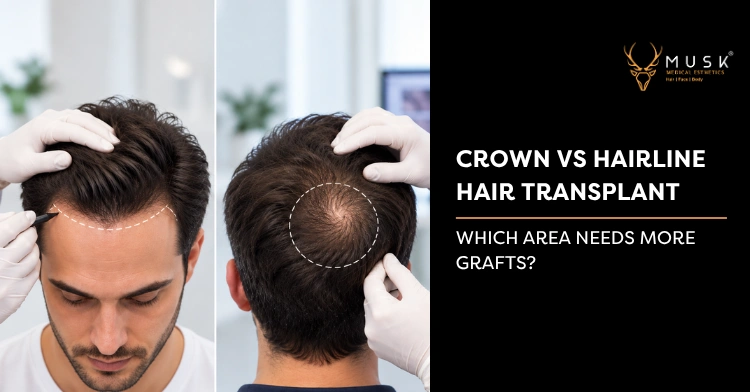
The crown can appear slower to develop than the frontal hairline, and it often deserves a longer observation period before the result is judged.
The crown is different from the frontal zone because follicles must reproduce the natural circular or spiral whorl while covering a comparatively broad scalp area.
Musk Clinic’s dedicated crown hair transplant guidance notes that initial growth may appear around months three to four, become more visible from six to nine months and continue towards the final appearance over approximately 12 to 18 months.
This means two areas transplanted during the same operation may not appear equally mature at month six.
If your frontal hairline is becoming obvious while the crown still looks relatively sparse, the difference alone does not prove that the crown grafts have failed.
What Changes Between 6 and 12 Months?
Between six and twelve months, the major changes increasingly involve density, hair calibre, length, pigmentation and blending, rather than basic wound healing.
A typical progression can look like this:
Timeline | Typical Development |
Months 3–4 | Fine new hairs begin emerging |
Months 5–6 | Growth becomes easier to see |
Months 6–9 | Density and coverage become noticeably stronger |
Months 9–12 | Hair becomes thicker, longer and easier to style |
12 Months And Beyond | Final maturation is assessed; some areas may continue improving |
Published clinical literature describes appreciable growth around six to nine months and continued improvement towards the final result thereafter.
Musk Clinic’s hair transplant results gallery can also be used to understand why results should be compared using similar hair-loss patterns, transplant areas and graft counts rather than only dramatic before-and-after photographs.
Why Do Some Patients Grow Faster Than Others?
Hair transplant growth does not occur at exactly the same speed in every patient.
Several factors can influence how a six-month result appears.
Individual Hair-Growth Cycles
Follicles do not all leave the resting phase simultaneously.
Some hairs therefore emerge sooner than others.
Hair Characteristics
Thicker and darker hair can create visible coverage earlier than very fine hair.
Treatment Area
Frontal hairline and crown restoration may appear to mature differently.
Existing Native Hair
A recipient area with useful native hair may look fuller earlier than a completely bald region.
Recipient Scalp Condition
Previous surgery, scarring or other scalp characteristics can affect treatment planning and recovery.
Ongoing Hair Loss
Native hair around transplanted follicles can continue to thin from androgenetic alopecia, potentially affecting how dense the overall result appears.
Individual Healing and Health Factors
Medical history, smoking, medications and other individual factors can influence healing and should be discussed with the treating surgeon.
Is Patchy Growth Normal After 6 Months?
Some unevenness can still occur at six months because different transplanted follicles may begin and mature at different times.
A patch that appears weaker than the surrounding transplant should therefore be evaluated in context.
More useful questions include:
- Is there visible new hair in the area?
- Has it improved compared with months three and four?
- Are fine hairs present even if density is low?
- Was the area transplanted at the same density?
- Is it part of the crown?
- Was there existing scar tissue?
- Has native hair continued to thin around it?
Six months is late enough for progress to be reviewed, but often too early for a final judgement based purely on density.
How Should You Check Your 6-Month Result?
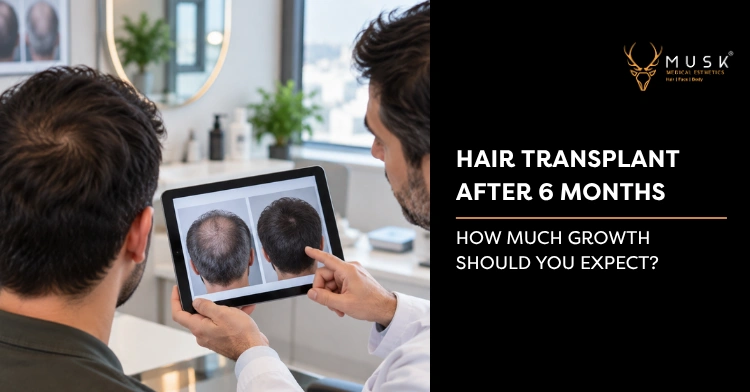
The most reliable way to evaluate progress is to compare standardised photographs, not your appearance under different lighting every day.
Use the following six-month review checklist.
Use The Same Lighting
Strong overhead light can make even healthy hair appear thinner.
Take progress photographs under similar lighting each time.
Keep The Same Camera Angle
Compare front with front, top with top and crown with crown.
Small changes in angle can dramatically alter visible scalp exposure.
Keep Hair Length Similar
A six-month photograph with short hair should not be compared directly with a twelve-month image where the hair is several centimetres longer.
Compare Dry Hair with Dry Hair
Wet or oily hair separates into strands and exposes considerably more scalp.
Review The Hairline and Crown Separately
Different recipient areas can develop at different rates.
Look for Progress, Not Final Density
The main six-month question is:
“Is the result moving in the right direction?”
not:
“Is this my final result?”
This approach produces a more meaningful assessment than trying to count individual hairs in photographs.
What If You Have Very Little Growth After 6 Months?
If there is little or no visible growth anywhere in the transplanted region by six months, it is reasonable to arrange a review with the surgeon who performed the procedure.
That does not automatically mean the transplant has failed.
Clinical references describe variation in regrowth timing, with transplanted hairs appearing over several months and maturation continuing after month six.
A professional review can consider:
- The original graft distribution
- Transplanted areas
- Preoperative photographs
- Hair calibre
- Signs of emerging fine hairs
- Scalp condition
- Native hair loss
- Previous surgery
- Medications and medical history
- Progress photographs from earlier months
Concerns are better assessed using the complete clinical record than through isolated photographs online.
When Should You Contact Your Hair Transplant Surgeon?
Month six is an appropriate time for a routine progress review, particularly if the result is substantially different from what was discussed before surgery.
Contact your medical team sooner if you experience unusual symptoms such as:
- Persistent scalp pain
- New or worsening redness
- Recurrent discharge
- Significant inflammation
- Persistent troublesome folliculitis
- New scarring concerns
- Sudden unusual hair loss
- Other scalp symptoms that concern you
These findings are different from simply having incomplete density at six months.
Incomplete density can still be part of normal maturation. New inflammatory or scalp symptoms need individual assessment.
Can You Speed Up Hair Growth After 6 Months?
There is no guaranteed method to force transplanted follicles to reach their final result faster.
Some treatments have been studied as adjuncts to hair transplantation. For example, clinical trials have investigated platelet-rich plasma in FUE procedures and reported differences in early regrowth or density in certain study groups.
However, this does not mean every patient requires PRP or another add-on treatment.
Similarly, medicines used to manage androgenetic alopecia may be appropriate for some patients, particularly to help preserve native hair, but they should be recommended according to individual medical suitability.
Avoid adding supplements, topical products or medicines solely because an online timeline makes you feel behind.
The safest approach is to discuss your progress with your treating doctor before changing the postoperative plan.
What Should You Avoid Doing at the 6-Month Stage?
The six-month point can create unnecessary anxiety because patients often start comparing themselves with online before-and-after photographs.
Avoid these common mistakes:
- Judging the final result too early
- Counting visible hairs from photographs
- Comparing your crown with someone else’s hairline
- Comparing different graft counts without considering treatment area
- Checking density under changing lighting
- Starting medicines or supplements without medical advice
- Assuming slow growth means failed grafts
- Ignoring continuing loss of your native hair
The most useful comparison is always against your own baseline photographs and earlier progress.
How Does Musk Clinic Review Hair Transplant Progress?
At Musk Clinic, postoperative hair transplant assessment considers more than whether hair is visible at one particular month.
Progress can be reviewed in the context of the original hair-loss pattern, recipient areas, number and distribution of grafts, donor characteristics, existing native hair and the expected growth timeline.
Patients researching treatment can learn more about the clinic’s approach through hair transplant in Ahmedabad.
At six months, the aim of a review is generally to determine whether growth is progressing appropriately, not to judge the final transplant result prematurely.
The Bottom Line
At 6 months after a hair transplant, you should generally expect noticeable growth and visible improvement, but not your final density.
Thinking of the result as roughly halfway developed can be useful for expectation-setting, but it should not be treated as a strict medical percentage. Some follicles may still be emerging, while many hairs that are already growing will continue gaining length, thickness, colour and visual volume over the following months.
The hairline may appear more mature than the crown, and individual growth rates vary.
The most meaningful assessment comes from comparing standardised progress photographs and reviewing the complete treatment plan with your surgeon.
If your six-month progress is causing concern, use the milestone as an opportunity for a clinical review rather than assuming the final outcome has already been reached.
Frequently Asked Questions (FAQs)

Dr. Anand B. Shah
- 10 Years of Experience
Dr Anand B. Shah, is a board-certified Maxillofacial & Craniofacial surgeon who is highly skilled in cosmetic facial and hair restoration surgery and has exclusively practised the same, internationally and nationally.