






Hair Transplant for NRI Patients: Complete Guide to Medical Tourism in India
 By Dr. Anand Shah
 Hair loss is frustrating.
It slowly changes how you see yourself.
You might notice your hairline moving back in photos.
Maybe the crown looks thinner under bright lights. Or maybe friends casually mention it, even if they do not mean any harm.
If you are living abroad as an NRI, the frustration often comes with another problem. Cost.
In countries like the United States, the United Kingdom, Canada, or Australia, a hair transplant can cost anywhere between $8,000 and $15,000, depending on grafts and clinic reputation.
For many people, that price feels overwhelming. You start researching alternatives. That is when India comes into the picture.
India has become one of the world’s leading destinations for medical tourism.
According to India’s Ministry of Tourism and several global healthcare reports, medical tourism in India has grown significantly over the last decade because of advanced technology, skilled doctors, and affordable treatment options.
But this is not just about cost savings.
As an NRI, choosing India often gives you something more important. Comfort. Familiarity. Cultural understanding. Language ease. And access to specialists who perform hair transplant procedures every single day.
That changes the decision completely.
Instead of delaying treatment for years because of high prices, you can plan a short trip to India, combine it with family time if you wish, and return home with a restored hairline and renewed confidence.
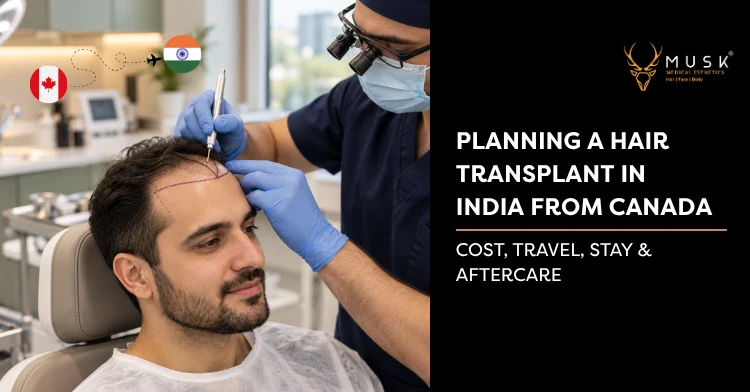
In this guide, you will learn how hair transplant for NRI patients works in India. You will understand what procedures are available, how much you should realistically budget, how long you need to stay, and what recovery looks like once you return abroad.
Why NRIs Prefer India for Hair Transplant
If you are considering a hair transplant, you are not alone.
Thousands of NRIs travel to India every year specifically for hair restoration procedures. The decision is rarely random. It is practical. It is financial. And it is strategic.
Let us break down exactly why India makes sense for you.
Significant Cost Advantage
The first reason is obvious. Cost.
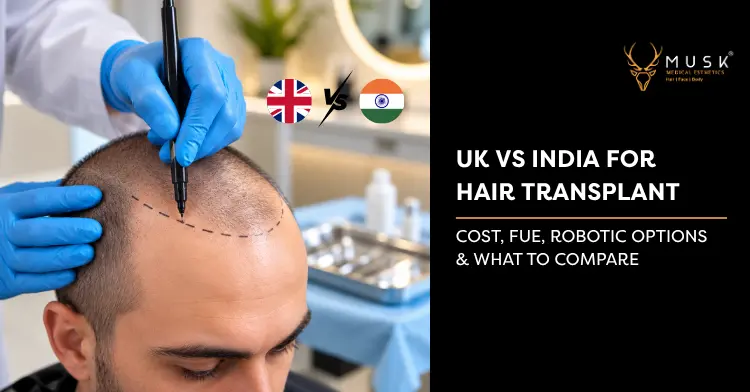
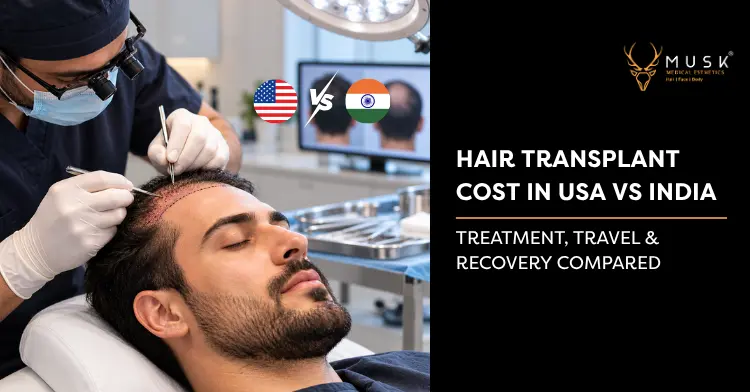
In the United States, the average hair transplant can range from $8,000 to $15,000, depending on grafts and clinic reputation. In the United Kingdom, you might pay £6,000 to £12,000. In Canada or Australia, prices are similarly high.
Now compare that with India.
In India, hair transplant costs are typically calculated per graft. The average cost per graft ranges between ₹25 to ₹60, depending on the clinic, technology, and surgeon expertise. Even for a 3,000-graft session, your total cost may fall between $1,200 to $3,000, approximately.
That is a massive difference.
Even after adding flights, hotel stay, and local travel, you are often still spending far less than you would abroad.
The reason for this difference is not lower quality. It is lower operational costs, currency exchange advantage, and high procedural volume in India.
Advanced Technology and Skilled Surgeons
You might be wondering if lower cost means compromise.
The answer is no if you choose the right clinic.
India has thousands of cosmetic surgeons trained in advanced hair restoration techniques such as:
- FUE, which stands for Follicular Unit Extraction
- Sapphire FUE, which uses sapphire blades for precise incisions
These are the same techniques used in top clinics across the US and Europe.
Many Indian surgeons attend international conferences and are members of global organizations like the International Society of Hair Restoration Surgery. You can verify surgeon memberships directly on the ISHRS website mentioned earlier.
Because India handles a high volume of cases, surgeons often gain extensive hands-on experience. That matters. Experience directly affects graft survival rate, natural hairline design, and density results.
When you choose carefully, you are not compromising on quality. You are leveraging expertise at a better price point.
Easy Communication and Cultural Comfort
Another reason India works well for you as an NRI is communication.
Most hair transplant clinics in India operate in English. Medical documentation, consultations, and postoperative instructions are provided clearly. You do not have to worry about language barriers.
There is also cultural familiarity.
If you are of Indian origin, you already understand the environment. Food preferences, family support, and comfort levels are easier to manage. Many NRIs even combine their procedure with a family visit.
That reduces stress.
And when you are undergoing a medical procedure, even a minor one, comfort makes a difference.
Minimal Waiting Period
In countries like the UK and Canada, waiting times for medical procedures can be long, even in private clinics.
In India, scheduling is usually faster.
Once your online consultation is complete and your graft requirement is assessed, you can often book your procedure within days or weeks, depending on availability.
For you, that means less delay.
Instead of thinking about your hair loss for another year, you can take action now.
What is a Hair Transplant?
Before you book your ticket to India, you need to understand one thing clearly.
Not all hair transplants are the same.
A hair transplant is a surgical procedure where hair follicles are taken from one part of your scalp and implanted into areas where hair is thinning or completely gone.
The area where hair is taken from is called the donor area. Usually, this is the back or sides of your head. These hairs are genetically resistant to hair loss. That is why they are used for transplantation.
The thinning or bald area is called the recipient area.
The key reason hair transplant works long-term is that the transplanted hair retains its original genetic resistance. Once implanted successfully, the hair continues to grow naturally for years.
According to the American Academy of Dermatology, hair transplantation is considered a permanent solution for pattern baldness when performed correctly.
Now, let us talk about the main techniques you will hear about during consultations.
1 - FUE (Follicular Unit Extraction)
FUE stands for Follicular Unit Extraction. This is the most popular technique worldwide today.
In FUE, individual hair follicles are extracted one by one from the donor area using a small punch tool. These follicles are then implanted into tiny incisions made in the recipient area.
There is no large linear scar. Instead, you get tiny dot scars that are barely visible once healed.
Why you might choose FUE:
- Minimal scarring
- Faster healing compared to older methods
- Suitable for short hairstyles
- Less postoperative discomfort
Most NRI patients prefer FUE because it allows them to return abroad quickly without visible signs of surgery.
FUE sessions can range from 1,500 to 4,000 grafts, depending on your hair loss stage and donor capacity.
This technique is ideal if you have moderate hair loss and a strong donor area.
2 - FUT (Follicular Unit Transplantation)
FUT stands for Follicular Unit Transplantation. It is also known as the strip method.
In this technique, a thin strip of skin with hair follicles is removed from the donor area. The strip is then dissected under a microscope into individual grafts and implanted into the recipient area.
Because a strip is removed, FUT leaves a linear scar at the back of the head. This scar can usually be covered if you keep your hair slightly longer.
Why do some patients still choose FUT:
- Sometimes allows a higher number of grafts in one session
- It may be suitable if the donor density is very high
- Can be cost-effective in certain clinics
However, many international patients prefer FUE because it avoids a visible linear scar and has a shorter recovery window.
During your consultation, the surgeon will evaluate your scalp and recommend the most suitable technique.
3 Sapphire FUE
You will also hear about advanced versions of FUE.
Sapphire FUE uses sapphire blades instead of traditional steel blades to create recipient site incisions. The idea is to create finer, cleaner incisions that may improve healing and density placement.
For you, the difference usually comes down to:
- Density goals
- Budget
- Surgeon’s expertise
- Specific hairline design requirements
The technique matters, but the surgeon’s experience matters more. A skilled surgeon can produce natural results with FUE or Sapphire FUE when done correctly.
Cost Breakdown for NRI Patients
When you are planning a hair transplant from abroad, you are not just thinking about the procedure cost. You are thinking about the total investment. That includes graft charges, travel, stay, and recovery expenses.
The good news is that even after adding everything together, India is still significantly more affordable than most Western countries.
Let us break it down clearly.
Per Graft Cost in India
In India, hair transplant pricing is usually calculated per graft.
On average, you can expect:
- ₹25 to ₹60 per graft, depending on clinic reputation and technology
- Premium clinics may charge slightly higher for advanced methods like Sapphire FUE
To give you a rough dollar estimate, that typically translates to about $0.30 to $0.75 per graft, depending on exchange rates.
For comparison, in the United States, the average cost per graft ranges from $4 to $8.
That is a major difference.
Here is a simple comparison example:
- USA: 3,000 grafts at $5 per graft = $15,000
- India: 3,000 grafts at ₹40 per graft = ₹120,000
That is roughly $1,500, depending on the exchange rate
This price difference is the primary reason many NRIs seriously consider traveling to India.
Total Cost Based on Graft Requirement
Your total procedure cost depends on how many grafts you need.
Here is a general estimate:
- 1,500 grafts: Approximate cost in India: $500 to $1,200
- 2,500 grafts: Approximate cost in India: $900 to $2,000
- 3,500 grafts: Approximate cost in India: $1,300 to $2,800
- 4,000 grafts or more: Approximate cost in India: $1,800 to $3,500
The exact number depends on:
- Technique used
- Surgeon’s experience
- Clinic infrastructure
- Complexity of hairline design
Keep in mind that higher graft sessions require careful planning. An experienced clinic will not promise unrealistic numbers just to attract you.
Always ask for a detailed breakdown in writing after your online consultation.
Additional Travel Expenses
Now, let us factor in travel.
You should realistically budget for:
- Flights: Round-trip tickets from the US, UK, Canada, or Australia may range from $700 to $1,500, depending on the season.
- Hotel Stay: You will typically need to stay 5 to 7 days. A comfortable hotel may cost $40 to $120 per night, depending on the city and standard. For one week, that could be $300 to $800.
- Local Transportation: Airport pickup and drop off are often included in medical tourism packages. If not, local transport may cost $50 to $150 total.
- Medication and Aftercare Products: These are usually included in the procedure cost, but it is good to confirm.
So your estimated total trip cost may look like this:
Procedure: $2,000
Flight: $1,200
Hotel: $600
Miscellaneous: $200
Total: $4,000
Even at $4,000, you are still saving thousands compared to Western pricing.
That is why many NRIs see this as a smart financial decision rather than a compromise.
Medical Tourism Packages for NRIs
Many reputable clinics in India offer NRI-focused packages.
These packages often include:
- Online consultation
- Personalized graft planning
- Procedure charges
- Airport pickup and drop off
- Hotel accommodation options
- Postoperative checkups
- Remote follow-up consultations
This makes your planning easier.
Instead of coordinating everything separately, you get a structured experience from arrival to departure.
Step-by-Step Process for NRIs Planning Hair Transplant in India
Now that you understand the procedures and the cost, let us focus on execution.
Planning your hair transplant from abroad does not have to be complicated. In fact, most of the process can be completed before you even book your flight.
If you follow a structured approach, you reduce risk, avoid surprises, and make the entire journey smooth.
Here is how you do it.
Online Consultation
Your journey starts with an online consultation.
Most reputable clinics in India offer virtual assessments for NRI patients. You will usually be asked to send clear photos of your scalp from multiple angles:
- Front hairline
- Top view
- Crown
- Both sides
- Back donor area
Make sure the lighting is good, and your hair is dry. Blurry or unclear images can lead to inaccurate graft estimation.
After reviewing your photos, the clinic will:
- Estimate the number of grafts required
- Recommend the best technique
- Share a tentative cost
- Explain the expected results
Some clinics also schedule a video consultation so you can speak directly with the surgeon.
Selecting the Right Clinic
This is the most important decision you will make.
Do not choose a clinic based only on the lowest price. That is where many patients make mistakes.
Here is what you should evaluate carefully:
- Surgeon Credentials: Check the surgeon’s qualifications. Look for specialized training in hair restoration. Verify memberships in professional organizations such as the International Society of Hair Restoration Surgery.
- Before and After Photos: Ask for high-resolution, consistent lighting images. Look for natural hairlines, proper density, and realistic outcomes.
- Patient Testimonials: Look for video testimonials if possible. Reviews from international patients can give you confidence.
- Transparency in Communication: If a clinic promises 6,000 grafts in one day without properly evaluating your donor area, that is a red flag.
- Direct Surgeon Involvement: Confirm whether the surgeon performs key steps such as hairline design, extraction supervision, and graft implantation.
When you choose carefully, you reduce the chances of poor density, unnatural hairlines, or overharvesting of donor hair.
Visa and Travel Planning
Most NRIs can travel to India using a tourist visa.
However, you should confirm visa requirements based on your country of residence through the official Indian visa portal.
In some cases, a medical visa may also be an option, especially if you are combining procedures.
Plan your stay for at least 5 to 7 days.
Typical timeline:
- Day 1: Arrival and in-person consultation
- Day 2: Procedure
- Day 3 to 5: Initial recovery and first wash
- Day 6 or 7: Fly back
Avoid scheduling your flight too soon after the procedure. Give yourself a few days for swelling to reduce and initial healing to begin.
Book flexible tickets if possible.
Procedure Day Experience
On the day of your procedure, you can expect the following:
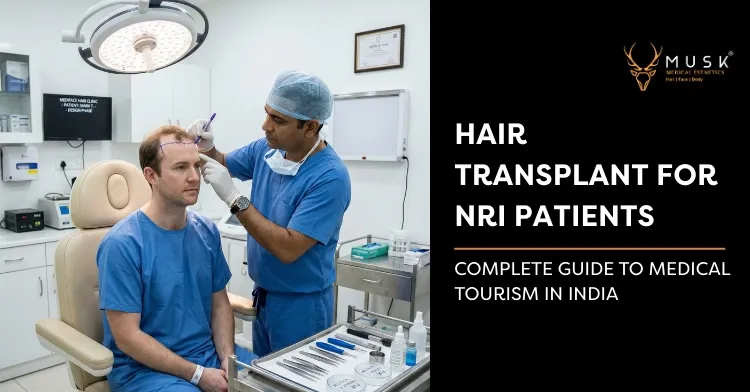
You arrive at the clinic in the morning. The surgeon will review your case again and draw your hairline. This is your chance to discuss density and design.
Local anesthesia will be administered. You will remain awake, but you should not feel pain during the procedure.
Depending on the number of grafts, the session may last 6 to 8 hours. There may be short breaks in between.
After implantation is complete, your scalp will be bandaged or covered lightly. You will receive medication and postoperative instructions before leaving.
Most hair transplants are day-care procedures. You go back to your hotel the same day.
You may experience mild swelling or tightness for a few days. This is normal.
Post-Procedure Stay and Travel Back
The first few days are important.
You will usually return to the clinic for a gentle hair wash on day 2 or 3. The staff will show you how to wash your hair properly once you return abroad.
You should avoid:
- Touching or scratching the grafted area
- Heavy exercise
- Direct sun exposure
- Alcohol for a few days
Flying back is generally safe after 3 to 5 days, but always confirm with your surgeon.
When you return home, follow the aftercare plan strictly. Most clinics offer remote follow-up through video calls and progress photo reviews.
This ongoing communication is especially important for NRI patients.
If you plan well, the entire process can be smooth, structured, and predictable.
Recovery Timeline for International Patients
One of the biggest concerns you may have is this.
What happens after I fly back?
The good news is that hair transplant recovery is predictable. When performed correctly and when aftercare instructions are followed properly, the healing process follows a clear timeline.
If you understand what to expect, you will not panic during normal phases like shedding or mild swelling.
Let us walk through it step by step.
First 7 Days
The first week is all about protection and healing.
In the first 2 to 3 days, you may notice:
- Mild swelling on the forehead
- Small scabs forming around grafts
- Slight redness in the recipient area
- Tightness or numbness in the donor area
This is completely normal.
Swelling usually peaks around day 2 or 3 and then gradually subsides. Sleeping with your head slightly elevated helps reduce swelling.
Tiny scabs will form around each implanted graft. Do not scratch or pick at them. These scabs typically fall off within 7 to 10 days.
If you experience severe pain, unusual discharge, or high fever, contact your clinic immediately. However, serious complications are rare when the procedure is performed under sterile conditions.
Weeks 2 to 4
This is the phase that surprises many patients.
Around week 2 to 4, you may notice the transplanted hairs starting to fall out.
Do not panic.
This is called shock loss, and it is completely normal. The hair shafts shed, but the implanted follicles remain inside the scalp.
According to the American Academy of Dermatology, shedding after transplant is a common and temporary phase before new growth begins.
During this time:
- Your scalp may look similar to how it looked before surgery
- You may feel like nothing has changed
This phase requires patience.
The follicles are adjusting and entering a resting phase before new growth begins.
Months 3 to 6
Now the exciting part begins.
Around month 3, you may start noticing tiny new hairs emerging in the transplanted area.
At first, growth may look thin and uneven. That is normal. Hair grows in cycles.
By month 4 or 5:
- Hair becomes more visible
- Density starts improving
- The hairline looks more defined
At this stage, you will likely feel more confident. Friends or colleagues may begin to notice subtle improvement.
Remember, growth speed varies from person to person. Genetics, aftercare, and overall health play a role.
9 to 12 Months
This is when you see your real results.
By month 9:
- Hair thickens significantly
- Density improves noticeably
- Hair blends naturally with existing strands
By month 12:
- You typically see 80 to 100 % of the final result
- Hair looks natural
- You can cut, style, and manage it like normal hair
In some crown cases, full density may take slightly longer, up to 14 to 16 months.
At this stage, most NRI patients feel the decision to travel to India was worth it.
You invested time and planning. Now you see permanent, natural growth.
The key throughout recovery is communication. Continue sending progress photos to your clinic. Attend virtual follow-ups if offered. Ask questions if you are unsure about anything.
Risks and How to Minimize Them
Let us be honest.
Every surgical procedure carries some level of risk. A hair transplant is considered minimally invasive, but that does not mean you should ignore potential complications.
The key is not fear. The key is preparation.
When you choose the right clinic and follow instructions properly, risks become very manageable.
Here is what you should realistically know.
Shock Loss
Shock loss is one of the most common concerns.
You may temporarily lose some existing hair around the transplanted area after surgery. This happens because the scalp experiences minor trauma during implantation.
In most cases, this hair grows back within a few months.
You can reduce the risk or severity of shock loss by:
- Choosing an experienced surgeon
- Avoiding aggressive overpacking of grafts
- Following postoperative care carefully
- Taking prescribed medications if recommended
Shock loss is usually temporary. Do not confuse it with permanent damage.
Swelling and Redness
Mild swelling on the forehead and around the eyes is common during the first few days.
Redness in the recipient area can last a few days to a couple of weeks, depending on your skin type.
You can minimize swelling by:
- Sleeping with your head elevated
- Avoiding bending forward too often
- Taking prescribed anti-inflammatory medication
These symptoms typically resolve on their own.
Infection Risk
Infection after a hair transplant is rare, especially when performed in a sterile clinical setting.
However, infection can occur if:
- Hygiene standards are poor
- You scratch or touch the grafts with unclean hands
- Aftercare instructions are ignored
To minimize risk:
- Follow cleaning instructions exactly
- Take prescribed antibiotics if given
- Avoid gyms, swimming pools, and dusty environments during early recovery
If you notice unusual pain, pus discharge, or persistent fever, contact your clinic immediately.
Poor Density or Unnatural Hairline
This is the risk you should be most concerned about.
An inexperienced clinic may:
- Overharvest your donor area
- Implant grafts at the wrong angle
- Create an unnatural, straight hairline
- Promise unrealistic graft numbers
Once the donor area is damaged, it cannot be restored easily.
That is why selecting the right clinic matters more than finding the cheapest option.
To minimize this risk:
- Review multiple before and after cases
- Confirm the surgeon personally designs your hairline
- Ask how many grafts are safe for your donor area
- Avoid clinics that push immediate booking without proper evaluation
A natural hair transplant should look undetectable.
Conclusion
By now, you have a complete picture.
- You understand the procedures.
- You know the realistic cost.
- You know how to plan your trip.
- You know what recovery looks like.
- You understand the risks and how to minimize them.
Now the only question left is this.
Where should you go?
Choosing the right clinic is the most important decision in your entire hair transplant journey.
As an NRI, you need more than just a surgeon. You need a team that understands long-distance planning, remote consultations, travel coordination, and structured follow-up after you return abroad.
This is where the Musk Clinic stands out.
At Musk Clinic, your journey starts with a detailed online consultation. You receive a clear graft estimate, honest advice, and realistic expectations. No exaggerated promises. No pressure tactics. Just transparent guidance based on your donor capacity and hair loss stage.
If you are serious about restoring your hair safely and affordably in India, the next step is simple.
Frequently Asked Questions (FAQs)

Dr. Anand B. Shah
- 10 Years of Experience
Dr Anand B. Shah, is a board-certified Maxillofacial & Craniofacial surgeon who is highly skilled in cosmetic facial and hair restoration surgery and has exclusively practised the same, internationally and nationally.