






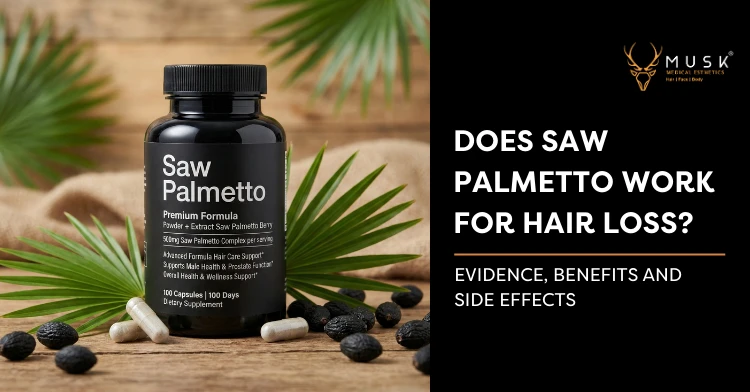
Does Saw Palmetto Work for Hair Loss? Evidence, Benefits and Side Effects
 By Dr. Anand Shah
 If you are dealing with hair thinning or early hair loss, you have probably come across saw palmetto while searching for solutions.
It often appears in articles, supplements, and hair care products that promise a more natural way to slow hair loss.
The big question is whether saw palmetto actually works or if it is just another popular ingredient with overstated claims.
Many people today look for alternatives to prescription hair loss treatments.
Some want to avoid potential side effects, while others prefer plant-based or non-prescription options. This has made saw palmetto one of the most talked-about natural ingredients for hair loss, especially for people concerned about hormone-related thinning.
Saw palmetto is often compared to prescription medications that target DHT, a hormone linked to pattern hair loss.
Supporters claim it can help reduce hair thinning by working on the same pathway, just in a gentler way. Critics argue that the evidence is limited and that results are often subtle at best.
This mix of opinions can make it hard to know what to believe.
In this guide, you will get a detailed and balanced look at saw palmetto for hair loss.
What Is Saw Palmetto?
Saw palmetto is a small palm plant that grows mainly in the southeastern United States.
The plant produces dark berries, and these berries are the part used for supplements and extracts.
Historically, saw palmetto was used in traditional medicine for urinary and reproductive health. Native American communities used the berries for a range of concerns, including digestive and urinary issues.
Over time, it became more widely used in modern herbal medicine, especially for conditions related to the prostate.
The connection to hair loss came later, when researchers noticed that saw palmetto appeared to affect certain hormonal pathways involved in both prostate health and hair growth.
Why Saw Palmetto Is Linked to Hair Loss
Saw palmetto became associated with hair loss because of its potential effect on hormones, specifically dihydrotestosterone, also known as DHT.
DHT is a hormone that plays a major role in pattern hair loss.
In people who are genetically sensitive, DHT causes hair follicles to shrink over time, leading to thinner hair and eventual hair loss.
Saw palmetto is thought to help reduce the activity of an enzyme involved in converting testosterone into DHT. Because prescription hair loss medications work by targeting this same pathway, saw palmetto began to attract attention as a natural alternative.
It is important to note that while the theory makes sense biologically, the strength of this effect and how well it translates to real-world hair growth is still being studied.
Understanding this link helps set the stage for examining how hair loss works and why DHT is such a critical factor.
What Causes Pattern Hair Loss?
The most common form of hair loss is androgenetic alopecia.
This is often called male pattern hair loss or female pattern hair loss. If you have a family history of thinning hair, you are more likely to experience it yourself.
In pattern hair loss, hair follicles gradually become smaller over time. Each new hair that grows is thinner, shorter, and weaker than the one before. Eventually, some follicles stop producing visible hair altogether.
This process happens slowly, which is why hair loss can take years to become noticeable.
Pattern hair loss does not usually happen evenly across the scalp.
In men, it often starts at the temples or crown.
In women, it typically appears as overall thinning, especially along the part line.
The underlying cause, however, is similar in both cases.
What Is DHT?
DHT stands for dihydrotestosterone. It is a hormone derived from testosterone through the action of an enzyme called 5-alpha reductase.
DHT plays an important role in male development, but it also has a strong effect on hair follicles.
In people who are genetically sensitive to DHT, this hormone binds to receptors in hair follicles on the scalp. Over time, this interaction shortens the hair growth phase and causes follicles to shrink. As a result, hair grows back thinner after each cycle.
It is important to understand that DHT does not affect all hair equally. Hair follicles on the scalp can be sensitive to DHT, while follicles in the beard or body may actually respond positively to it.
This difference explains why some people lose scalp hair while maintaining or gaining body hair.
Why Targeting DHT Matters
Because DHT plays such a central role in pattern hair loss, many effective treatments focus on reducing its impact.
Some treatments lower overall DHT levels, while others block its action at the follicle level.
Targeting DHT does not usually regrow large amounts of hair on its own, especially in advanced hair loss. However, it can slow or stabilize the thinning process. This is particularly important in early stages, when follicles are still active and capable of producing hair.
This is where saw palmetto enters the conversation. It is believed to influence the same hormonal pathway involved in DHT production, though likely in a milder way than prescription medications.
To understand whether that influence is meaningful, the next step is to look at how saw palmetto is thought to work for hair loss.
How Saw Palmetto Is Thought to Work for Hair Loss
Now that you understand how DHT contributes to pattern hair loss, it becomes easier to see why saw palmetto is often discussed as a potential solution.
The idea behind saw palmetto is not that it creates new hair, but that it may help slow the process that causes hair follicles to weaken over time.
Mechanism of Action
Saw palmetto is believed to work by interfering with the activity of the enzyme called 5-alpha reductase.
This enzyme is responsible for converting testosterone into DHT. By reducing this conversion, saw palmetto may help lower the amount of DHT available to affect hair follicles.
Some laboratory and small clinical studies suggest that compounds in saw palmetto berries can inhibit this enzyme to a certain degree. This is the same general pathway targeted by prescription treatments for pattern hair loss, though the strength of the effect is likely much lower.
Because of this milder action, saw palmetto is often described as a gentler option.
It may not block DHT completely, but it could reduce its impact enough to slow thinning in some people, especially in early stages of hair loss.
Oral vs Topical Saw Palmetto
Saw palmetto can be taken orally as a supplement or applied topically as part of a hair product.
These two forms are thought to work in different ways.
Oral saw palmetto is absorbed into the bloodstream and may influence hormone pathways throughout the body. This broader action is why it has been studied for prostate health as well as hair loss.
However, because supplements vary in strength and absorption, results can be inconsistent.
Topical saw palmetto is applied directly to the scalp. The idea here is to target DHT activity locally at the hair follicle without significantly affecting hormone levels elsewhere. Some products combine saw palmetto with other ingredients that support scalp health or follicle function.
There is currently limited evidence comparing oral and topical forms head to head.
Both approaches are still being studied, and neither has the same level of research support as prescription treatments.
How It Compares to Other DHT Blockers
When compared to established DHT blockers, saw palmetto appears to have a weaker effect.
Prescription medications are designed to produce a predictable and measurable reduction in DHT.
Saw palmetto, on the other hand, varies depending on the extract, dosage, and individual response.
This does not mean saw palmetto has no value. For some people, especially those with mild thinning or concerns about stronger medications, a modest reduction in DHT activity may still be helpful. The key is understanding that results, if they occur, are likely to be subtle and gradual.
To see whether this theory holds up in real life, the next section looks closely at the scientific studies that have examined saw palmetto and hair loss.
Benefits of Saw Palmetto for Hair Loss
After reviewing the evidence, the next logical question is what benefits you can realistically expect from saw palmetto.
While it is not a miracle solution, saw palmetto may offer certain advantages for specific people, especially when hair loss is still in its early stages.
Potential Hair Benefits
When you look at what saw palmetto may actually do for hair loss, it helps to think in terms of support rather than transformation.
The benefits, when they occur, tend to be gradual and subtle.
They are most noticeable when hair loss is still developing and follicles are not severely damaged.
- May slow down hair thinning: Saw palmetto may reduce DHT activity to a small degree. This can help slow the rate at which hair follicles shrink over time, especially in people with early pattern hair loss.
- May reduce excessive hair shedding: Some users notice less hair fall after consistent use. This aligns with research showing that saw palmetto may help stabilize hair loss rather than trigger significant regrowth.
- May help preserve existing hair: By easing hormonal pressure on sensitive follicles, saw palmetto may help hair stay in the growth phase longer. This can support the appearance of fuller and healthier hair over time.
- May improve overall hair quality: In mild cases, some people report slight improvements in hair thickness or texture. These changes are usually modest and develop gradually with consistent use.
Overall, these potential benefits suggest that saw palmetto works best as a maintenance option.
It is more likely to help protect existing hair than to restore areas where hair has already been lost.
Benefits Compared to Prescription Treatments
Many people consider saw palmetto not because it is stronger than prescription treatments, but because it feels like a more approachable first step.
Understanding how it compares helps set realistic expectations.
- Available without a prescription: Saw palmetto can be purchased easily as a supplement or topical product. This makes it accessible for people who are not ready to start prescription medication.
- Perceived as a gentler option: Some individuals prefer saw palmetto because it is plant-based and thought to have milder effects on hormone pathways. This perception is a common reason people try it before medical treatments.
- May feel more suitable for early or mild hair loss: For people with minimal thinning, saw palmetto may offer enough support to slow progression without committing to stronger interventions.
- Lower expectation of dramatic results: Unlike prescription treatments, saw palmetto is not typically expected to deliver strong regrowth. This can make it appealing to those focused on gradual maintenance rather than major change.
While these points explain why saw palmetto is popular, it is important to remember that prescription treatments have far stronger scientific backing.
Saw palmetto may be useful for some people, but it should not be viewed as an equal replacement for medically approved therapies.
Limitations and What Saw Palmetto Cannot Do
Understanding the limits of saw palmetto is just as important as understanding its potential benefits.
Many people feel disappointed because they expect supplement-level treatments to deliver medical-level results. Knowing what saw palmetto cannot realistically do helps you set expectations and make smarter decisions.
- Does not regrow significant lost hair: Saw palmetto cannot bring back hair in areas where follicles have already stopped producing hair. Once follicles become inactive, reducing DHT alone is not enough to restart growth.
- Limited effectiveness in advanced hair loss: When hair thinning has progressed to visible bald patches or widespread loss, saw palmetto is unlikely to make a noticeable difference. Supplements tend to work best when hair loss is still mild.
- Results vary widely between individuals: Not everyone responds the same way to saw palmetto. Differences in genetics, hormone sensitivity, and supplement quality all affect outcomes. This makes results unpredictable.
- Works slowly and produces subtle changes: Any potential benefit usually takes several months to appear. Even then, changes are often mild, such as slower shedding rather than visible regrowth.
- Does not address all hair loss causes: Hair loss can be triggered by stress, nutritional issues, scalp conditions, or medical problems. Saw palmetto targets hormonal pathways only and does not fix these other factors.
Overall, saw palmetto should be viewed as a supportive option rather than a complete solution.
It may help slow thinning in certain cases, but it is not designed to reverse advanced hair loss.
Saw Palmetto vs Finasteride
When deciding whether saw palmetto is worth trying, many people naturally compare it to finasteride.
Both are discussed in the context of DHT and pattern hair loss, but they are not equal in strength, evidence, or expected results.
Learning the differences helps you choose based on facts rather than assumptions.
| Factor | Saw Palmetto | Finasteride |
|---|---|---|
| Type | Dietary supplement derived from a plant extract | Prescription medication |
| How it works | May mildly reduce DHT activity by partially inhibiting 5-alpha reductase | Directly and strongly inhibits 5-alpha reductase |
| Effectiveness for hair loss | Modest and inconsistent results | Clinically proven to slow or stop hair loss in many users |
| Strength of evidence | Limited studies with small sample sizes | Strong evidence from large-scale clinical trials |
| Impact on DHT levels | Mild and variable reduction | Significant and measurable DHT reduction |
| Expected results | Slowing of hair thinning in some early cases | Noticeable stabilization and preservation of existing hair |
| Speed of results | Slow and subtle changes over several months | Results often noticeable within 3–6 months |
| Regulation and consistency | Not strictly regulated; product quality varies | Strictly regulated with consistent dosage |
| Side effect profile | Generally perceived as gentler, but less studied | Well-documented side effects and safety data |
| Best suited for | Mild or early-stage hair thinning, supplement users | Moderate to advanced pattern hair loss |
| Reliability | Unpredictable outcomes | High reliability when used consistently |
Saw palmetto and finasteride are often mentioned together, but they are not interchangeable.
Finasteride offers stronger, more predictable results backed by extensive research.
Saw palmetto may be useful as a supportive option for early hair thinning, but expectations should remain conservative.
Who Should Consider Saw Palmetto for Hair Loss?
Saw palmetto is not a universal solution, but it can make sense for certain people depending on their hair loss stage and personal preferences.
Looking at who it is best suited for helps you decide whether it aligns with your goals and expectations.
- People with early-stage hair thinning: Saw palmetto may be helpful if you are noticing mild thinning or early recession rather than large bald areas. At this stage, hair follicles are still active, which gives supportive treatments a better chance to slow progression.
- Individuals seeking a non-prescription option: If you prefer to explore hair loss solutions that do not require a prescription, saw palmetto may feel like a more accessible starting point. It is often chosen by people who want to avoid medication early on.
- Those focused on slowing hair loss, not regrowth: Saw palmetto is more likely to help stabilize hair loss than to regrow lost hair. It may suit people whose main goal is to preserve existing hair rather than reverse thinning.
- People cautious about stronger treatments: Some individuals are hesitant to begin prescription therapies due to concerns about side effects. For these users, saw palmetto may be considered a gentler, lower-commitment option, as long as expectations remain realistic.
- Those interested in a maintenance-focused approach: Saw palmetto may fit into a long-term maintenance plan when hair loss is progressing slowly. It is often viewed as a supportive measure rather than a primary treatment.
Overall, saw palmetto works best for people who understand its limitations and are comfortable with gradual, modest outcomes.
If your hair loss is more advanced or progressing quickly, it may not be sufficient on its own.
When Saw Palmetto May Not Be the Right Choice
Saw palmetto can be a reasonable option in certain situations, but it is not suitable for everyone.
Knowing when it is unlikely to help can prevent delays in getting the right treatment and help you manage expectations more effectively.
- Advanced hair loss or visible bald areas: Saw palmetto is unlikely to help when hair follicles have already become inactive. Large bald patches, deep recession, or long-term thinning usually require more targeted treatments.
- Need for faster or stronger results: If hair loss is progressing quickly or causing significant concern, saw palmetto may feel too slow and subtle. It does not provide the level of reliability seen with medical treatments.
- Hair loss caused by non-hormonal factors: Hair shedding triggered by stress, nutritional deficiencies, medical conditions, or scalp issues will not improve by targeting DHT alone. Saw palmetto does not address these underlying causes.
- Expecting significant regrowth from supplements alone: Saw palmetto is not designed to regrow large amounts of hair. If your goal is visible regrowth rather than stabilization, relying on it alone can lead to disappointment.
- Unclear hair loss diagnosis: Starting saw palmetto without understanding your hair loss type may delay more effective options. Early and accurate assessment is key to better long-term outcomes.
Overall, saw palmetto should not be used as a default solution when hair loss is advanced or rapidly worsening.
In these cases, professional evaluation becomes especially important.
Conclusion
Saw palmetto can sound appealing, especially if you are looking for a natural or non-prescription way to address hair loss.
However, the evidence shows that its effects are usually subtle, slow, and not reliable for everyone.
Hair loss is a complex condition influenced by genetics, hormones, lifestyle, and overall health.
What works for one person may not work for another. Supplements like saw palmetto can play a supportive role in certain cases, but they are rarely enough on their own when hair loss is progressing or already advanced.
Making decisions based only on online claims or trends can lead to wasted time and missed opportunities for more effective treatment.
This is where professional guidance becomes essential. A proper assessment helps identify the exact type and stage of your hair loss and clarifies which treatments are most likely to work for you.
At Musk Clinic, hair loss is approached with care, precision, and personalization. Each patient receives a detailed evaluation to determine whether options like supplements, medical treatments, or advanced procedures are appropriate.
The focus is always on solutions that deliver safe, natural, and lasting results rather than quick fixes.
Frequently Asked Questions (FAQs)

Dr. Anand B. Shah
- 10 Years of Experience
Dr Anand B. Shah, is a board-certified Maxillofacial & Craniofacial surgeon who is highly skilled in cosmetic facial and hair restoration surgery and has exclusively practised the same, internationally and nationally.