





Australia to India for Hair Transplant: Cost, Flights, Recovery & Treatment Planning
 By Dr. Anand Shah
Introduction
Traveling from Australia to India for a hair transplant is not simply a choice between two procedure prices. The real plan includes your graft requirement, treatment technique, flights, visa, accommodation, time away from work, long-haul return travel, early recovery and aftercare after you are back in Australia.
For patients in Sydney, Melbourne, Brisbane, Perth, Adelaide and other Australian cities, India may be worth comparing when procedure cost and treatment options are important. But a lower headline quote is only useful if the treatment plan is clinically appropriate and the travel and follow-up arrangements are realistic.
Musk Clinic is located in Ahmedabad, Gujarat, India. It does not operate a hair transplant clinic in Australia. This guide explains how Australian patients can compare the full treatment journey before committing to surgery or non-refundable travel.
Key Takeaways
- Compare Like for Like: Match the graft estimate, treatment areas, technique and surgeon involvement before comparing an Australian quote with an India quote.
- Budget Beyond Surgery: Flights, visa, accommodation, local transport, meals, time away from work and possible unplanned care all affect the total trip cost.
- Medicare Has Limits: Medicare generally does not cover elective cosmetic surgery, and the MBS hair-transplant item specifically excludes male pattern baldness.
- Plan Flights Around Recovery: A long-haul itinerary should be built around postoperative review and travel readiness, not the shortest possible stay.
- Check Medical-Tourism Insurance: Standard travel insurance may exclude planned procedures or complications, so Australians should verify cover before booking.
- Choose Technique for the Patient: Manual FUE, FUT and robotic-assisted FUE are different approaches. Suitability depends on the donor area, hair-loss pattern and long-term plan.
- Australia-Specific Results Exist: Musk Clinic publishes documented cases from New South Wales and Brisbane using ARTAS robotic FUE. Those cases can show process and planning, but they cannot predict another patient’s result.
How Should Australians Compare Hair Transplant Cost in India with Treatment at Home?
There is no single national hair-transplant price in Australia or India. Private cosmetic pricing varies by graft requirement, treatment area, technique, surgeon involvement and clinic. For Australians considering India, the useful comparison is the total cost of two similar treatment plans rather than two unrelated advertised prices.
A 1,500-graft frontal restoration should not be compared with a 3,200-graft hairline, mid-scalp and crown procedure simply because both are called FUE. Ask each clinic to explain the estimated graft count, technique, included care and whether another session may reasonably be needed.
| Cost Factor | Treatment in Australia | Treatment in India from Australia |
|---|---|---|
| Hair Transplant Procedure | Usually the main direct expense for private cosmetic treatment | May have a lower procedure-level quote depending on the treatment plan |
| Flights | Usually unnecessary when treatment is local | International airfare and possible connecting flights required |
| Visa and Entry Requirements | Not applicable for domestic treatment | Appropriate Indian visa and current entry requirements must be confirmed |
| Accommodation | May be minimal for local treatment | Ahmedabad stay should cover consultation, treatment and early review |
| Local Transport | Routine travel from home to clinic | Airport transfers and local travel should be budgeted |
| Time Away from Work | Mostly treatment and local recovery time | Includes travel days, treatment, early recovery and a return-flight buffer |
| Follow-Up | In-person review may be easier | Remote follow-up should be organized before leaving India |
| Unexpected Care | Access to the treating clinic may be simpler | Extra hotel nights, changed flights or local care in Australia can add cost |
Bottom Line: Compare the complete door-to-door plan for the same clinical treatment, not just the surgery fee converted between AUD and INR.
What Changes the Hair Transplant Quote?
The quote changes when the treatment plan changes. Graft count is important, but donor quality, recipient area, technique, previous surgery and long-term hair-loss planning can all affect the procedure and its cost.
- Extent of hair loss and size of the recipient area
- Estimated graft requirement and available donor reserve
- Hairline, temple, mid-scalp, crown or vertex involvement
- Manual FUE, FUT or robotic-assisted FUE where appropriate
- Previous transplant scars or repair work
- Hair calibre, curl, density and donor characteristics
- Whether one session or staged treatment is more realistic
- Surgeon involvement, clinic infrastructure and technology
- Medicines, postoperative care and follow-up included in the quote
Patients can review Musk Clinic’s hair transplant cost factors before requesting a personalized estimate.
Does Medicare Cover Hair Transplant Surgery for Male Pattern Baldness?
For typical cosmetic male pattern baldness, Australians should generally plan for hair transplantation as a self-funded procedure. The Australian Government states that Medicare does not cover elective and cosmetic surgery. The Medicare Benefits Schedule hair-transplant item applies to certain congenital, traumatic or disease-related alopecia and specifically excludes male pattern baldness.
Patients who are unsure about a medical indication can review the current Medicare coverage guidance and the MBS hair-transplant item or discuss their situation with their Australian doctor.
Will Australian Travel Insurance Cover a Planned Hair Transplant in India?
Do not assume that standard travel insurance covers medical tourism. Smartraveller advises that basic travel policies rarely cover planned medical procedures and recommends checking cover for postoperative care, complications and medical evacuation. Medicare also does not cover healthcare costs overseas.
Before paying for flights or surgery, read the current Smartraveller medical tourism guidance and ask your insurer in writing what is included and excluded.
What Should You Send Before Booking Flights from Australia?
A remote assessment should establish whether the trip is reasonable before you purchase flights. Photographs cannot replace the final in-person examination, but they can help estimate the hair-loss pattern, donor capacity, likely graft requirement and whether FUE, FUT or robotic-assisted FUE may be considered.
- Front hairline photograph
- Left and right temple views
- Top and mid-scalp photograph
- Crown or vertex photograph
- Back and side donor-area photographs
- Age and history of hair loss
- Family history of pattern hair loss
- Previous medicines, PRP or transplant procedures
- Current medicines, allergies and relevant medical conditions
- Smoking history and treatment goals
Musk Clinic’s medical tourism process includes pre-travel consultation and planning for international patients.
How Should You Plan Flights from Australia to Ahmedabad?
Flights should be planned around the medical itinerary, not the other way around. Depending on your departure city and airline, travel to Ahmedabad may involve one or more connections, so allow enough time to arrive rested, complete the in-person assessment and avoid rushing directly from a long-haul flight into surgery.
Before the Outbound Flight
- Confirm the treatment date only after the online assessment and clinic plan
- Choose an itinerary that allows recovery from jet lag and travel fatigue before surgery
- Keep medicines and essential documents in cabin baggage
- Avoid tightly timed connections that create unnecessary stress before treatment
- Consider flexible or changeable fares if postoperative travel timing may need adjustment
Before the Return Flight
- Keep the return date flexible until early recovery has been reviewed
- Ask how to protect the recipient area during the journey
- Carry prescribed medicines and the clinic’s written procedure summary
- Plan for luggage handling so you are not lifting heavy bags soon after surgery
- Know who to contact if swelling, bleeding, pain or another concern develops after you leave India
What Visa and Entry Requirements Should Australian Patients Check?
Australian citizens traveling specifically for treatment should verify the correct Indian visa category and current entry requirements before booking. India’s official e-Visa system includes an e-Medical Visa category, but eligibility, documentation and arrival rules can change.
Use the official Government of India e-Visa portal for current requirements, and check the latest Smartraveller India advice close to your travel date.
If you hold an Overseas Citizen of India card or another travel status, confirm the documents that apply to you. Do not rely on an older clinic article or social-media post for entry rules.
How Long Should You Stay in Ahmedabad After a Hair Transplant?
The stay should cover the in-person assessment, procedure, early recovery and postoperative review before a long journey back to Australia. Musk Clinic currently notes that overseas patients are typically advised to plan around 3 to 4 days for pre- and post-operative care, but that should be treated as a planning starting point rather than a guaranteed travel-clearance date.
Your actual stay may need to be longer depending on graft count, technique, swelling, donor healing, medical history and how recovery is progressing. A flexible itinerary is more useful than forcing every patient into the same number of days.
| Stage | What to Plan | Why It Matters |
|---|---|---|
| Before Travel | Complete remote assessment and receive a provisional treatment plan | Reduces the risk of traveling without realistic graft and technique expectations |
| Arrival in Ahmedabad | Allow time for the final in-person scalp and donor examination | The definitive surgical plan is confirmed face to face |
| Procedure Day | Keep the day free for treatment and immediate instructions | Session length depends on graft count and technique |
| Early Recovery | Remain available for washing guidance, swelling review and donor checks | Early concerns are easier to assess while you are near the clinic |
| Before Flying Home | Ask the treating doctor to confirm travel readiness | Long-haul travel should follow clinical recovery rather than a fixed online timetable |
Can You Fly Back to Australia Soon After a Hair Transplant?
Return-flight timing should be decided with the treating doctor after the procedure, not from a generic online timeline. Hair transplantation is usually an outpatient procedure, but a long journey back to Australia still requires planning around swelling, graft protection, medicines, comfort and the possibility of slower-than-expected healing.
Smartraveller recommends thinking carefully about postoperative care and the risks of medical tourism before traveling. The exact timing that is suitable for you depends on the procedure and your recovery, so the treating team should confirm when you are ready to fly.
- Scalp swelling and comfort during a long trip
- Protecting the recipient area from rubbing or accidental contact
- Access to prescribed medicines in cabin baggage
- Hydration, sleep and long periods of sitting
- Avoiding heavy lifting or strenuous luggage handling
- Managing stopovers and extended travel time
- Ability to change the return flight if recovery needs more time
Which Hair Transplant Options Can Australian Patients Consider in Ahmedabad?
Technique should be selected for the patient, not chosen from a marketing label. Australians traveling to Musk Clinic may be assessed for manual FUE, FUT or ARTAS 9X robotic-assisted FUE depending on donor characteristics, hair-loss pattern, previous surgery and restoration goals.
Manual FUE
Follicular Unit Extraction removes individual follicular units from the donor area and transfers them to the planned recipient areas. It avoids a long linear donor scar, although small extraction marks remain and donor management is still important.
FUT
Follicular Unit Transplantation removes a strip of donor scalp that is divided into follicular units. It can be considered in selected cases where the surgeon believes it better fits donor preservation, graft requirements or previous treatment history.
ARTAS 9X Robotic-Assisted FUE
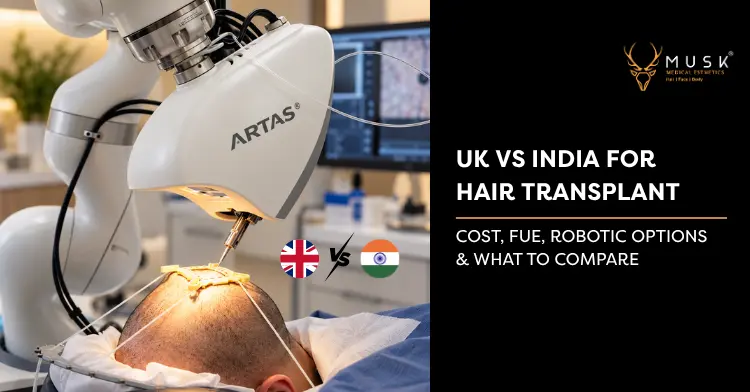
ARTAS 9X is a physician-guided robotic FUE system that uses imaging and robotic assistance during follicular-unit harvesting. Technology can support consistency and planning, but it does not replace surgeon judgment, hairline design or long-term donor strategy.
Patients comparing technology can review Musk Clinic’s ARTAS 9X robotic hair transplant information before consultation.
What Should Australians Compare Before Choosing a Hair Transplant Clinic in India?
Country and price alone do not predict a result. The important comparison is how the clinic plans the donor area, who performs the surgical steps, how the hairline is designed, what evidence is provided and how follow-up works after you return home.
- Who performs or directly supervises extraction and recipient-site creation
- How donor density and long-term donor reserve are assessed
- Whether the graft estimate is explained rather than simply advertised
- How the hairline is designed for age, facial proportions and future hair loss
- Which technique is recommended and why
- Facility standards, infection-control processes and emergency planning
- Documented before-and-after cases with graft count, technique and treatment area
- Written aftercare instructions and a clear plan for remote follow-up
Does Musk Clinic Have Documented Hair Transplant Cases from Australia?
Yes. Musk Clinic’s current results library includes Australia-based cases with stated graft counts, treatment areas and technique. These examples can help prospective patients understand how a real treatment plan was documented, but no individual case should be treated as a prediction or guarantee.
| Patient Location | Technique | Documented Treatment Details |
|---|---|---|
| New South Wales, Australia | ARTAS Robotic FUE | 3,119 grafts; hairline, frontal tuft and mid-scalp; Norwood stage 4A |
| Brisbane, Australia | ARTAS Robotic FUE | 3,235 grafts; hairline, frontal tuft, mid-scalp and vertex; Norwood stage 4A to 5A |
Patients can review the broader hair transplant results library and the documented Brisbane ARTAS case for context.
How Should Aftercare Work After You Return to Australia?
Aftercare should be organized before the procedure. International patients need to know when to send photographs, when video reviews are scheduled, which symptoms can be handled remotely and which concerns require local medical assessment in Australia.
- Keep a written procedure summary, graft count and technique details
- Save the medicines list, allergies and postoperative instructions
- Know when the clinic expects progress photographs or video reviews
- Ask who to contact for urgent questions across time zones
- Know which symptoms require assessment by an Australian GP or emergency service
- Discuss ongoing native-hair loss and whether medical therapy needs local monitoring
- Keep copies of relevant records in case an Australian clinician needs to review you
When Might Treatment in Australia Be More Practical, and When Might India Be Worth Comparing?
Neither route is automatically better. Local treatment may be more practical when easy in-person follow-up and avoiding long-haul travel matter most. India may be worth comparing when the clinical plan, total trip economics, surgeon fit and available technology make sense for you.
| Treatment in Australia May Suit You Better If | Treatment in India May Be Worth Comparing If |
|---|---|
| You strongly prefer local in-person follow-up | Procedure cost is an important decision factor |
| Long-haul travel is medically difficult or stressful | You are comfortable traveling internationally and following a remote-care plan |
| You cannot take additional days for travel and recovery | You can allow enough time in India for treatment and early review |
| You have complex health needs requiring local coordination | You have identified a suitable surgeon, technique and treatment plan |
| The Australian treatment quote fits your budget | You want to compare ARTAS 9X or other options available in Ahmedabad |
| You prefer not to manage visa, hotel and flight logistics | You already travel to India or have family support during the trip |
Bottom Line: The choice should combine clinical suitability, total cost, travel practicality and aftercare rather than price alone.
What Questions Should You Ask Before Booking an Australia-to-India Hair Transplant Trip?
Get the treatment plan, responsibilities, costs and follow-up process in writing before paying for non-refundable travel. Use the same level of scrutiny you would apply to surgery in Australia.
Treatment Plan
- Why am I considered a suitable candidate?
- How many grafts are estimated and which areas will be treated?
- How much donor reserve should remain for future hair loss?
- Why is manual FUE, FUT or robotic-assisted FUE being recommended?
Surgeon and Facility
- Who designs the hairline?
- Who performs extraction, recipient-site creation and implantation?
- What facility standards and emergency processes are in place?
- Can I see documented cases with similar hair loss and treatment areas?
Cost and Travel
- What does the quotation include and exclude?
- Could another session reasonably be needed?
- How many days should I plan to remain in Ahmedabad?
- What happens if my return flight needs to change?
Aftercare
- When should I send progress photographs?
- Are scheduled video reviews available?
- Who do I contact for urgent questions?
- What symptoms mean I should seek local medical care in Australia?
Why Might Australia-Based Patients Consider Musk Clinic in Ahmedabad?
For an Australian patient, the useful question is not simply whether treatment in India costs less. It is whether the clinic can create a realistic plan before travel, explain donor strategy and technique, support the stay in Ahmedabad and continue follow-up after the patient returns home.
- Ahmedabad-based hair restoration with pre-travel consultation for international patients
- Manual FUE, FUT and ARTAS 9X robotic-assisted FUE options where clinically appropriate
- Treatment planning based on donor area, hair-loss pattern and long-term goals
- Medical tourism support with travel-planning, accommodation and transport guidance
- Remote postoperative support for patients returning overseas
- Documented patient cases from New South Wales and Brisbane with stated graft counts and technique
These factors can make the journey easier to evaluate, but suitability, recovery and expected outcomes still need to be assessed individually.
The Bottom Line
Planning an Australia-to-India hair transplant should start with the clinical plan, not the airfare. Establish donor capacity, likely graft needs, technique, surgeon involvement and aftercare first. Then calculate the complete budget for flights, visa, accommodation, local transport, time away from work and a recovery buffer.
For Australians considering Musk Clinic in Ahmedabad, an online assessment can help determine whether the trip is reasonable before money is committed to travel. The goal is not to find the lowest advertised number. It is to compare a treatment plan that is clinically appropriate, logistically realistic and supported after you return home.
Frequently Asked Questions (FAQs)

Dr. Anand B. Shah
- 10 Years of Experience
Dr Anand B. Shah, is a board-certified Maxillofacial & Craniofacial surgeon who is highly skilled in cosmetic facial and hair restoration surgery and has exclusively practised the same, internationally and nationally.