






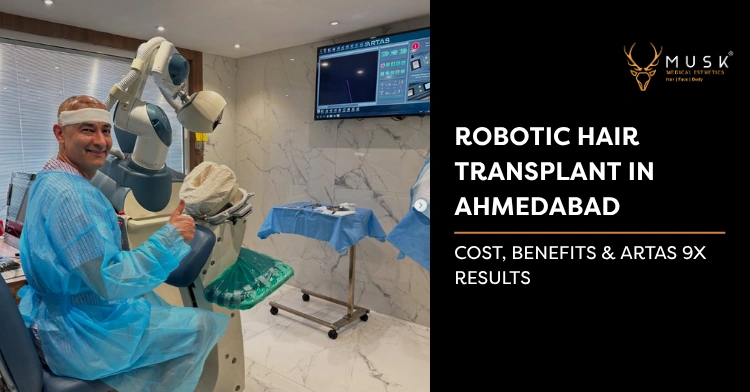
Robotic Hair Transplant in Ahmedabad: Cost, Benefits & ARTAS 9X Results
 By Dr. Anand Shah
 Hair loss decisions can feel overwhelming because every clinic seems to promise natural results, fast recovery, and advanced technology. The real question is simpler: is a robotic hair transplant in Ahmedabad the right option for your hair loss pattern, budget, and long-term goals?
ARTAS 9X robotic hair transplant is a technology-assisted form of FUE. It uses imaging, mapping, and robotic precision to help identify and harvest suitable follicular units from the donor area. But the best results still depend on medical planning, aesthetic judgement, and careful follow-up.
At Musk Clinic, patients usually ask three questions first: how much will it cost, how is ARTAS 9X different from manual FUE, and when will I see results? This guide answers those questions in a practical way, without making unrealistic promises.
Use this as a decision guide before your consultation. It explains benefits, limitations, cost factors, recovery, results, and the questions you should ask before choosing robotic hair restoration.
Key Takeaways
- ARTAS 9X is an advanced FUE option: Robotic hair transplant uses image-guided technology to assist follicle harvesting and support consistent graft selection for suitable candidates.
- Cost is case-specific: Robotic hair transplant cost in Ahmedabad depends on graft count, baldness grade, donor area quality, technique, surgeon involvement, and aftercare.
- Robotics does not replace planning: A natural result still depends on hairline design, graft distribution, donor management, recipient-site creation, and medical follow-up.
- Results take time: Early growth often begins after a few months, but fuller cosmetic change usually develops gradually over 9 to 12 months.
- Candidate selection matters: ARTAS 9X is not ideal for every hair type, scalp condition, or hair loss pattern, so evaluation is essential before booking.
- The donor area is finite: A good plan protects the back and sides of the scalp because those follicles are the main source for long-term coverage.
- Aftercare affects experience: Recovery, washing, sun protection, medication use, PRP support, and follow-up all influence how smoothly the patient journey feels.
- Comparison should go beyond price: Patients should compare technology, doctor oversight, safety systems, real results, and follow-up care before choosing a clinic.
What is a robotic hair transplant in Ahmedabad?
A robotic hair transplant in Ahmedabad is a doctor-planned FUE hair restoration procedure where robotic technology assists with donor-area mapping and follicle harvesting. The robot supports precision and consistency, but your doctor still decides candidacy, hairline design, graft distribution, safety planning, and long-term treatment strategy.
In standard FUE, individual follicular units are removed from the donor area, usually the back and sides of the scalp, and transplanted into thinning or bald areas. ARTAS 9X builds on this idea by using digital imaging and robotic assistance during the extraction phase.
The official Venus ARTAS platform describes robotic hair restoration as using stereoscopic vision, AI-driven follicle analysis, and a robotic arm to help physicians harvest grafts with repeatability. That matters most during long sessions, where fatigue and tiny changes in angle can affect extraction quality.
Still, the technology is only one part of the result. Hairline shape, angle, density, donor preservation, and future hair loss planning are medical and artistic decisions. A skilled team must connect the robotic step to the full treatment plan.
How does ARTAS 9X robotic hair transplant work?
ARTAS 9X works by digitally analyzing the donor area, identifying suitable follicular units, and assisting with precise extraction. It is designed to reduce random human guesswork during harvesting, while the clinical team continues to guide planning, quality checks, graft handling, and placement.
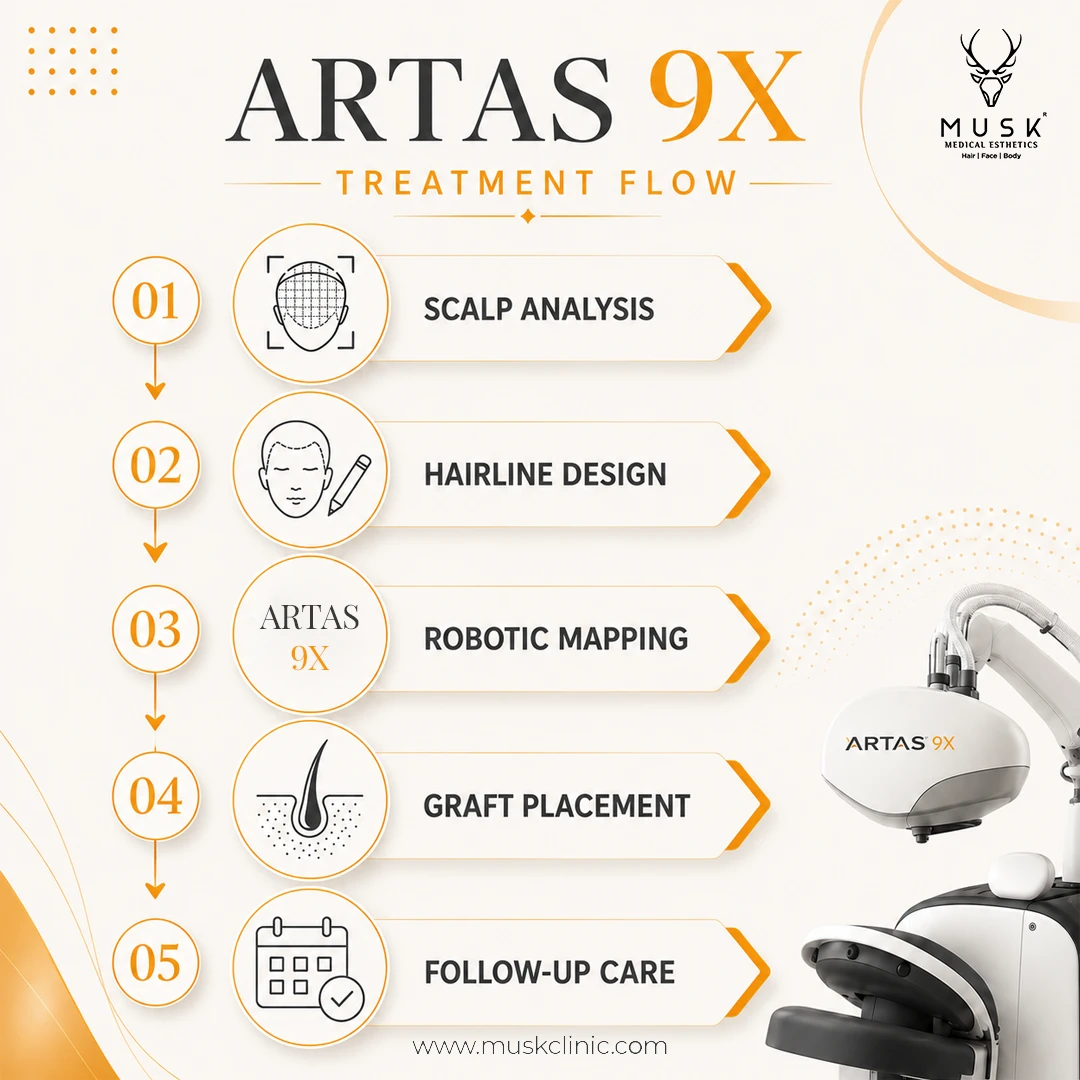
The process usually begins with scalp analysis, hair loss grading, donor-area evaluation, and medical history review. Your doctor will check whether your hair type, donor density, expectations, and general health make you a suitable candidate.
During planning, the hairline and recipient zones are marked. The team decides how many grafts may be needed for the front, mid-scalp, crown, or temples. The goal is not only to cover visible thinning, but also to protect the donor supply for the future.
During robotic harvesting, ARTAS uses imaging to read follicle position, angle, and direction. The official device information notes that AI can track follicle characteristics and patient movement during the procedure, while the platform's vision system repeatedly recognizes follicular features.
After extraction, grafts are checked and preserved before placement into the recipient sites. This is where surgical judgement becomes critical. The angle, direction, density, and distribution of grafts determine whether the result looks natural in real life, not just in close-up photos.
How much does robotic hair transplant cost in Ahmedabad?
A hair transplant is a surgical procedure that moves healthy hair follicles from one part of your scalp to areas affected by thinning or baldness.
In most cases, hair is taken from the back or sides of your head because these areas are usually more resistant to hair loss.
Unlike scalp micropigmentation, a hair transplant uses your real hair. The transplanted follicles continue to grow naturally after the procedure, which is why many people consider it a long-term hair restoration solution.
Hair transplants have become increasingly advanced over the years.
Modern techniques can produce natural-looking results when performed by an experienced surgeon.
Cost factor | What it means | Why it affects price |
Graft count | Estimated follicles needed for hairline, crown, temples, or mid-scalp | More grafts usually increase procedure time, team effort, and total cost |
Hair loss grade | Extent and pattern of baldness | Advanced baldness may need staged planning or higher graft numbers |
Donor quality | Density, hair caliber, curl, and available safe donor supply | Weak donor supply may require a more conservative plan |
Technique | ARTAS 9X, manual FUE, FUT, or combined planning | Technology and surgical complexity affect pricing |
Hairline design | Softness, angle, density, and facial balance | Natural-looking work takes planning time and careful placement |
Aftercare | Reviews, medicines, washing guidance, and follow-up | Support improves the patient experience and recovery confidence |
Supportive therapy | PRP, medicines, or hair-strengthening protocols if advised | Additional treatments may be recommended for native hair support |
Note: Timelines vary by patient, technique, graft handling, health, scalp condition, and aftercare compliance.
Bottom Line: A good ARTAS 9X result should be judged on naturalness, donor preservation, and long-term planning - not just early growth photos.
What are the benefits of ARTAS 9X robotic hair transplant?
The main benefits of ARTAS 9X are precision, consistency, digital mapping, reduced fatigue during extraction, and minimally invasive donor harvesting. These benefits can be valuable for suitable patients, especially when paired with doctor-led hairline planning and careful graft handling.
Robotic assistance can help standardize repetitive extraction movements. This is important because FUE harvesting requires thousands of small, accurate decisions. Even experienced teams must manage fatigue during long sessions.
The FDA-cleared device information for ARTAS iX describes its use in assisting physicians with identifying and extracting follicular units, creating recipient sites, and implanting harvested follicles in indicated patients. This supports its role as an assisting system, not a replacement for the surgeon.
Patients often value ARTAS 9X because it can support a minimally invasive experience, no linear FUT-style strip scar, and more predictable donor harvesting. But a natural result still comes from combining technology with artistic placement and a long-term hair loss plan.
Is ARTAS 9X better than manual FUE or FUT?
ARTAS 9X is not automatically better for every patient. It may offer more consistency during FUE harvesting, while manual FUE gives experienced surgeons flexibility, and FUT may still be useful when a large graft yield is needed. The right technique depends on the patient, not the trend.
A balanced comparative study found that robotic and traditional FUE can differ in yield, discard rate, and transection patterns. The practical lesson is clear: technology matters, but operator experience, patient selection, hair type, and graft handling also matter.
This is why consultation is essential. Some patients may do well with ARTAS 9X. Others may be better suited to manual FUE, FUT, PRP, medication, or a staged plan. The goal is not to sell one method to everyone. The goal is to choose the method that protects donor hair and creates a believable result.
Technique | Best fit | Main strengths | Key limitation |
ARTAS 9X robotic FUE | Suitable patients who want technology-assisted donor harvesting | Digital mapping, robotic consistency, no linear strip scar | Not ideal for every hair type or donor pattern |
Manual FUE | Patients needing flexible surgeon-controlled extraction | Highly adaptable, no linear strip scar, widely used | Outcome depends heavily on operator skill and fatigue control |
FUT / strip method | Selected patients needing larger graft yield or specific donor strategy | Can provide strong graft numbers in some cases | Leaves a linear scar and needs a different recovery profile |
PRP / medical support | Early thinning or native hair support around surgery | May strengthen existing hair and support scalp health | Does not create new follicles in bald areas |
Note: Technique selection should consider hair loss stage, donor area, hair type, expectations, previous surgery, and medical history.
Bottom Line: The best hair transplant technique is the one that matches your scalp, donor supply, future hair loss risk, and aesthetic goal.
Who is a good candidate for robotic hair transplant?
A good candidate for robotic hair transplant usually has stable donor hair, realistic expectations, a suitable hair type, enough donor density, and a hair loss pattern that can be improved with graft relocation. A consultation is needed because not every patient with thinning hair needs surgery.
Candidacy starts with the donor area. This area is the main source of transplantable follicles, and it is limited. A strong plan avoids overharvesting because future thinning may require additional support or later procedures.
A patient with early diffuse thinning may need diagnosis and medical stabilization before surgery. A patient with a clear frontal recession and healthy donor area may be a better surgical candidate. A patient with weak donor density may need a conservative plan, even if technology is available.
Many patients assume more grafts always mean better density. In reality, natural-looking density depends on hair caliber, placement angle, donor preservation, graft survival, and how existing hair may continue to thin over time.
What results can you expect after ARTAS 9X?
ARTAS 9X results develop gradually. Most patients should not expect final density in the first few months. Early shedding, slow regrowth, and uneven thickness can be normal parts of the hair transplant timeline, while fuller visible change usually takes months to mature.
Cleveland Clinic notes that hair transplant full results can take up to a year, and transplanted hair may fall out as the graft heals before regrowing. This waiting period is one reason patients need realistic expectations before surgery.
A practical timeline often looks like this: initial healing in the first days, scab shedding in the early weeks, temporary shedding in the first few months, early growth around month 3 or 4, visible improvement around month 6, and stronger cosmetic maturity between months 9 and 12.
Crown cases may take longer to look dense because crown hair grows in a circular pattern and needs careful distribution. Hairline cases may look more obvious earlier, but final softness and blending still need time.
Patients should review actual results with similar hair loss patterns, not just dramatic before-and-after photos. The best comparison is someone with similar age, donor quality, baldness grade, hair caliber, and graft count.
Timeline | What patients may notice | What to remember |
Day 1 to 7 | Mild swelling, redness, tightness, scabs, and donor-area sensitivity | Follow washing and medication instructions closely |
Week 2 to 4 | Scabs settle and transplanted hairs may begin shedding | Shedding does not always mean graft loss |
Month 3 to 4 | Early fine hair growth may appear | Growth can be uneven and slow at first |
Month 6 | Visible improvement, but density may still look incomplete | This is progress review time, not final judgement |
Month 9 to 12 | Better thickness, styling, and blending | Most patients judge results closer to this stage |
After 12 months | Final review and long-term maintenance planning | Native hair may still need medical support |
Note: Timelines vary by patient, technique, graft handling, health, scalp condition, and aftercare compliance.
Bottom Line: A good ARTAS 9X result should be judged on naturalness, donor preservation, and long-term planning - not just early growth photos.

How should you prepare for robotic hair transplant?
Preparation should begin before the procedure date. Your doctor may review medications, smoking, alcohol use, scalp health, prior treatments, hair dyes, supplements, and medical conditions. Good preparation reduces avoidable risk and helps the team plan your procedure more safely.
Before surgery, ask for a written plan that explains graft estimate, donor zone, hairline design, expected timeline, aftercare, follow-up, and what to do if you notice swelling, irritation, or unusual discomfort.
Musk Clinic’s hair transplant preparation checklist can support patients who want practical dos and don’ts before FUE or FUT surgery. Use it as a starting point, then follow the specific instructions given by your doctor.
For some patients, combining transplant planning with PRP or medical hair loss treatment may be discussed. This is usually about supporting existing hair, not replacing the need for grafts in areas that are already bald.
What questions should you ask before choosing a robotic hair transplant clinic?
Before choosing a robotic hair transplant clinic, ask about the exact technology used, who designs the hairline, who performs each step, how grafts are handled, what aftercare is included, and how the clinic manages complications or slow growth concerns.
A strong consultation should answer both medical and practical questions. You should understand why ARTAS 9X is recommended, or why another method may be better. If the explanation only focuses on a discount or package, keep asking questions.
- Technology: Which robotic system is used, and how does it assist the procedure?
- Doctor oversight: Who evaluates candidacy, designs the hairline, and supervises graft placement?
- Graft planning: How many grafts are recommended, and why that number?
- Donor safety: How will the team avoid overharvesting and protect future options?
- Results evidence: Can you see similar cases with similar hair loss grade and donor quality?
- Aftercare: What follow-up, washing guidance, and recovery support are included?
- Long-term plan: What happens to existing non-transplanted hair as hair loss progresses?
Why choose Musk Clinic for ARTAS 9X robotic hair transplant in Ahmedabad?
Musk Clinic combines ARTAS 9X technology with doctor-led planning, aesthetic hairline design, and follow-up support for patients considering robotic hair transplant in Ahmedabad. The clinic’s positioning is built around precision, safety, personalization, and natural-looking outcomes for suitable candidates.
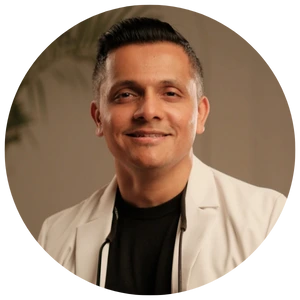
Dr. Anand B. Shah’s background in Maxillofacial and Craniofacial surgery adds surgical and facial-aesthetic perspective to hairline planning. That matters because a good transplant should suit the patient’s face, age, donor supply, and future hair loss pattern.
The clinic also highlights 8+ in-house doctors, 17+ international technology partners, and 17,000+ happy patients across hair, skin, face, body, cosmetic surgery, and aesthetic treatments. For hair restoration patients, that broader setup can help connect surgical planning with skin, scalp, PRP, and follow-up care where needed.
For NRI and international patients, treatment planning should include travel timing, recovery buffer, early follow-up, and remote review expectations. The NRI guide can help patients understand how to plan medical tourism for hair transplant in India before booking travel.
Conclusion
Robotic hair transplant in Ahmedabad can be a strong option for patients who want technology-assisted FUE, precise donor mapping, and a doctor-guided restoration plan. ARTAS 9X can support consistency and efficiency, but it does not remove the need for careful diagnosis, realistic expectations, and skilled aesthetic planning.
The most useful way to judge cost, benefits, and ARTAS 9X results is through a personalized consultation. Ask about graft count, donor safety, hairline design, aftercare, and long-term hair loss control. A good decision should protect both your current result and your future options.
Frequently Asked Questions (FAQs)
Dr. Anand B. Shah
- 10 Years of Experience
Dr Anand B. Shah, is a board-certified Maxillofacial & Craniofacial surgeon who is highly skilled in cosmetic facial and hair restoration surgery and has exclusively practised the same, internationally and nationally.