







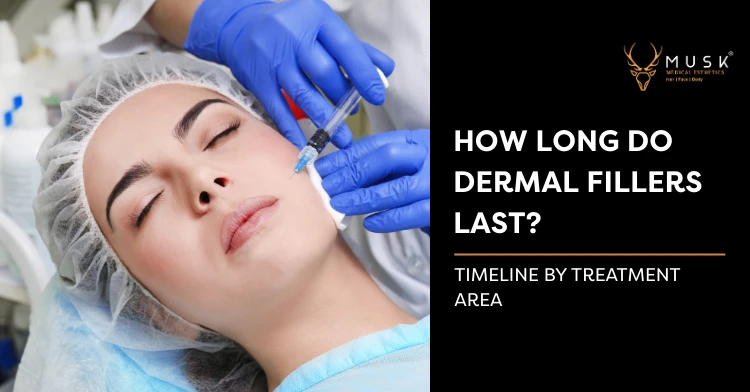
How Long Do Dermal Fillers Last? Timeline by Treatment Area
 By Pooja Sharma
 If you are thinking about Dermal Fillers, one of the first questions you probably ask is simple: how long will the results last?
You might see claims online that fillers last anywhere from six months to several years.
Some people say their results faded quickly, while others say their filler still looks good years later. All of this can make it hard to know what to expect.
The truth is that dermal filler longevity is not the same for everyone. How long your filler lasts depends on several factors, including the type of filler used, where it is injected, how your body metabolizes it, and even how expressive your face is.
Dermal fillers are designed to be temporary. They work with your body, not against it. Over time, your body slowly breaks the filler down and absorbs it.
This is normal and expected. It is also one of the reasons fillers are considered safe when performed correctly.
In this guide, you will get a clear and realistic breakdown of how long dermal fillers last by treatment area.
What Are Dermal Fillers and Why Don’t They Last Forever?
To understand how long dermal fillers last, you first need to understand what they are made of and how your body responds to them.
Fillers are not permanent implants. They are designed to work with your natural biology and slowly break down over time.
This temporary nature is intentional. It allows treatments to look more natural, adapt as your face changes, and remain safer over the long term.
What Dermal Fillers Are Made Of
Most modern dermal fillers are made from substances that already exist in your body or closely mimic them.
This reduces the risk of rejection and makes the filler easier to absorb over time.
The most common types include:
- Hyaluronic acid fillers: Hyaluronic acid is a substance naturally found in your skin. It attracts water and helps keep skin hydrated and plump. These fillers are the most popular because they look natural and can be dissolved if needed.
- Calcium hydroxylapatite fillers: This material is similar to minerals found in your bones. These fillers are thicker and often used for deeper volume loss or facial structure.
- Poly L lactic acid fillers: These fillers stimulate collagen production rather than adding immediate volume. Results appear gradually and improve over time.
Among these options, hyaluronic acid fillers are used most often. They offer predictable results and a strong safety profile. Most FDA-approved fillers fall into this category.
How the Body Breaks Down Fillers
Your body treats dermal filler as a temporary substance. Over time, natural processes begin to break it down.
Enzymes slowly dissolve hyaluronic acid fillers. For other fillers, the body gradually absorbs the material while producing new collagen around the area. This breakdown happens at different speeds depending on where the filler is placed.
Areas with more movement, like the lips, tend to break down filler faster. Areas with less movement, like the cheeks or under the eyes, usually hold filler longer. Blood flow also plays a role. Higher circulation speeds up absorption.
This process is gradual. You do not wake up one day and suddenly lose all your results. Volume fades slowly, which allows for subtle maintenance treatments if desired.
Temporary vs Semi Permanent Fillers
Most fillers used today are temporary or semi-permanent. This is by design.
Temporary fillers offer important safety advantages. If you are unhappy with the result or if your face changes over time, adjustments can be made. Hyaluronic acid fillers can even be dissolved completely if necessary.
Semi-permanent fillers last longer but still break down eventually. Even these are not meant to last forever.
Permanent fillers are rarely used today due to higher risks and limited flexibility. Modern aesthetic medicine prioritizes natural results, adaptability, and safety over permanence.
The key takeaway is simple. Dermal fillers are not meant to last forever, and that is a good thing. Their temporary nature allows treatments to stay aligned with your face as it naturally ages.
Key Factors That Affect How Long Dermal Fillers Last
Dermal fillers do not last the same amount of time for everyone.
Two people can receive the same product in the same area and still notice different timelines. This is normal and expected.
Several key factors influence how long your filler results last. Understanding these helps you set realistic expectations and plan future treatments more confidently.
Type of Filler Used
Not all fillers are created equal. The formulation of the filler plays a major role in how long it lasts.
Some fillers are softer and designed to move naturally with facial expressions. These tend to break down faster. Others are thicker and more structured, which allows them to last longer, especially in areas that need support.
Another important factor is how the filler is manufactured. More highly cross-linked fillers are generally more resistant to breakdown. This is why providers choose specific products for specific areas of the face.
All dermal fillers used in the United States must be approved or cleared by the Food and Drug Administration. Approved products are tested for safety and performance.
Treatment Area
Where the filler is placed has a major impact on how long it lasts.
High movement areas such as the lips and smile lines, tend to break down filler faster. These areas are constantly moving when you talk, eat, or smile. Increased movement leads to faster metabolism of the filler.
Low movement areas such as the cheeks, temples, and under eyes usually hold filler longer. These areas experience less muscle activity and often have more structural support.
Blood flow also matters. Areas with higher circulation tend to absorb filler more quickly than areas with lower circulation.
Your Body and Lifestyle
Your body plays a big role in filler longevity.
If you have a fast metabolism, your body may break down filler more quickly. People who exercise intensely or very frequently sometimes notice slightly shorter filler duration, especially in high movement areas.
Lifestyle habits also matter. Smoking can affect skin quality and circulation, which may shorten how long results last. Excessive sun exposure can accelerate skin aging and impact overall results.
Good Skincare and sun protection will not stop filler breakdown, but they can help maintain overall skin quality so results look better for longer.
Injection Technique and Provider Skill
How the filler is injected matters just as much as what is injected.
Depth of placement is critical. Filler placed too shallow or too deep may not last as long or may not look as intended. Experienced providers choose the correct depth and product for each area of your face.
Product selection also matters. A skilled provider does not use the same filler everywhere. They match the filler to your anatomy, skin thickness, and aesthetic goals.
This is one of the biggest reasons results vary between providers. Technique directly affects both appearance and longevity.
Dermal Filler Longevity by Treatment Area
One of the biggest factors in how long dermal fillers last is where they are placed.
Some areas of the face move constantly, while others stay relatively still. Some areas have strong blood flow, while others do not. All of this affects how quickly your body breaks the filler down.
Below is a clear, area-by-area timeline to help you understand what is typical. These are averages, not guarantees, but they give you a realistic baseline for planning treatments.
1. Lip Fillers
Lip fillers typically last 6 to 12 months.
The lips are one of the most active areas of the face. You talk, smile, eat, and drink throughout the day, and all that movement speeds up filler breakdown. Lips also have strong blood flow, which further contributes to shorter longevity.
If this is your first time getting lip filler, results may fade closer to the six-month mark. With repeat treatments, many people notice that filler seems to last a bit longer over time because some structure remains.
Lip filler maintenance is common and expected. Smaller, regular touch-ups often look more natural than waiting for filler to fully disappear.
2. Cheek Fillers
Cheek Fillers usually last 12 to 24 months.
The cheeks are a low movement area, especially when filler is placed deeper for structural support. This allows filler to hold its shape and break down more slowly.
Cheek filler is often used to restore volume, lift the midface, and support surrounding areas. Because it plays a structural role, it tends to last longer than filler placed in more superficial areas.
People who receive cheek filler for contouring rather than heavy volume may notice slightly shorter timelines, but overall, cheeks are one of the longest-lasting treatment areas.
3. Nasolabial Folds (Smile Lines)
Filler in the nasolabial folds typically lasts 9 to 18 months.
These lines are affected by facial expressions, smiling, and talking. This movement shortens filler lifespan compared to areas like the cheeks, but not as quickly as the lips.
Longevity also depends on technique. In many cases, supporting the cheeks rather than directly filling the fold can lead to longer-lasting and more natural results.
Maintenance is often gradual. You may notice softening rather than sudden Volume Loss.
4. Under Eye (Tear Trough) Fillers
Under Eye Fillers often last 12 to 24 months, and sometimes longer.
This area has very little movement, which allows filler to remain stable. When placed correctly and conservatively, under eye filler tends to break down slowly.
Because the skin is thin and delicate, providers usually use small amounts. Even a subtle amount of filler can last a long time here.
Under eye filler requires an advanced technique. Longevity is good, but precision and safety are more important than duration alone.
5. Jawline Fillers
Jawline fillers generally last 12 to 24 months.
The jawline is a structural area with less constant movement compared to the mouth. Fillers used here are usually thicker and designed for definition and support.
Longevity can vary based on goals. Sharp contouring may require maintenance sooner than subtle structure enhancement. Men often receive firmer fillers in this area, which can also affect how long results last.
Jawline filler tends to fade gradually, making touch ups easy to time.
6. Chin Fillers
Chin Fillers also last around 12 to 24 months.
The chin does move when you speak, but it is still considered a relatively stable area for filler. Product placed here is often deeper and more structural, which increases longevity.
Chin filler is commonly used for projection, balance, and profile improvement. Because it supports facial proportions, results tend to remain noticeable for a long time.
Maintenance is usually infrequent compared to areas like the lips.
7. Temple Fillers
Temple fillers usually last 12 to 18 months.
The temples are a low movement area, which helps filler last longer. Temple filler is often used to restore volume loss that can make the face look tired or hollow.
Because the area is delicate and close to important blood vessels, conservative treatment is key. When done properly, results are long-lasting and subtle.
Volume fades slowly, making it easier to plan maintenance without sudden changes.
8. Nose (Non Surgical Rhinoplasty)
Nose filler typically lasts 9 to 18 months.
Longevity varies widely depending on the product used and how your body responds. The nose does not move much, but blood flow and anatomy play a role.
Safety is especially important in this area. Longer lasting filler is not always better here. The focus should be on precise placement and conservative volume rather than maximum duration.
Touch ups are common, but they should always be approached carefully.
9. Hand Fillers
Hand fillers usually last 12 to 18 months.
Hands experience frequent movement and sun exposure, but filler is often placed deeper to restore volume rather than fine detail. This helps extend longevity.
Results fade gradually as volume loss returns. Many people choose maintenance treatments once a year to keep their hands looking smooth and youthful.
Timeline Expectations After Getting Dermal Fillers
Knowing how long fillers last is helpful, but it is just as important to understand what the timeline looks like after treatment.
Results do not appear and disappear overnight. There is a clear progression from injection day to long-term fade.
Here is what you can realistically expect at each stage.
Immediately After Treatment
Right after your filler appointment, you will likely notice swelling, redness, or mild bruising.
This is a normal response to the injections, not the final result.
Your filler may look uneven or more pronounced at this stage. In areas like the lips, swelling can temporarily make results look larger than expected. This does not mean too much filler was used.
Most providers recommend avoiding heavy exercise, heat, and pressure on the treated area for the first 24 to 48 hours. Following aftercare instructions helps reduce swelling and supports better results.
Around 2 Weeks Post Treatment
At about two weeks, filler is considered settled.
Swelling has mostly resolved, and the filler has integrated into the surrounding tissue. This is when you see your true result.
If small adjustments are needed, this is usually the window when providers evaluate whether a touch-up is appropriate. Many clinics schedule follow-up appointments around this time.
This timeline applies to most FDA-regulated fillers approved by the Food and Drug Administration.
3 to 6 Months
Between three and six months, your filler is typically at its best.
Volume looks natural, skin appears smoother, and facial balance is well established. Most people are very happy with their results during this phase.
In high movement areas like the lips, you may begin to notice subtle softening by the six month mark. In low movement areas, results usually remain very stable.
This stage often determines how frequently you will want maintenance treatments in the future.
9 to 18 Months
This is when the gradual breakdown becomes more noticeable.
You will not suddenly lose all volume. Instead, results fade slowly over time. Lines may soften less, contours may become less defined, and volume loss may return gradually.
Many people choose maintenance treatments before the filler fully disappears. Small touch ups at this stage often require less product than starting from scratch.
The exact timing depends on the area treated, the filler used, and how your body metabolizes it.
How to Make Dermal Fillers Last Longer
While dermal fillers are temporary, there are steps you can take to help your results last as long as possible.
This is not about stopping natural breakdown. It is about supporting the filler and your skin so results fade more slowly and more evenly.
Small choices before and after treatment can make a noticeable difference over time.
Choosing the Right Filler for Each Area
One of the most important factors in longevity is using the right filler in the right place.
Different areas of the face need different filler properties. Softer fillers work better in areas that move a lot, like the lips. Thicker fillers are better for structural areas like the cheeks, jawline, and chin.
An experienced provider chooses a product based on your anatomy, not convenience.
This improves both how long the filler lasts and how natural it looks as it settles and fades.
Proper Aftercare
What you do after treatment matters more than most people realize.
Following your provider’s aftercare instructions helps reduce swelling, bruising, and unnecessary stress on the filler. This usually includes avoiding:
Heavy exercise for at least 24 hours
Excessive heat, such as saunas or hot yoga
Pressure or massage on the treated area unless instructed
Staying hydrated and maintaining good skin care also helps your skin support the filler better. While this will not stop breakdown, it helps the results look smoother and more consistent as they fade.
Maintenance Treatments
Waiting until filler completely disappears is not always the best approach.
Many people choose small maintenance treatments before full breakdown occurs. This can extend results over time and often requires less product than starting fresh.
Maintenance Treatments tend to look more natural because they build gradually. They also help avoid the cycle of dramatic volume loss followed by large corrections.
Your provider can help you create a maintenance plan based on how quickly your body metabolizes filler and which areas you treat.
Dermal Fillers vs Other Injectable Treatments
Dermal fillers are often grouped together with other injectables, but they serve very different purposes.
Understanding how fillers compare to other treatments helps you choose the right option and set better expectations for longevity.
Dermal Fillers vs Botox
Dermal fillers and Botox are often mentioned together, but they work in completely different ways.
Dermal fillers add volume. They are used to restore fullness, enhance contours, and support facial structure. Their results are visible immediately and gradually fade as the filler breaks down over time.
Botox does not add volume. It relaxes specific muscles to soften dynamic wrinkles caused by facial expressions. Botox results usually last three to four months, which is shorter than most fillers.
Many people use both treatments together. Fillers address volume loss, while Botox helps prevent wrinkles from forming or deepening.
When combined correctly, they can produce more balanced and longer-lasting aesthetic results.
Dermal Fillers vs Biostimulators
Biostimulators are another category of injectable treatments that work differently from fillers.
Dermal fillers provide immediate volume. You see results right away, and those results slowly fade over time.
Biostimulators work by encouraging your body to produce its own collagen. Results develop gradually over several weeks or months. Instead of adding volume directly, they improve skin quality and firmness from within.
Longevity differs as well. Biostimulator results can last longer in some cases, but they require patience and multiple sessions. Fillers are better if you want instant improvement or precise contouring.
In many treatment plans, fillers and biostimulators are used together. Fillers create immediate shape, while biostimulators support long-term skin quality.
Conclusion
The treatment area, the type of filler used, your anatomy, and how your body processes the product over time.
Some areas, like the lips, naturally break down filler faster due to movement and blood flow. Other areas, like the cheeks, chin, and under eyes, tend to hold filler much longer. This is normal and expected.
When you understand these timelines, you can plan treatments realistically instead of relying on marketing claims or guesswork.
The most important factor is not just how long filler lasts, but how well it is chosen and placed. Skilled technique, appropriate product selection, and conservative planning all play a major role in both safety and long-term results.
Musk Clinic focuses on personalized injectable treatments that enhance your natural features rather than overcorrect them. Every dermal filler treatment plan is tailored to your facial structure, movement, and long-term goals.
Instead of chasing maximum longevity, the team at Musk Clinic prioritizes balance, safety, and results that age well over time. This approach leads to outcomes that look natural, not just today, but months and years later.
If you are considering dermal fillers or want a clearer idea of how long results will last for your specific concerns, a professional consultation is the best next step.
Frequently Asked Questions (FAQs)

Dr Pooja Sharma
- 5 Years of Experience