






 By Dr. Anand Shah
 If you are thinking about getting a hair transplant, one big question probably comes to mind.
Is this the right age to do it?
You may be 25 and worried that you are too young. You may be 35 and wondering if this is the ideal time. Or you may be 45 and asking yourself if it is too late.
Hair loss does not follow a strict schedule. Some men notice thinning in their early twenties. Others maintain a strong hairline until their forties. Because hair loss is influenced by genetics and hormones, the timing can vary widely from person to person.
According to the American Academy of Dermatology, hereditary hair loss can begin as early as the late teens or early twenties for some individuals.
Age matters in hair transplant planning, but not in the way many people assume.
It is not about being too young or too old in a simple sense. It is about stability, donor supply, long-term planning, and realistic expectations.
At 25, your hair loss pattern may still be evolving. At 35, it may be more predictable. At 45, it may be largely stabilized. Each stage brings different advantages and challenges.
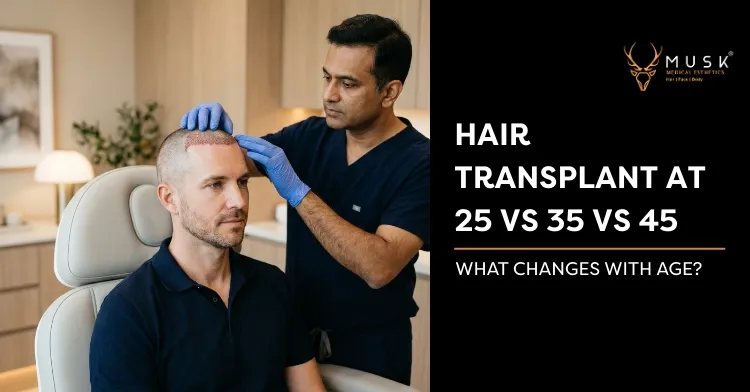
In this guide, you will learn how hair transplant decisions change at 25, 35, and 45.
Does Age Matter for Hair Transplant Surgery?
Yes, age does matter. But not simply because of the number on your birth certificate.
What really matters is how your hair loss is progressing, how stable your pattern is, and how well your donor area can support long-term restoration.
Let’s break this down.
Hair Loss Progression and Genetics
Hair loss is usually genetic. If your father or grandfather experienced male pattern baldness, you may follow a similar pattern.
The challenge is that in your twenties, the full pattern often has not revealed itself yet.
At 25, you might only see early recession at the temples. By 35, that recession may have extended further. By 45, the pattern is often much clearer and more stable.
This progression matters because a hair transplant moves permanent donor hair to thinning areas. If future hair loss continues aggressively around the transplanted area, you could end up with uneven density unless long-term planning is done carefully.
Stability of Hair Loss Pattern
Stability is one of the most important factors in determining timing.
If your hair loss is rapidly progressing, performing a transplant too early can create challenges later. You may need additional procedures to keep up with ongoing thinning.
By your mid-thirties or forties, hair loss often stabilizes. This makes surgical planning more predictable.
That does not mean you cannot have surgery at 25. It means the strategy must be conservative and forward-thinking.
Donor Area Considerations
Your donor area is limited.
The hair at the back and sides of your scalp is genetically resistant to balding. This area supplies the grafts used in transplantation.
You only have a finite number of grafts available for your lifetime.
At 25, you may not yet know how much future hair loss you will experience. Using too many grafts early can reduce flexibility later.
At 35 or 45, your donor area can be assessed more accurately against a clearer hair loss pattern.
Protecting your donor supply is one of the most important aspects of age-based planning.
Long-Term Planning and Future Hair Loss
A hair transplant is not just about today. It is about how you will look 10, 20, or even 30 years from now.
At 25, you may prioritize restoring a youthful hairline. At 45, your goal may be natural age-appropriate density.
Long-term planning involves:
- Designing a conservative hairline
- Anticipating future thinning
- Preserving grafts for potential future procedures
- Considering medical therapy to slow progression
Age affects how aggressively or conservatively a surgeon should plan your restoration.
Hair Transplant at 25: Pros and Cons
If you are 25 and losing hair, it can feel overwhelming.
You may feel like you are too young to be dealing with thinning. You may notice changes in photos. You may feel less confident in social or professional settings.
A hair transplant at 25 is possible. But it requires careful planning.
Let’s look at the advantages and risks.
Hair Transplant at 25: Pros and Cons
If you are 25 and losing hair, it can feel overwhelming.
You may feel like you are too young to be dealing with thinning. You may notice changes in photos. You may feel less confident in social or professional settings.
A hair transplant at 25 is possible. But it requires careful planning.
Let’s look at the advantages and risks.
Advantages of Early Intervention
One benefit of having a transplant at 25 is restoring confidence early.
If your hair loss is causing stress or affecting your self-image, early intervention can provide relief.
You also typically have strong donor hair at this age. Younger patients often have thick, healthy grafts that respond well to transplantation.
If hair loss is limited to the temples or frontal hairline and appears relatively stable, a conservative transplant may provide excellent results.
Psychological and Confidence Factors
At 25, appearance often plays a large role in confidence.
You may be dating, building your career, or establishing your identity. Hair loss at this stage can feel particularly distressing.
For some patients, the psychological benefit of restoring hair early outweighs the potential need for future maintenance.
The key is balancing emotional urgency with long-term strategy.
Hair Transplant at 35: Pros and Cons
By the time you reach 35, your situation is often very different from when you were 25.
Hair loss patterns tend to be more established. You may have been watching a gradual thinning for several years. You likely have a clearer idea of how your hair behaves over time.
For many patients, this age range offers a balance between predictability and donor strength.
Let’s break it down.
More Predictable Hair Loss Pattern
At 35, your hair loss pattern is usually easier to assess.
If you have temple recession, crown thinning, or frontal hairline loss, it is often clearer how aggressive the progression has been.
This predictability allows your surgeon to design a transplant plan that accounts for future loss more accurately.
You are less likely to experience sudden, rapid changes compared to your early twenties.
That stability supports better long-term planning.
Balanced Donor and Recipient Planning
At this stage, your donor area is often still strong.
You typically have a good supply of grafts available while also having a clearer understanding of where thinning is occurring.
This allows for balanced graft allocation.
Instead of guessing how much hair you may lose later, your surgeon can distribute grafts strategically to create natural density that ages well.
Planning is usually more straightforward compared to a transplant at 25.
Ideal Age Range for Many Patients
Many hair restoration specialists consider the early to mid-thirties an ideal window for surgery.
You are young enough to enjoy long-term results, yet old enough that your hair loss pattern is more stable.
This does not mean 35 is perfect for everyone. But it often offers a good combination of:
- Predictability
- Donor strength
- Realistic expectations
At this age, many patients approach surgery with a clearer understanding of maintenance and long-term planning.
Hair Transplant at 45: Pros and Cons
If you are 45 and considering a hair transplant, your situation is usually more stable.
By this age, your hair loss pattern has often declared itself. You likely know whether you are dealing with mild thinning, significant recession, or crown balding.
This clarity changes how planning works.
Stabilized Hair Loss Pattern
At 45, hair loss progression is often slower and more predictable.
This makes surgical planning easier.
Your surgeon can evaluate your current pattern and design a restoration plan that aligns with how you are likely to age.
There is less uncertainty compared to surgery at 25.
This stability reduces the risk of unexpected gaps forming behind transplanted areas.
Realistic Expectations About Density
At 45, many patients prioritize natural improvement over perfect density.
You may not be looking to recreate your teenage hairline. Instead, you may want to restore balance and frame your face in a way that looks age-appropriate.
Because expectations are often more realistic at this stage, satisfaction rates can be very high.
The goal becomes refinement rather than dramatic transformation.
Donor Quality at Midlife
Donor quality at 45 can still be strong, but it varies more between individuals.
Some patients maintain thick donor hair into their fifties and beyond. Others may experience thinning in the donor zone.
A thorough evaluation is essential to determine how many grafts are available and how they should be used.
Protecting donor supply remains important, especially if crown coverage is needed.
Comparing Hair Transplant Outcomes by Age
To make it easier to understand the differences, here is a side-by-side comparison of how hair transplant planning and outcomes may vary at 25, 35, and 45.
| Factor | Hair Transplant at 25 | Hair Transplant at 35 | Hair Transplant at 45 |
|---|---|---|---|
| Hairline Design | Must be very conservative to protect future appearance | Can be balanced and age-appropriate | Focus on mature, natural framing rather than lowering the hairline aggressively |
| Hair Loss Predictability | Often still evolving and unpredictable | More established and easier to assess | Usually stabilized and clearly defined |
| Graft Allocation Strategy | Preserve donor supply carefully for future needs | Balanced distribution between frontal and mid-scalp areas | Target established thinning areas, including the crown if needed |
| Likelihood of Future Procedures | Higher chance of needing additional transplants later | Higher chance of needing additional transplants later | Lower likelihood if the pattern is stable |
| Donor Area Planning | Critical to avoid overharvesting early | Strong balance between use and preservation | Depends on donor strength and overall density |
| Healing and Recovery | Fast and predictable | Strong and predictable healing | Slightly slower in some cases, but generally good if healthy |
| Expectation Focus | Youthful restoration and confidence boost | Natural, balanced improvement | Age-appropriate refinement and density |
This comparison shows that age does not determine whether you can have a transplant. Instead, it influences how carefully the procedure must be planned.
Psychological Factors at 25 vs 35 vs 45
Hair loss is not just physical. It is emotional.
How you feel about your hair often changes as you move through different stages of life. Your priorities, confidence, and expectations shift over time.
Let’s look at how psychology may differ at 25, 35, and 45.
Confidence and Social Impact
At 25, hair loss can feel devastating.
You may feel like you are losing something too early. Social pressure, dating, and comparison with peers can amplify insecurity.
At this age, restoring your hair can significantly boost self-esteem and confidence.
At 35, confidence is often more established. While hair loss may still bother you, it may feel less urgent emotionally. You may approach surgery with a more practical mindset.
At 45, many patients are less focused on perfection and more focused on improvement. The goal may be to look refreshed rather than dramatically transformed.
Career and Lifestyle Considerations
At 25, you may be early in your career. You might worry about how appearance affects opportunities or first impressions.
At 35, career stability is often stronger. You may prioritize natural, professional results that age well.
At 45, lifestyle factors such as family, work commitments, and recovery time may influence scheduling more than emotional urgency.
Each stage brings different motivations for pursuing treatment.
Manage Expectations
Expectation management is critical at every age.
At 25, expectations may be driven by a desire to fully restore a teenage hairline. This is where careful consultation becomes important.
At 35, expectations tend to be more balanced. You may focus on density and symmetry rather than dramatic lowering of the hairline.
At 45, expectations are often realistic and aligned with natural aging. Patients typically seek subtle, harmonious improvement.
Understanding your own motivations helps you decide if the timing is right.
Is There an Ideal Age for a Hair Transplant?
You might be hoping for a simple answer.
Is there a perfect age when everything aligns?
The honest answer is no. There is no universal ideal age.
What matters more than age itself is stability, donor strength, and realistic long-term planning.
Let’s break this down.
Is There an Ideal Age for a Hair Transplant?
You might be hoping for a simple answer.
Is there a perfect age when everything aligns?
The honest answer is no. There is no universal ideal age.
What matters more than age itself is stability, donor strength, and realistic long-term planning.
Let’s break this down.
Minimum Age Guidelines
Most reputable surgeons prefer not to perform hair transplants on patients under 21.
This is because hair loss patterns are usually too unpredictable before that age.
By 23 to 25, some patients may be suitable candidates, especially if their hair loss appears stable and limited.
The key is not just being over a certain age. It is demonstrating pattern stability and understanding future risks.
Health and Suitability Over Chronological Age
The best time for a hair transplant is when:
- Your hair loss pattern is reasonably predictable
- Your donor area is strong
- Your expectations are realistic
- Your long-term plan is clear
For some people, that happens at 25. For others, it happens at 35 or 45.
The goal is not to chase the perfect age. The goal is to make the right decision for your specific situation.
Conclusion
Choosing when to have a hair transplant is not about hitting a perfect age milestone.
It is about timing your decision wisely.
At 25, the focus should be on conservative planning and protecting your future donor supply. At 35, you often gain the advantage of predictability and balanced strategy. At 45, stability and realistic expectations can lead to highly satisfying, natural results.
Each age brings different strengths and different risks.
What matters most is not whether you are 25, 35, or 45. It is whether your hair loss pattern is stable, your donor area is strong, and your plan accounts for the next 10 to 20 years.
This is where expert guidance becomes essential.
At Musk Clinic, we design every hair transplant plan based on your age, hair loss stage, donor quality, and long-term goals. We focus on conservative, natural hairline design and strategic graft allocation to ensure your results look appropriate not just today, but years from now.
Frequently Asked Questions (FAQs)

Dr. Anand B. Shah
- 10 Years of Experience
Dr Anand B. Shah, is a board-certified Maxillofacial & Craniofacial surgeon who is highly skilled in cosmetic facial and hair restoration surgery and has exclusively practised the same, internationally and nationally.